

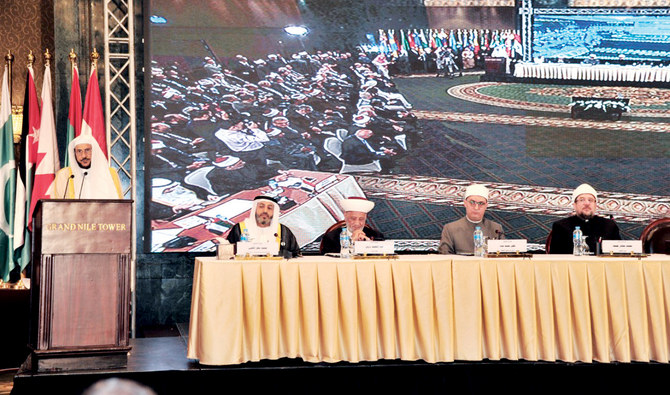
Extremist misinformation leads to death and destruction: Saudi Islamic affairs minister

Saudi Minister of Islamic Affairs, Dawah and Guidance Sheikh Abdullatif Al-Asheikh speaks at the opening session of the 30th International Conference of the Supreme Council for Islamic Affairs in Cairo on Sunday. (SPA)
Updated 16 September 2019
Follow

Extremist misinformation leads to death and destruction: Saudi Islamic affairs minister

CAIRO: The Saudi Minister of Islamic Affairs, Dawah and Guidance Sheikh Abdullatif Al-Asheikh has said that misinformation disseminated by extremists and terrorists among Muslims leads to revolutions and loss of life, as well as the destruction of homelands and the dispersal of people.

Al-Asheikh made the remarks during a speech at the opening session of the 30th International Conference of the Supreme Council for Islamic Affairs, organized by the Egyptian Ministry of Awqaf in Cairo under the theme “Nation building in Islamic Jurisprudence.”

He said that one of the most important rules for building countries agreed on by all nations and civilizations, and strengthened and emphasized by Islam, was establishing the rules of justice, tolerance, coexistence and fighting corruption and corrupters.

Al-Asheikh said that one of the greatest sources of corruption was the intellectual corruption that generates all practical and behavioral corruption.

Al-Asheikh said that the radical ideology on which the terrorist organization the Muslim Brotherhood was founded spread militancy and hatred among people in the name of Islam, causing non-Muslims to resent Islam.

He underlined that building nations and promoting their strength does not happen through laziness and indolence, but by studying all material causes and civilized means in all aspects of life, whether military, economic, scientific and social. “Islam took into account these aspects with greatest care,” Al-Asheikh said.

He said that Saudi Arabia was able to reconcile religious values with modernity, so that the land of the Two Holy Mosques became an example of civilization and modernity while adhering to the religious and Islamic foundations.

“The Kingdom also became a solid rock breaking the cunning of the enemies of Arabism and Islam, this would not have been possible without the help of God and the wisdom of its leaders, namely King Salman and Crown Prince Mohammed bin Salman,” Al-Asheikh said.

Al-Asheikh concluded his speech by highlighting that Vision 2030, the National Transformation Program 2020 and the vital projects that the Kingdom was witnessing was a clear indication of the endeavors of Saudi Arabia in fighting corruption and corruptors.


Saudi wildlife center records rare sighting of critically endangered leatherback turtle in Red Sea

Updated 4 sec ago
Follow

Saudi wildlife center records rare sighting of critically endangered leatherback turtle in Red Sea

  • NCW says the leatherback traveled thousands of kilometers to reach the Red Sea
  • The closest known nesting grounds are located in India’s Andaman Islands, some 6,500 km distant

RIYADH: Saudi Arabia's National Center for Wildlife (NCW) has documented a rare sighting of a leatherback sea turtle in the Red Sea, marking a significant biological record for one of the planet's most critically endangered marine species.

The sighting occurred approximately 30 kilometers off the coast of Al-Qunfudhah within the Blue Holes Protected Area, a newly established marine reserve, according to the Saudi Press Agency.

The NCW confirmed that the presence of a leatherback in these waters is an exceptional event. Recognized as the largest turtle species on Earth, the leatherback can weigh up to 900 kilograms. It is easily identified by its unique leathery, black carapace—distinguished by five longitudinal ridges rather than a hard bony shell—and its ability to dive to depths exceeding 1,000 meters.

Shutterstock image

Noting the species' migratory nature, the center explained that leatherbacks travel thousands of kilometers foraging for jellyfish. The specimen likely navigated through the Bab el-Mandeb Strait in search of food. 

This is considered a remarkable journey, the NCW said, noting that the nearest known populations reside in the Indian Ocean, spanning waters from South Africa to Sri Lanka (roughly 7,000 to 8,000 kilometers away). The closest known nesting grounds are located in India’s Andaman Islands, approximately 6,500 kilometers distant. No nesting activity has been recorded in the Red Sea.

According to the IUCN Red List, the leatherback is Critically Endangered in the Indian Ocean. While data for the Red Sea and Arabian Gulf is scarce, recent isolated sightings include a juvenile recorded in Jordan in December 2025 and another off Djibouti in 2019.

The NCW emphasized that these rare appearances highlight the ecological importance of the Kingdom's marine conservation efforts in the Red Sea. The center pointed to the Farasan Islands Marine Protected Area, along with the new Blue Holes and Ras Hatiba reserves, as critical sanctuaries that could support the potential expansion of such endangered species' ranges.