ISLAMABAD: Sentiment and support for Saudi Arabia remained high in Pakistan, a day after attacks on two Saudi oil facilities in the kingdom’s Eastern province caused widespread fear and damage, and which official statements in Pakistan described as acts of sabotage.
Pakistan Muslim League-Nawaz Chairman, Raja Zafarul Haq, told Arab News on Saturday that the country was ready to safeguard Saudi Arabia’s security and sovereignty.
“Pakistan is ready to take any step for the safety and security of the Kingdom,” he said and added that countries who “claim to be friends of Saudi Arabia should stand by it” to stop such attacks on its sovereignty.
Latif Khosa, former governor of Punjab province and a central leader of Pakistan Peoples Party, shared the same views, and urged world powers to come out in support of Saudi Arabia.
“World powers should support Saudis against such militant groups,” he said.
In Pakistan, a Muslim majority country of 208 million people with close political and people-to-people ties with Saudi Arabia, the sentiment from the general public was one of shock and horror.
“We condemn the attack on Saudi Arabia,” said 38-year-old Asif Ali, a technician. “It’s our holy land and must be defended by the entire Muslim Ummah at all costs.”
“This attack is highly condemnable. The Saudi oil company must be protected and the world community should help eliminate such militants,” a telecom professional, Ammar Hyder, 40, told Arab News.
The country’s foreign ministry said in an official statement on Saturday that the country “reiterates its full support and solidarity with the brotherly Kingdom of Saudi Arabia against any threat to its security and territorial integrity.”


Pakistan’s government and people condemn attacks on Saudi oil facilities
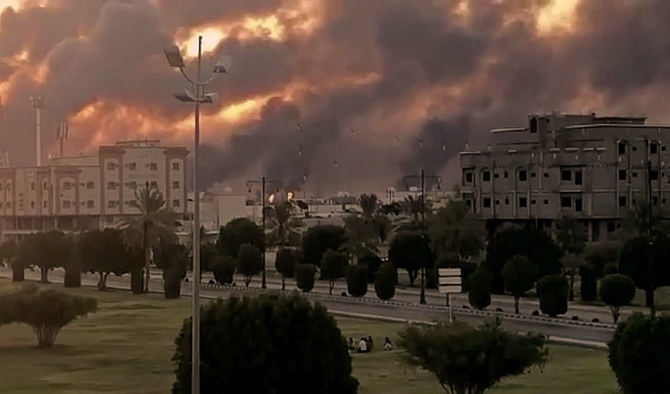
Pakistan’s government and people condemn attacks on Saudi oil facilities

- High level members of political parties call on world community to stand with Saudi Arabia during attacks on its sovereignty
- Pakistan’s has strong people-to-people ties with Saudi Arabia, with public sentiment one of shock and horror

Pakistan raises fuel prices by Rs55 per liter as Middle East conflict drives oil surge
- Government says adequate fuel stocks in place despite global energy shock
- Oil prices jump from about $78 to over $106 per barrel amid regional conflict
ISLAMABAD: Pakistan on Friday increased petrol and diesel prices by Rs55 ($0.20) per liter each as escalating conflict in the Middle East sent global oil prices sharply higher and disrupted energy supply routes, officials said.
Global oil markets have been rattled since coordinated strikes by the United States and Israel against Iran began last week, triggering retaliatory attacks across the region, raising fears of disruption to key energy shipping routes and pushing petroleum prices sharply upward.
The price adjustment in Pakistan was announced after a joint press conference by Finance Minister Muhammad Aurangzeb, Deputy Prime Minister and Foreign Minister Ishaq Dar and Petroleum Minister Ali Pervaiz Malik, who said the government was monitoring international energy markets and domestic supply conditions amid the crisis.
“So, the decision we have made by changing the levy a little bit is that we are going ahead with increasing the price of both fuels, petrol and diesel, by Rs55 ($0.20),” Malik told reporters.
“And as soon as this matter settles, we will revise the prices downward with the same speed and take steps on how to increase people’s income and purchasing power.”
He said Pakistan entered the crisis with “comfortable energy reserves” due to earlier planning but rising global prices had forced the government to adjust domestic fuel rates to maintain supply continuity.
He said international petrol prices had climbed from roughly $78 per barrel on March 1 to around $106.8 per barrel, while diesel prices had risen to about $150 per barrel.
Malik added that the government had taken steps to minimize the burden on consumers, noting diesel plays a critical role in agriculture, transportation and public mobility.
Malik also warned that authorities would take strict action against anyone attempting to hoard fuel or manipulate supply for profiteering.
The minister said Pakistan was working with international partners to secure additional energy supplies, including arrangements with Saudi Aramco and the use of Pakistan National Shipping Corporation vessels to transport crude oil imports.
Finance Minister Aurangzeb said a high-level government committee formed by Prime Minister Shehbaz Sharif had been meeting daily to review developments in global petroleum markets and their potential impact on Pakistan’s economy.
“Pakistan currently maintains adequate energy stocks and macroeconomic stability,” Aurangzeb said, adding that the government’s response was based on preparedness rather than panic.
He said the committee, which includes senior ministers, the governor of the State Bank of Pakistan and other officials, was assessing short-, medium- and long-term implications of the crisis for inflation, foreign exchange reserves and broader economic indicators.
Deputy PM Dar said the regional conflict had significantly disrupted global energy markets, with international petroleum prices rising by as much as 50–70 percent in recent days.
The deputy prime minister added that Pakistan was also engaged in diplomatic efforts aimed at de-escalating tensions and restoring stability in the region.
Petroleum prices will now be reviewed more frequently, potentially on a weekly basis, and any reduction in global oil prices would be passed on to consumers.
Pakistan, which relies heavily on imported fuel to meet its energy needs, is particularly vulnerable to global oil price shocks that can quickly feed into inflation and pressure the country’s external accounts.


