Saudi doctor warns of e-cigarette risks after US ban over vaping-related deaths

1 / 2
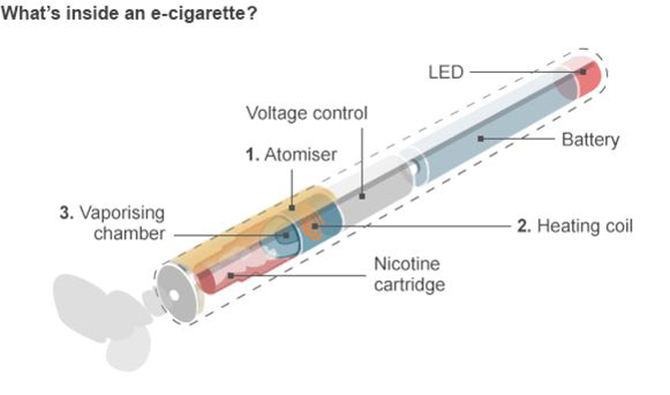
e-cigarette, what is inside it
2 / 2
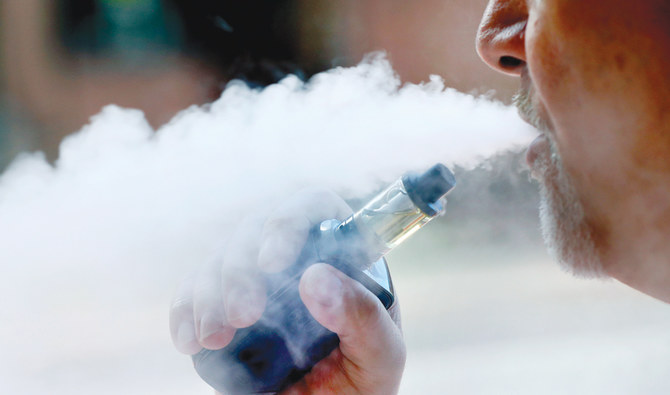
In the US, some individuals were placed in induced comas after smoking home-made vaping devices. (Reuters)
Updated 14 September 2019
Follow

Saudi doctor warns of e-cigarette risks after US ban over vaping-related deaths

  • E-cigarette flavor can damage cells lining blood vessels and in turn damage the heart, say scientists

RIYADH: A Saudi doctor has warned of the dangers of smoking e-cigarettes after the US moved to ban the devices following a spate of vaping-related deaths. Dr. Shaikh Abdullah, a pediatric and adolescent specialist at King Abdul Aziz Medical City, in Riyadh, said vaping posed serious health risks including slow brain development in teenagers, lung and heart disease.
US President Donald Trump this week announced that his administration would ban flavored e-cigarettes in the wake of six deaths and 450 reported cases of lung illness tied to vaping across 33 American states. He said e-smoking was a “new problem,” especially among young people.
Although the sale and import of vaping products has been banned in Saudi Arabia since September 2015, some users in the Kingdom still reportedly manage to obtain the devices.

Heart disease
Abdullah, who works on National Guard health affairs at the medical center, said: “Smoking harms almost all organs in the body including the heart. Nearly one-third of deaths from heart disease are the result of passive smoking.
“One might be tempted to turn to e-cigarettes as a way to ease the transition from traditional cigarettes to not smoking at all. But smoking e-cigarettes is not advisable either.
“Vapor causes deposition of nicotine into the body, it is highly addictive and can raise blood pressure and spikes adrenaline which increases the heart rate and chances of heart attack,” he added.
Abdullah said that vaping could also cause slow brain development in teens and affect memory, concentration, learning, self-control and mood. In addition, e-cigarettes irritated the lungs and could lead to serious lung damage and even death, he added.

Smoking harms almost all organs in the body including the heart. Nearly one-third of deaths from heart disease are the result of passive smoking.

Dr. Shaikh Abdullah, Pediatric and adolescent specialist at King Abdul Aziz Medical City

In a statement, the US Food and Drug Administration (FDA) said: “Both the FDA and the US Centers for Disease Control and Prevention (CDC) are working tirelessly to investigate the distressing incidents of severe respiratory illness associated with use of vaping products.
“The FDA and the CDC are working closely with state and local health officials to investigate these incidents as quickly as possible, and we are committed to taking appropriate actions as a clearer picture of the facts emerges.”
Arab News’ Rawan M. Radwan, who gave up smoking for vaping, said: “I feel that vaping is more recreational than an addictive habit. I do understand the dangers of e-cigarettes, but it’s still the preferred choice.”
Conventional smoking increases the risk of stroke, heart attack, COPD (lung diseases), asthma, diabetes, and most cancers. E-cigarettes are often considered to be effective in helping conventional smokers to quit.
However, the results of a 2013 clinical trial published in the Lancet, recommended more research was urgently needed to establish the overall benefits and dangers of e-cigarettes both on users and nonusers.
Vaping is the inhaling of vapor created by an electronic cigarette, a battery-operated smoking device with cartridges filled with liquid that usually contains nicotine, flavorings and chemicals.
Although there are more than 1,000 toxic chemicals found in cigarettes, the contents of vape juices are still widely unknown.
Radwan said: “Though I am not sure about its legality in Saudi Arabia, vape juice and devices are obtainable through sellers on the internet. Some stores provide vape salts and juices on customer request. I think vaping is popular because cigarettes and shishas are out.” She added that shisha tobacco cost SR100 ($27) or more per kilo, making e-cigarettes the more affordable choice. In the US, some individuals were placed in induced comas after smoking home-made vaping devices.
Trump met with top health officials at the White House to discuss ways to keep the products away from teenagers.
“We can’t allow people to get sick. And we can’t have our kids be so affected,” the New York Times quoted the president as saying.
A study published in the Journal of the American College of Cardiology, in May this year, found that e-cigarette flavor can damage cells lining blood vessels and in turn damage the heart.

What does vaping-related illness look like?

The following is a look at the illness and how US doctors are treating it.

PATIENT PROFILE: Most of the US cases so far have involved young men under the age of 20 who were otherwise healthy. All reported vaping within 90 days prior to developing symptoms, and many had vaped within a week of feeling sick.
Patients experienced symptoms for several days to several weeks before being admitted to the hospital.

SYMPTOMS: Nearly all patients involved in the outbreak so far have reported respiratory issues, including a dry, or unproductive, cough that does not bring up mucus, shortness of breath and chest pain that worsened with deep breathing.
About 80 percent had gastrointestinal symptoms, including nausea, vomiting or diarrhea. Those symptoms often appeared before patients started having trouble breathing.
Most also had general symptoms of illness, including fever, chills, weight loss and fatigue.
Chest X-rays and CT scans revealed shadows or abnormalities in both lungs in all of the patients, which has become a defining characteristic of the illness.
An analysis of lung cells from five patients in North Carolina turned up pockets of oily deposits within immune system cells called macrophages.
Experts have not yet determined whether these are an artifact of the immune system’s attempt at removing vaping oils — a foreign substance — from the lungs, or if they are central to the disease process itself.

TREATMENT: Many of the patients had sought treatment before going to a hospital. Nearly half were initially treated with antibiotics either before going to the hospital or after being hospitalized, but patients failed to respond.
Ultimately, nearly all of the patients were hospitalized, with more than half admitted to an intensive care unit suffering from respiratory failure.
Most patients recovered after six days of treatment. Many responded to steroids, which reduced inflammation in the lungs. Doctors also believe time in the hospital that patients spent on a ventilator and not vaping helped the lungs heal.
Because no infectious cause has been found, the CDC believes the illnesses are the result of chemical injury to the lungs. It is not yet clear whether patients will have any lasting damage.


SOURCES: The New England Journal of Medicine and the CDC’s Mortality and Morbidity Weekly Report


India and Saudi Arabia share robust defense partnership anchored in mutual trust, ambassador says

Updated 6 sec ago
Follow

India and Saudi Arabia share robust defense partnership anchored in mutual trust, ambassador says

RIYADH: India and Saudi Arabia share a robust and steadily expanding defence partnership anchored in mutual trust, Indian Ambassador Suhel Ajaz Khan said.

Speaking to Arab News ahead of the World Defense Show in Riyadh, which will feature a major Indian presence, the ambassador said: “Saudi Arabia is one of India’s most trusted and valued strategic partners. Our ties are rooted in a rich tapestry of civilizational, cultural, and commercial connections that date back centuries. In recent years, the relationship has grown exponentially, evolving into a robust strategic partnership.

“The landmark state visit of Prime Minister Narendra Modi to the Kingdom in April 2025 was a true reflection of this deepening bond. He and Crown Prince Mohammed bin Salman had highly productive engagements in Jeddah, resulting in key outcomes — including the agreement on establishment of two India-Saudi joint venture refineries in India, and MoUs in space cooperation, health, sports, and postal cooperation, the envoy said. 

“The second leaders’ meeting of the India-Saudi Arabia Strategic Partnership Council was also co-chaired by the two leaders during this visit. The council reviewed the work of the various committees, subcommittees and working groups under the SPC,” he added.

“On the defense side, India and Saudi Arabia share a robust and steadily expanding partnership, anchored in mutual trust and based on the Defense Cooperation Agreement signed in 2014 during the India visit of the then crown prince and defense minister King Salman,” Khan said.

“Over the past few years, this cooperation has deepened through regular high-level engagements, and enhanced interactions between the armed forces of both countries,” he said.

The most significant development has been the addition of a Ministerial Pillar of Defence Cooperation to the Strategic Partnership Council, chaired by the defense ministers, announced during the Jeddah visit of the Indian prime minister.

Seven rounds of discussions under the Joint Committee on Defense Cooperation have been held so far. The continued exchange of senior defence delegations reflects the priority accorded to defence cooperation under the framework of the Strategic Partnership Council. 

“Over the last few years, we have seen two editions of naval exercises, Al Mohed Al Hindi and the first land forces exercises, Sada Tanseeq. There have also been regular port calls by Indian naval and coast guard vessels,” Khan said.

After a gap of nearly 12 years, the first ministerial delegation on the defence side visited Riyadh for WDS 2024, the delegation was headed by Minister of State for Defense Ajay Bhatt. 

During that visit, an agreement was signed by Munitions India Ltd. for defence exports from India to Saudi Arabia worth $225 million, Khan said.

India will feature prominently at WDS 2026 being held from Feb. 8-12.

“We congratulate the Kingdom for its organization of WDS in recent years, which has grown significantly since its inception. While preparations are underway, we expect a high-level delegation for this event. The senior leadership of Indian Armed Forces will also be part of the delegation. There will be an India Pavilion set up by our Ministry of Defense in the show.

“While earlier, a number of Indian companies have participated in the WDS, this will be the first time an India Pavilion will be set up and will showcase India’s growing defence manufacturing capabilities,” the envoy said.

The past year has been particularly productive for India–Saudi defence relations. 

“We witnessed, for the first time, service-to-service level staff talks, along with high-level visits from both sides, including the first visit of the Chief of General Staff of the Saudi Armed Forces Gen. Fayyad bin Ruwaili, to India in December 2025,” Khan said.

He noted that there are several areas between the two sides that reflect the depth of the partnership, one of the primary fields being military-to-military cooperation, including joint exercises, training exchanges, and service-to-service engagements.

“Amongst them maritime and naval cooperation is key, reflecting our shared interest in the security of the Indian Ocean region, the Red Sea, and critical sea lines of trade and communication. The two rounds of the naval exercises Al Mohed Al Hindi have provided an excellent base for continued collaboration in this area,” Khan said.

“Another rapidly expanding area of engagement is defence industry and industrial collaboration. India’s growing defense manufacturing ecosystem driven by the motto of ‘Make in India, Make for the World’ aligns closely with Saudi Arabia’s Vision 2030,” he added. 

India’s defence industrial capabilities have grown exponentially in recent years, crossing $15 billion, with exports upwards of $2.7 billion. 

“We have a large number of products which we can offer to the Saudi side,” the ambassador said.

Saudi Arabia has been sending cadets to India for training with the Indian Navy and the National Defense Academy, marking a significant boost in bilateral defense cooperation.

Khan said: “Training and capacity-building cooperation has emerged as an important pillar of the defence partnership between India and Saudi Arabia. The participation of Saudi cadets in professional military training institutions in India reflects the high level of trust and confidence between our armed forces.”

As part of a landmark initiative, six instructors and 55 cadets from the King Fahd Naval Academy of the Royal Saudi Naval Forces participated in Afloat Summer Training with the Indian Navy at Kochi in 2023, he said. 

This was followed by an expanded engagement in 2024, when five instructors and 76 cadets from the same academy undertook similar training. 

“We anticipate that this program will continue to grow and expand in the years ahead,” the ambassador said.

In 2023 and 2025, senior delegations from the National Defence College, New Delhi visited Saudi Arabia on study tours. 

Officers from the Saudi armed forces have also attended NDC courses in the past.

“These training exchanges not only contribute to professional skill development and interoperability but also foster enduring institutional linkages between our armed forces. We see this cooperation as a valuable investment in the long-term strength of the India–Saudi Arabia defence partnership," the ambassador said.