

‘Your 9/11 is our 24/7,’ say Afghans after 18 years of war

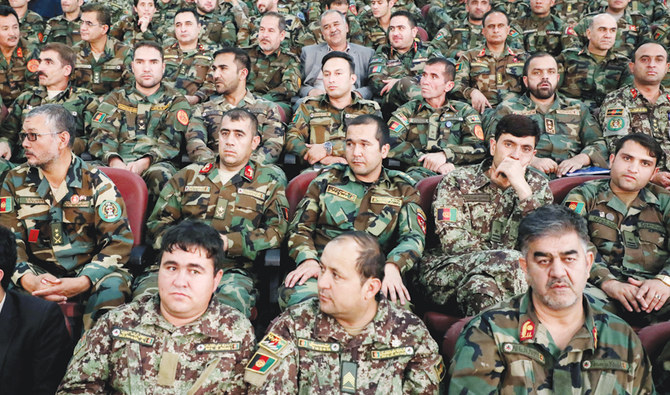
Afghan army officers listen to a speech by President Ashraf Ghani during a recent conference in Kabul as insurgents continued to stage violent attacks. (Reuters)
Updated 13 September 2019
Follow

‘Your 9/11 is our 24/7,’ say Afghans after 18 years of war

  • US leaders say they have no secret agenda in Afghanistan, and do not wish to maintain a long-term military presence there

KABUL: Exhausted by protracted fighting and lawlessness, some Afghans had hoped the US decision to invade Afghanistan to topple the Taliban in response to the Sept. 11, 2001 attacks would lead to peace and stability. Eighteen years on, some of those who welcomed the invasion question US intentions and feel disappointed. They argue that the country is more divided and bloody than ever, has weak government, a rampant narcotics trade and that extremism has soared, with the nation’s fate looking bleak.
“I was one of those people who hailed them (the US) because they had created the perception that they will fight terrorism, bring us democracy, peace and an accountable government,” Humaira Ayoubi, a former MP from western Farah, told Arab News.
“They drove the Taliban from power within weeks. How come 18 years on, despite their vast resources, technology and military might, the Taliban are back in control of more ground than the government in my province? Where is the rule of law, justice, peace and good governance?”
She said ordinary people in her constituency who also supported the arrival of US-led troops at the time now say Washington “has a hidden agenda — it can easily win the war, but does not want to, because it wants to remain in Afghanistan.”
Even former Afghan President Hamid Karzai, who came to power with US help after Taliban’s fall, has claimed that Washington uses “terrorism” in Afghanistan as an excuse to remain in the country.
US leaders say they have no secret agenda in Afghanistan, and do not wish to maintain a long-term military presence there.
Ayoubi said she and others had clearly told US diplomats and generals that they were pursuing the wrong policy in Afghanistan by not hitting the Taliban in neighboring Pakistan.
Nearly 3,000 people lost their lives during the Sept. 11 attacks, carried out by a group of Al-Qaeda operatives who flew planes into the twin towers of the World Trade Center in New York, and the Pentagon in Washington, DC. A fourth plane, also bound for the US capital, crashed en route in Pennsylvania.
Al-Qaeda leaders were protected by the Taliban in Afghanistan, which led to the subsequent invasion following the attacks. Since then, countless Afghan civilians have been killed in Taliban attacks and offensives by US and government forces.

BACKGROUND

• A Taliban suicide bomber detonated a vehicle laden with explosives at an Afghan army in Kabul on Thursday, killing 4 troops.

• The attack was the first by the group since US President Donald Trump called off peace talks at Camp David this week.

Waheed Paikan, a journalist working for the BBC in Kabul, has tried to point out to the world the scale of the deaths caused by the war in Afghanistan. On the 18th anniversary of the Sept. 11 attacks, he tweeted: “Your 9/11 is our 24/7!”
Wahidullah Ghazikhail, who runs the Center for Studies and Research think tank in Kabul, said US leaders had given Afghans bogus promises for “justifying” the invasion.
“Eighteen years later, the situation is not like Afghans hoped at the beginning. Women’s rights, freedom of speech and the freedom of the media were justification for America’s invasion. Our forces are weak and without NATO and American troops they cannot defend us,” he told Arab News.

He said Afghans needed to know why, despite the continued US presence, the Taliban had become strong again, and other militant groups such as Daesh had emerged in recent years.
Meanwhile, a Taliban suicide bomber detonated a vehicle laden with explosives at an Afghan army outside Kabul on Thursday, killing 4 troops, government officials said.
The attack was the first by the group since US President Donald Trump called off peace talks at Camp David this week.


At top UN court, Myanmar denies deadly Rohingya campaign amounts to genocide

Updated 57 min ago
Follow

At top UN court, Myanmar denies deadly Rohingya campaign amounts to genocide

  • The country defended itself Friday at the United Nations top court against allegations of breaching the genocide convention
  • Myanmar launched the campaign in Rakhine state in 2017 after an attack by a Rohingya insurgent group

THE HAGUE: Myanmar insisted Friday that its deadly military campaign against the Rohingya ethnic minority was a legitimate counter-terrorism operation and did not amount to genocide, as it defended itself at the top United Nations court against an allegation of breaching the genocide convention.
Myanmar launched the campaign in Rakhine state in 2017 after an attack by a Rohingya insurgent group. Security forces were accused of mass rapes, killings and torching thousands of homes as more than 700,000 Rohingya fled into neighboring Bangladesh.
“Myanmar was not obliged to remain idle and allow terrorists to have free reign of northern Rakhine state,” the country’s representative Ko Ko Hlaing told black-robed judges at the International Court of Justice.
Gambia filed genocide case in 2019
African nation Gambia brought a case at the court in 2019 alleging that Myanmar’s military actions amount to a breach of the Genocide Convention that was drawn up in the aftermath of World War II and the Holocaust.
Some 1.2 million members of the Rohingya minority are still languishing in chaotic, overcrowded camps in Bangladesh, where armed groups recruit children and girls as young as 12 are forced into prostitution. The sudden and severe foreign aid cuts imposed last year by US President Donald Trump shuttered thousands of the camps’ schools and have caused children to starve to death.
Buddhist-majority Myanmar has long considered the Rohingya Muslim minority to be “Bengalis” from Bangladesh even though their families have lived in the country for generations. Nearly all have been denied citizenship since 1982.
Myanmar denies Gambia claims of ‘genocidal intent’
As hearings opened Monday, Gambian Justice Minister Dawda Jallow said his nation filed the case after the Rohingya “endured decades of appalling persecution, and years of dehumanizing propaganda. This culminated in the savage, genocidal ‘clearance operations’ of 2016 and 2017, which were followed by continued genocidal policies meant to erase their existence in Myanmar.”
Hlaing disputed the evidence Gambia cited in its case, including the findings of an international fact-finding mission set up by the UN’s Human Rights Council.
“Myanmar’s position is that the Gambia has failed to meet its burden of proof,” he said. “This case will be decided on the basis of proven facts, not unsubstantiated allegations. Emotional anguish and blurry factual pictures are not a substitute for rigorous presentation of facts.”
Aung San Suu Kyi represented Myanmar at court in 2019. Now she’s imprisoned
Nobel Peace Prize winner Aung San Suu Kyi represented her country at jurisdiction hearings in the case in 2019, denying that Myanmar armed forces committed genocide and instead casting the mass exodus of Rohingya people from the country she led as an unfortunate result of a battle with insurgents.
The pro-democracy icon is now in prison after being convicted of what her supporters call trumped-up charges after a military takeover of power.
Myanmar contested the court’s jurisdiction, saying Gambia was not directly involved in the conflict and therefore could not initiate a case. Both countries are signatories to the genocide convention, and in 2022, judges rejected the argument, allowing the case to move forward.
Gambia rejects Myanmar’s claims that it was combating terrorism, with Jallow telling judges on Monday that “genocidal intent is the only reasonable inference that can be drawn from Myanmar’s pattern of conduct.”
In late 2024, prosecutors at another Hague-based tribunal, the International Criminal Court, requested an arrest warrant for the head of Myanmar’s military regime for crimes committed against the country’s Rohingya Muslim minority. Senior Gen. Min Aung Hlaing, who seized power from Suu Kyi in 2021, is accused of crimes against humanity for the persecution of the Rohingya. The request is still pending.