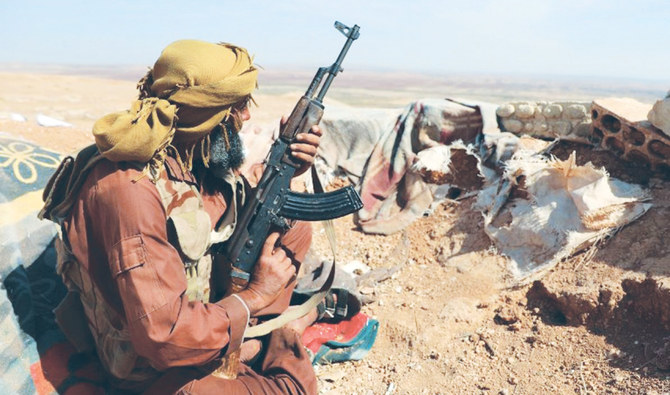

BEIRUT: The Syrian regime forces claimed on Saturday its air defenses foiled a drone attack by “terrorist” groups on a main military base in northwestern Syria, where a Russian-brokered cease-fire has stopped months of fighting. The three drones, which were carrying explosives, were shot down on Friday and destroyed without causing any losses, the army said in a statement reported on Syrian state media.
The Idlib region saw a lull in air raids that have been pounding opposition-held territory after Russia’s Defense Ministry announced on Aug. 30 that Syrian forces would unilaterally cease fire in an “de-escalation zone” brokered two year ago.
The Russian Defense Ministry, which urged insurgent factions to join the truce, has long said along with its ally they were targeting Al-Qaeda-inspired militants and responding to attacks.
Moscow’s deployment of more special forces before the cease-fire succeeded in shrinking opposition-held territory after months of stalemate on the frontlines, where opposition fighters had earlier been holding back the army from major advances, Western intelligence sources said.
The opposition says although the heavy airstrikes by Russian and Syrian jets have stopped since the cease-fire, heavy shelling on opposition-held villages and towns continue to force thousands of civilians to leave to the safety of areas closer to the Turkish border.
They also say Russian special forces and Iranian-backed militias fighting alongside the Syrian army have breached the cease-fire by launching several major attempts to storm opposition-held areas in recent days that have so far been repelled.
Anti-regime protests
A day earlier, hundreds of Syrians held anti-regime protests in opposition-held Idlib province.
Some demonstrators gathered near the Bab Al-Hawa border crossing with Turkey, where Turkish border guards last week fired warning shots and tear gas to disperse Syrian protesters. They waved the three-star flag of the eight-year-old uprising and chanted against Bashar Assad’s regime, while some called on opposition backer Turkey to open its borders.
FASTFACT
Opposition says although the heavy airstrikes by Russian and Syrian jets have stopped since the cease-fire, heavy shelling on opposition-held villages and towns continue to force thousands of civilians to leave to the safety of areas closer to the Turkish border.
“We only want the Turkish government to open its borders for our brothers who live under the olive trees,” protester Abu Haytham told AFP, referring to displaced Syrians living in the open air.
Airstrikes have stopped since the agreement went into effect last Saturday morning, but sporadic artillery fire has continued. Russia-backed regime forces have been pressing an offensive against Idlib since the end of April.
More than 960 civilians have been killed in four months of heavy bombardment, according to the Britain-based Syrian Observatory for Human Rights. More than 400,000 people have been displaced. Last week, an Assad adviser said the Idlib cease-fire was “temporary.”
It “serves the grand strategy of liberating every inch of Syrian territory,” Buthaina Shaaban told Lebanon’s pro-Damascus Al-Mayadeen TV.
According to Al-Watan newspaper in Damascus, the truce sets an eight-day deadline for militants and opposition fighters to withdraw from areas around a key highway which the regime wants to control.
But anti-opposition forces have yet to pull out.
Syria’s conflict has killed more than 370,000 people and driven millions from their homes since it started with the brutal repression of anti-opposition protests in 2011.