

'Sheikh Zayed's painting brings me luck,’ says Lahore roadside artist

1 / 4
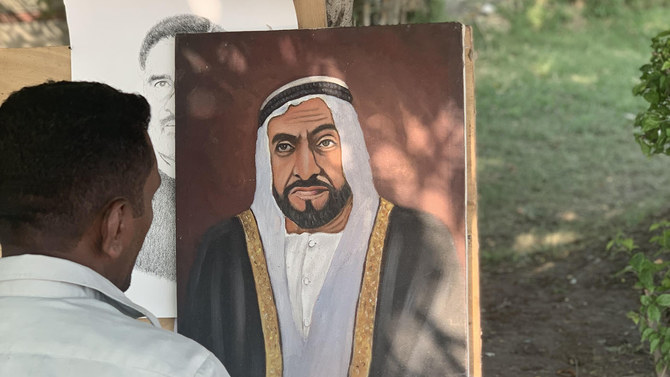
Shoukat Ali sits face to face with his ‘lucky’ portrait of Sheikh Zayed by the side of the main road in Lahore, on Sept. 7, 2019. (AN photo)
2 / 4
Lahore-based street artist Shoukat Ali in his usual spot by the side of a busy city road with his oil painting of Sheikh Zayed in Lahore, on Sept. 7, 2019. (AN photo)
3 / 4
Shoukat Ali sits face to face with his ‘lucky’ portrait of Sheikh Zayed by the side of the main road in Lahore, on Sept. 7, 2019. (AN photo)
4 / 4
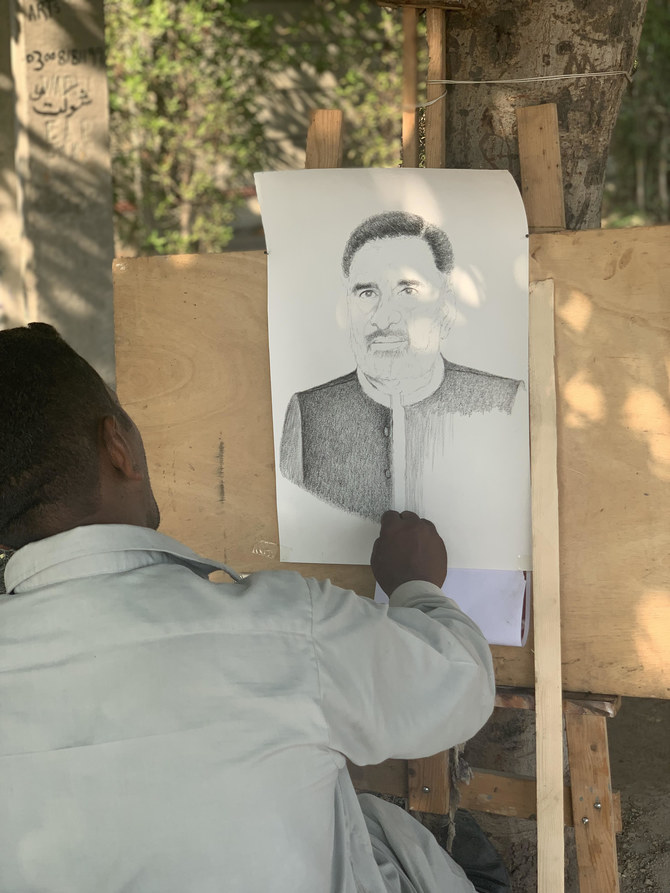
Shoukat Ali working on a commissioned portrait of a man in his usual spot by the side of a busy city road in Lahore, on Sept. 7, 2019. (AN photo)
Updated 07 September 2019
Follow

'Sheikh Zayed's painting brings me luck,’ says Lahore roadside artist

  • Roadside artist charges $13 for a commissioned portrait
  • ‘Don’t know who he is, but brings in customers’

LAHORE: Under the shade of a roadside tree next to a four-lane highway that leads to Lahore’s international airport, artist Shoukat Ali, 40, is hard at work next to a portrait of the UAE’s Late Sheikh Zayed bin Sultan, oblivious to the roar of rush hour traffic.
Ali, the son of a milk-man, has been sitting under the same tree for the last five years he said, and manages to attract roughly ten to twenty customers a month, who stop and commission their portraits with the artist.
“I don’t know who he is, but he helps me bring in customers,” Ali said, pointing to the oil painting of the late ruler of UAE and adds, “He’s lucky for me.”
Next to it, there is a pencil sketch of a smiling Maryam Nawaz, a recognizable face in the country, and daughter of ex-Pakistani Prime Minister, Nawaz Sharif.
“I know he is a King,” Ali said, and beamed. “I like his face.”
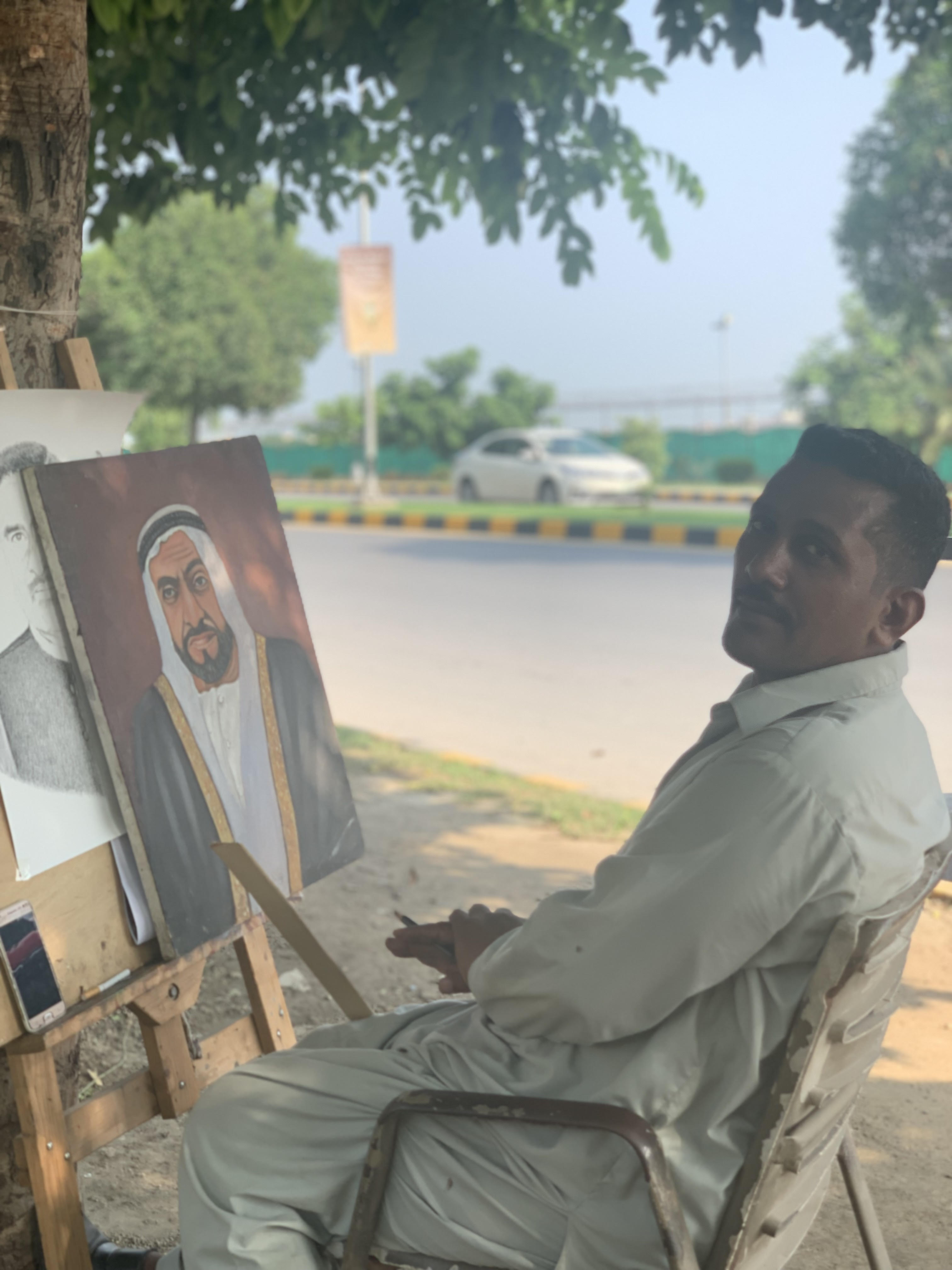


Lahore-based street artist Shoukat Ali in his usual spot by the side of a busy city road with his oil painting of Sheikh Zayed in Lahore, on Sept. 7, 2019. (AN photo) 

Ali dropped out of school in grade six, and began pursuing his hobby of making portraits, cutting out pictures of people from newspapers and practicing on any scrap of paper he could find. Eventually, he started charging for his services and even trained for some years with a mentor in Lahore’s Lakshmi Chowk, a part of the city’s old quarter, once considered the heart of its architectural and food legacies.
Now, working with a thick black pencil sharpened down to less than half its size, Ali says he makes just enough to get by. One portrait usually goes for Rs. 2,000 ($13), and coupled with a few tuitions to art students living nearby, his work brings in on average Rs. 30,000 a month ($193).
Still, he insists, life is good.
“I’m happy,” he said. “I don’t have to pay any rent here, or electricity bills.”
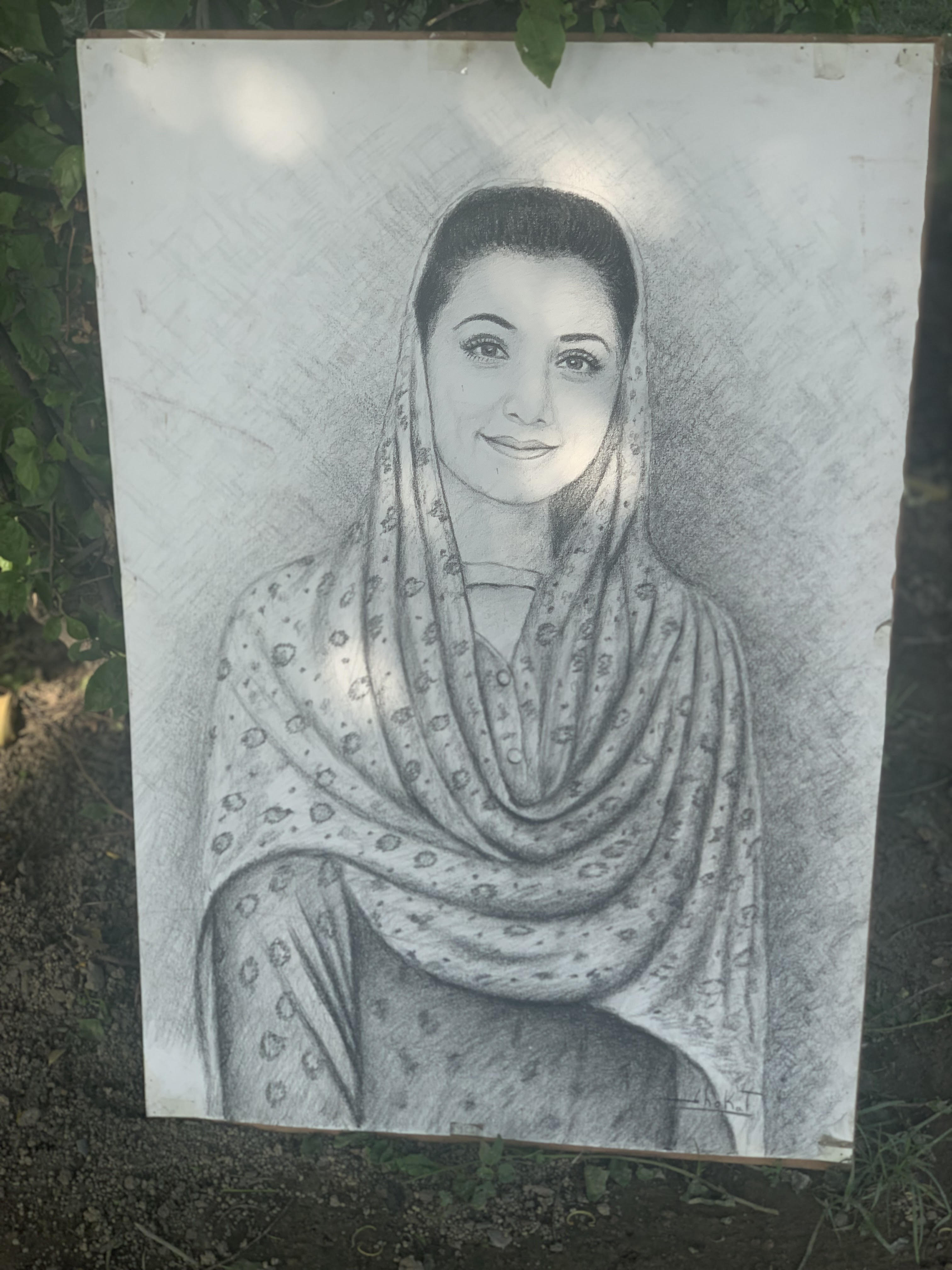


A pencil sketch of Maryam Nawaz by artist Shoukat Ali, among the side of a busy main road in Lahore, on Sept. 7, 2019. (AN photo) 

Nearby, on an electricity pole which serves as his only advertising medium, his name and phone number are written in a scrawl under the word “Arts.”
“What’s his name?” he asked, pointing to his prized portrait of Sheikh Zayed and then repeated it twice to remember over the relentless rumble of speeding cars.
Then, picking up a single cigarette from the wobbly easel in one hand, he put his pencil to paper and got right back to work.


Pakistan issues over $7 billion sukuk in 2025, nears 20 percent Shariah-compliant debt target

Updated 29 December 2025
Follow

Pakistan issues over $7 billion sukuk in 2025, nears 20 percent Shariah-compliant debt target

  • Finance Adviser Khurram Schehzad says this was the highest-ever Sukuk issuance in a single calendar year since 2008
  • Pakistan’s Federal Shariat Court ordered in 2022 the entire banking system to transition to Islamic principles by 2027

ISLAMABAD: Pakistan’s Finance Adviser Khurram Schehzad on Monday said the country achieved a landmark breakthrough in Islamic finance by issuing over Rs2 trillion ($7 billion) sukuk this year, bringing it closer to its 20 percent Shariah-compliant debt target by Fiscal Year 2027-28.

A sukuk is an Islamic financial certificate, similar to a bond, but it complies with Shariah law, which forbids interest. Pakistan’s Federal Shariat Court (FSC) had directed the government in April 2022 to eliminate interest and align the country’s entire banking system with Islamic principles by 2027.

Following the ruling, the government and the State Bank of Pakistan (SBP) have undertaken a series of measures, including legal reforms and the issuance of sukuk to replace interest-based treasury bills and investment bonds.

“In 2025, the Ministry of Finance (MoF) through its Debt Management Office, together with its Joint Financial Advisers (JFAs), successfully issued over PKR 2 trillion in Sukuk,” Schehzad said on X, describing it as “the highest-ever Sukuk issuance in a single calendar year since 2008 by Pakistan.”

Pakistan made a total of 61 issuances across one-, three-, five- and 10-year tenors, according to the finance adviser. The country also successfully launched its first Green Sukuk, a Shariah-compliant bond designed to fund environment-friendly projects.

He said the Green Sukuk was 5.4 times oversubscribed, indicating investor demand was more than five times higher than the amount the government planned to raise, which showed strong market confidence.

“The rising share of Islamic instruments in the government’s domestic securities portfolio (domestic debt) underscores strong momentum, growing from 12.6 percent in June 2025 to around 14.5 percent by December 2025, clearly positioning the MoF to achieve its 20 percent Shariah-compliant debt target by FY28,” Schehzad said.

“This milestone also reflects the structural deepening of Pakistan’s Islamic capital market, sustained investor confidence, and the strengthening of sovereign debt management.”

He said Pakistan was strengthening its government securities market by making it more resilient, diversified, and future-ready, supported by a stabilizing macroeconomic environment, a disciplined debt strategy, and a clear roadmap for Islamic finance.