ISLAMABAD: Pakistan’s Foreign Minister Shah Mahmood Qureshi said that regional security depended on ending the war in Afghanistan while addressing a joint press conference with his Chinese and Afghan counterparts after the third round of the China-Afghanistan-Pakistan Foreign Ministers’ Dialogue held in Islamabad on Saturday.
The trilateral dialogue was institutionalized in 2017 to cooperate on issues of common interest with particular emphasis on economic development, peace, and security. Its first meeting was held in Beijing in 2017 and second in Kabul in 2018.
“Regional and domestic security will rely on ending the war in Afghanistan,” Qureshi said, standing side by side with Afghanistan’s Foreign Minister Salahuddin Rabbani and Chinese counterpart Wang Yi. He said Pakistan had acted against militant networks in the country, “as we don’t want our soil to be used against anyone.”
China, a close ally of Pakistan, has been deepening its ties with Kabul and using its influence to try to bring the two neighbors closer together after a historic period of mistrust. In June this year, China played host to a Taliban delegation as part of its efforts to promote peace and reconciliation in Afghanistan.
The dialogue comes as the US and Taliban enter the final phases of a peace settlement to withdraw all American and foreign troops stationed in Afghanistan, amid a sudden surge in violence in the country. Afghanistan’s President Ashraf Ghani and senior officials in his government are increasingly critical of the peace talks, which they say grant legitimacy to the militant group.
“Taliban have yet to show their genuine commitment to the peace process,” Afghanistan’s Rabbani said during Saturday’s press conference. “This is manifested by their decision to continue with terrorist attacks, killing innocent Afghans from all walks of life on a daily basis.”
He also reiterated the need to improve bilateral relations with Pakistan.
“All three participants (are) recognizing that bilateral relations between Afghanistan and Pakistan need to improve in order to ensure a more peaceful and prosperous neighborhood,” he said.
Former Pakistani Ambassador Ali Sarwer Naqvi told Arab News the trilateral dialogue was an important forum to find common ground.
“Both Pakistan and China are neighbors of Afghanistan and are suffering directly due to its civil war. So, this forum can help them find the common ground to achieve the objective of peace and stability in Afghanistan,” he said.
Chinese Foreign Minister Wang Yi said Chinese interests in the region were growing with benefits for the whole region, adding that the Afghan peace process presented a major opportunity despite a grave security situation.
Yi welcomed peace negotiations between the Afghan Taliban and the US and termed the talks a good opportunity for peace in Afghanistan.
“We call on both Taliban and US to continue on this and implement the agreement after it is signed,” he said.
“It is the shared aspiration of 30 million Afghan people to put an end to the war. This is also the expectation of the whole region and international community,” he added.
The joint statement issued by Pakistan’s foreign office following the dialogue said that the three foreign ministers reiterated their resolve to further deepen various strands of trilateral cooperation, which included building political trust and supporting reconciliation, regional peace, and stability, development cooperation and connectivity, security cooperation and counter-terrorism.
The statement added that China, Afghanistan, and Pakistan took note of the talks between the US and the Taliban and expressed hope that intra-Afghan negotiations including direct negotiations between Afghanistan and Taliban would begin soon and lead to full cessation of violence.
“In this forum (of trilateral talks) China is a mediator and it is trying to remove the differences between the two countries as it has friendly relations with both,” Afghan affairs expert, Rahimullah Yousafzai, told Arab News. “It is also trying to improve cooperation in trade, security and connectivity.”
On the sidelines of the dialogue, Foreign Minister Shah Mahmood Qureshi held bilateral talks with his Chinese and Afghan counterparts separately.


Regional and domestic security relies on ending the war in Afghanistan, says Qureshi
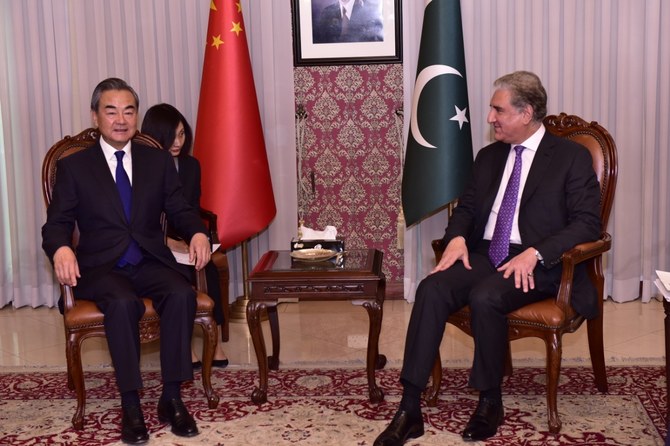
Regional and domestic security relies on ending the war in Afghanistan, says Qureshi

- Afghan FM Rabbani says Taliban yet to show commitment to peace
- Peace talks between the Taliban and the US good opportunity to end violence in Afghanistan says Chinese FM

Pakistan stocks recover as oil supply fears ease after Islamabad seeks Red Sea route— analyst
- Pakistan has sought Saudi help to secure oil supplies via Red Sea port after Iran’s closure of Strait if Hormuz
- Analyst says higher crude oil prices, expectations of IMF releasing next loan tranche also triggered bullish activity
ISLAMABAD: Pakistani stocks marked a sharp recovery when trading closed on Thursday, as institutional activity increased following Islamabad’s move to seek crude oil supplies through the Red Sea port eased oil supply fears, a financial analyst said.
Pakistani stocks have recorded a sharp decline this week, with the benchmark KSE-100 index recording its largest-ever single-day decline on Monday when it plunged 16,089 points. Escalating conflict in the Middle East triggered panic selling at the Pakistani bourse, forcing a temporary trading halt on Monday.
The KSE-100 index, however, gained 3.49 percent or 5,433.46 points to close at 161,210.67 when trading ended on Thursday, up from the previous close of 155,777.21 points, according to Pakistan Stock Exchange’s (PSX) data.
Pakistan’s Petroleum Minister Ali Pervaiz Malik met Saudi Ambassador Nawaf bin Said Al-Malki on Wednesday to discuss Iran’s closure of the key Strait of Hormuz, which has threatened Pakistan’s energy supply. Roughly 20 percent of the global oil and gas supply passes through the route. Saudi Arabia indicated it could facilitate shipments through the Red Sea port of Yanbu, offering an alternative route if Gulf shipping lanes remain disrupted, the petroleum ministry said on Wednesday.
“Stocks staged a sharp recovery at PSX amid institutional activity on easing fuel supply fears after KSA [Kingdom of Saudi Arabia] commits oil supplies through the Red Sea port,” Ahsan Mehanti, chief executive officer at Arif Habib Commodities, told Arab News.
He said higher global crude oil prices and expectations of the International Monetary Fund releasing its next tranche of the $7 billion loan for Pakistan also helped bullish activity at the PSX.
An IMF mission was in Pakistan to hold talks on the third review of a $7 billion Extended Fund Facility multi-year program, and for the second review of the $1.4 billion Resilience and Sustainability Facility this week.
However, the delegation left for Türkiye amid tensions in the Gulf. Pakistani officials have said talks are likely to continue virtually in the coming days.
Pakistani brokerage Topline Securities said in its daily market review report that strong institutional buying “turned the tide” on Thursday after the market’s recent overreaction to regional issues.
The report added that Hub Power Company (HUBC), Oil & Gas Development Company (OGDC), Fauji Fertilizer Company (FFC), Engro Corporation (ENGROH), and Meezan Bank Limited (MEBL) collectively contributed 2,197 points to the KSE benchmark’s gain.
Topline Securities said 723 million shares were traded on Thursday, with K-Electric Limited (KEL) stealing the spotlight as more than 1.17 billion shares changed hands.
Pakistani investors are closely monitoring developments in the Gulf, particularly around energy routes and further retaliatory actions, as the conflict’s trajectory remains uncertain.


