India loses contact with spacecraft trying to land on Moon

1 / 4
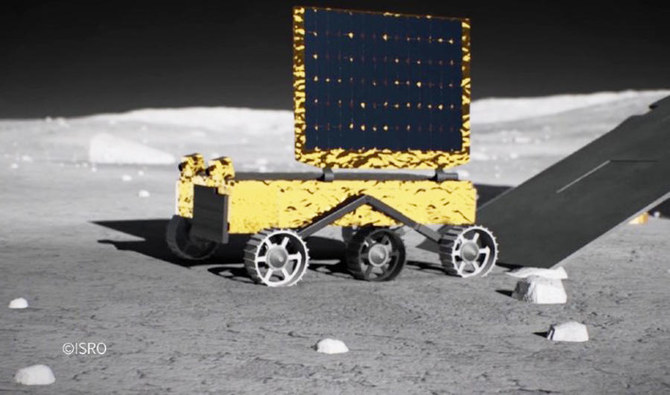
Videographic on the Chandrayaan-2 mission. The Indian probe is set to land on the lunar South Pole on Saturday. (AFP)
2 / 4
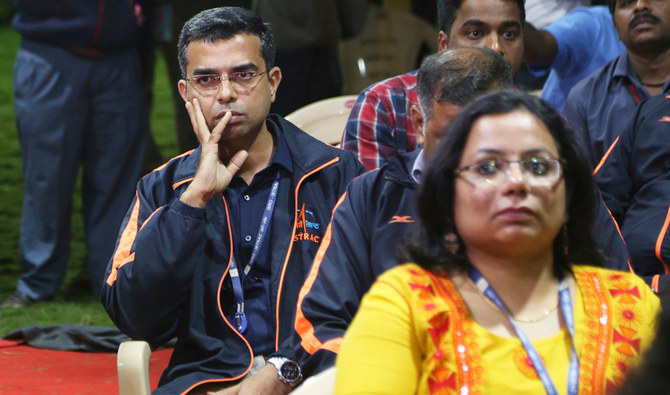
Indian Space Research Organization (ISRO) employees react as they wait for an announcement by organizations's chief Kailasavadivoo Sivan at its Telemetry, Tracking and Command Network facility in Bangalore, India, Saturday, Sept. 7, 2019. (AP)
3 / 4
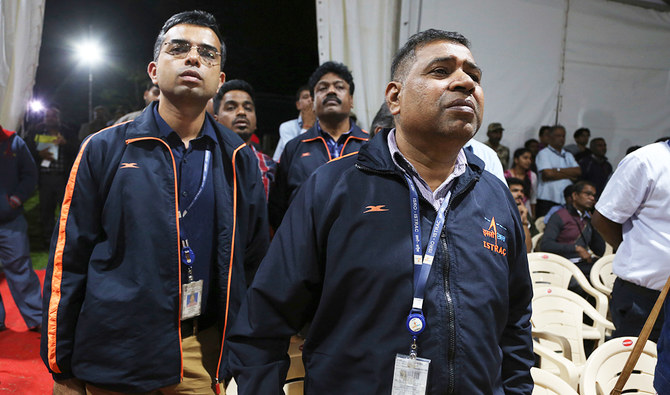
Indian Space Research Organization (ISRO) employees react as they listen to an announcement by organizations's chief Kailasavadivoo Sivan at its Telemetry, Tracking and Command Network facility in Bangalore, India, Saturday, Sept. 7, 2019. (AP)
4 / 4
Updated 07 September 2019
Follow

India loses contact with spacecraft trying to land on Moon

  • A successful landing would make India just the fourth country to land a vessel on the lunar surface, and only the third nation to operate a robotic rover there

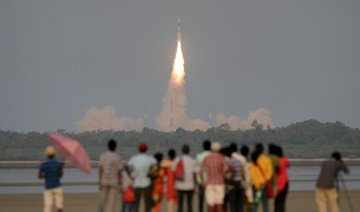
BANGALORE, INDIA: India lost contact with its unmanned spacecraft just before it was due to land on the Moon on Saturday, in a blow to the country’s ambitious low-cost lunar program.
India had hoped to become just the fourth country after the United States, Russia and China to successfully land on the Moon.
But as Prime Minister Narendra Modi looked on, the mood in mission control in the southern city of Bangalore soon deteriorated when it became clear that everything was not going according to plan.
After several tense minutes as the expected landing time came and went, Indian Space Research Organization (ISRO) chairman Kailasavadivoo Sivan announced that communication with the lander had been lost.
“The ‘Vikram’ lander descent was (going) as planned and normal performance was observed,” until the craft had descended to 2.1 kilometers (1.3 miles) above the South Pole region, Sivan said.
“Subsequently the communication from the lander to the ground station was lost. The data is being analyzed,” he said, surrounded by grim-faced engineers and technicians in the control room.
Modi told them after Sivan’s announcement that “what you have done (already) is not a small achievement.” The prime minister was due to address the nation at 0230 GMT.

Chandrayaan-2 — or Moon Chariot 2 — took off on July 22 carrying an orbiter, lander and rover almost entirely designed and made in India, a week after an initial launch was halted just before blast-off.
ISRO had acknowledged before the soft landing that it was a complex maneuver, which Sivan called “15 minutes of terror.”
The lander — named after Vikram A. Sarabhai, the father of India’s space program — aimed to be the first to reach the lunar South Pole region.
It was carrying rover Pragyan, wisdom in the Sanskrit language, which was due to emerge several hours after touchdown.
The rover was expected to explore craters for clues on the origin and evolution of the Moon, and also for evidence on how much water the polar region contains.
The 2.4-ton (5,300-pound) orbiter remains in operation and will circle the Moon for about a year, taking images of the surface, looking for signs of water, and studying the atmosphere.
According to Mathieu Weiss, a representative in India for France’s space agency CNES, analizing the South Pole is vital to determining whether humans could one day spend extended periods on the Moon.
Scientists believe that large amounts of water are in the area, making human settlement there more viable.
If people can survive on the Moon, then this means it could be used as a pitstop on the way to Mars, the next objective of governments and private interests such as Elon Musk’s Space X.

Asia’s third-largest economy also hopes to secure lucrative commercial satellite and orbiting deals in the competitive market.
The Chandrayaan-2 space mission — India’s most ambitious so far — stood out because of its low cost of about $140 million. The United States spent the equivalent of more than $100 billion on its Apollo missions.
India is preparing Gaganyaan, its first manned space mission, with the air force announcing Friday that the first level of selection of potential astronauts was complete.
The South Asian nation also hopes to land a probe on Mars. In 2014, it became only the fourth nation to put a satellite into orbit around the Red Planet.
China in January became the first nation to land a rover on the far side of the Moon. And in April, Israel’s attempt failed at the last minute when its craft suffered an engine failure and apparently crashed onto the lunar surface.
During a live videocast of that mission, control staff could be heard saying that engines meant to slow the craft’s descent and allow a soft landing had failed and contact with it had been lost.


Junta leader Gen. Mamdi Doumbouya is declared winner of Guinea’s election, provisional results show

Updated 31 December 2025
Follow

Junta leader Gen. Mamdi Doumbouya is declared winner of Guinea’s election, provisional results show

  • Mamady Doumbouya took power in 2021 coup

CONAKRY, Guinea: Guinea coup leader ​Mamady Doumbouya has been elected president, according to provisional results announced on Tuesday, completing the return to civilian rule in the bauxite- and iron ore-rich West African nation.
The former special forces commander, thought to be in his early 40s, seized power in 2021, toppling then-President Alpha Conde, who had been in office since 2010. It was one in a series of nine coups that have reshaped politics in West and Central Africa since 2020.
The provisional results announced ‌on Tuesday showed Doumbouya ‌winning 86.72 percent of the December 28 vote, ‌an ⁠absolute majority ​that allows ‌him to avoid a runoff.
The Supreme Court has eight days to validate the results in the event of any challenge.
Doumbouya’s victory, which gives him a seven-year mandate, was widely expected. Conde and Cellou Dalein Diallo, Guinea’s longtime opposition leader, are in exile, which left Doumbouya to face a fragmented field of eight challengers.
Doumbouya reversed pledge not to run
The original post-coup charter in Guinea barred junta members from running ⁠in elections, but a constitution dropping those restrictions was passed in a September referendum.
Djenabou Toure, the ‌country’s top election official who announced the results on ‍Tuesday night, said turnout was 80,95 percent. However ‍voter participation appeared tepid in the capital Conakry, and opposition politicians rejected ‍a similarly high turnout figure for the September referendum.
Guinea holds the world’s largest bauxite reserves and the richest untapped iron ore deposit at Simandou, officially launched last month after years of delay.
Doumbouya has claimed credit for pushing the project forward and ensuring Guinea benefits ​from its output.
His government this year also revoked the license of Emirates Global Aluminium’s subsidiary Guinea Alumina Corporation following a refinery dispute, ⁠transferring the unit’s assets to a state-owned firm.
The turn toward resource nationalism — echoed in Mali, Burkina Faso and Niger — has boosted his popularity, as has his relative youth in a country where the median age is about 19.
Political space restricted, UN says
Political debate has been muted under Doumbouya. Civil society groups accuse his government of banning protests, curbing press freedom and restricting opposition activity.
The campaign period was “severely restricted, marked by intimidation of opposition actors, apparently politically motivated enforced disappearances, and constraints on media freedom,” UN rights chief Volker Turk said last week.
On Monday, opposition candidate Faya Lansana Millimono told a press conference the election was marred by “systematic fraudulent practices” and ‌that observers were prevented from monitoring the voting and counting processes.
The government did not respond to a request for comment.