KARACHI: Saudi Arabia and the United Arab Emirates are in a position to help the residents of Indian-administered Kashmir who have been living under siege since the region’s special autonomy was revoked on August 5, analysts said on Thursday, with the caveat that Islamabad should not develop unrealistic expectations from Middle Eastern countries over the issue since any nation would watch its own interests first.
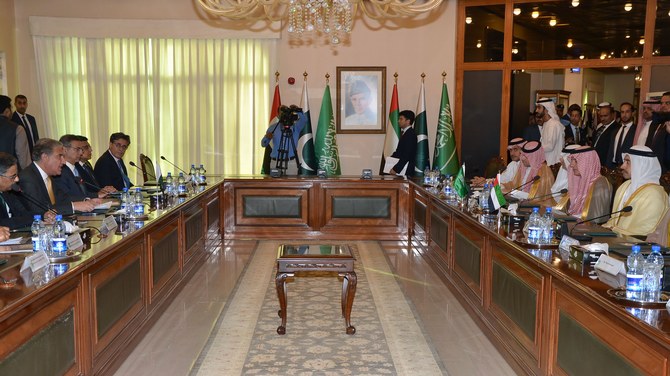
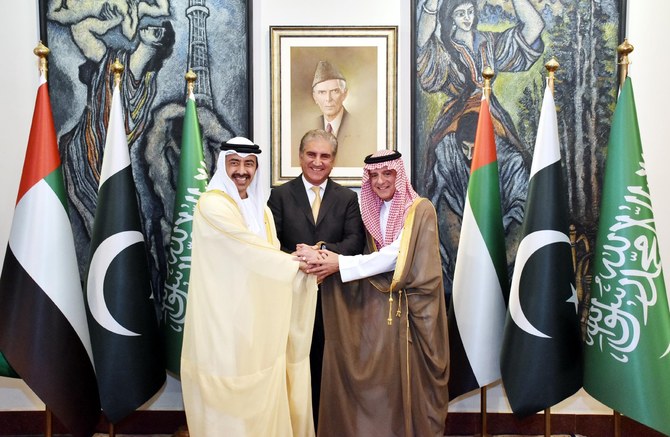
Talking to Arab News, Pakistan’s former ambassador to Riyadh, Shahid M. Amin, said the visit of Saudi Minister of State for Foreign Affairs Adel Al-Jubeir and UAE Minister of Foreign Affairs Sheikh Abdullah bin Zayed bin Sultan Al-Nahyan could help defuse tensions in South Asia.
However, he also maintained that the situation in Kashmir demanded the two Muslim countries to play a bigger role.
“This is not only a Muslim issue but a human issue as well,” he said. “So far we have only been hearing Pakistan’s version of what transpired during the meetings. The visiting ministers should have issued a statement, creating clarity about the purpose of their visit and denouncing India’s actions in Kashmir which are unethical and illegal according to international norms.”
On Wednesday, Pakistan saidPrime Minister Imran Khan had urged Saudi Arabia and the UAE to play a role and advise New Delhi to halt and reverse its “illegal actions” in Indian-administered Kashmir. The PM’s official statement also claimed that the visiting ministers had promised to help defuse hostilities between Pakistan and India over the disputed Kashmir region.
Tensions flared up between the two South Asian nuclear-armed neighbors when the government in New Delhi revoked the constitutional autonomy of Kashmir, which both countries rule in part but claim in full. This prompted fury from Pakistan which decided to sever trade and transportation ties with India and expelled its high commissioner to Islamabad.
Amin said the recent visit of the ministers was the outcome of Pakistan’s diplomatic outreach within the Islamic world in a context wherein most Pakistanis were calling for the global community of believers (ummah) to play its role.
Zebunnisa Burki, an analyst, said, however, that she was skeptical that the visit would help Pakistan build substantial pressure on India.
“I think more than anything else this visit was primed for the Pakistan government’s domestic constituency. They came, in all probability, to paper over what has been seen by people in Pakistan as a sort of a betrayal by the Ummah over the question of Kashmir. To me, that’s as far as it goes. It gave some element of face-saving to the Pak government,” she told Arab News.
Burki added that India was not in a mood to listen to anyone at the moment, mainly because “it knows it can – and has managed to – get away with brutalities in Kashmir.”
Mazhar Abbas, a Karachi-based analyst, said economic interests drove a country’s policies and the economic interest of Gulf states required them to work closely with India.
“We should not have unrealistic expectation that they will address the core issue. However, Saudi Arabia and the UAE can force India to undertake some confidence building measures by ending the curfew and rights violations in Kashmir,” he said, adding such action could also help resume the stalled dialogue process in the region.
Pakistan’s former ambassador to the UAE, Jamil Ahmed Khan, concurred with his assessment.
“We should not expect the UAE to openly condemn Indian actions, though diplomatically it may play a role to some extent,” he told Arab News, reminding that both Saudi Arabia and the UAE had come to Pakistan’s rescue when Islamabad recently faced a major financial crisis.
Khan suggested that Pakistan should only expect from friends what they could realistically deliver and look toward other members of the international community to highlight “Indian atrocities” in Kashmir.
“Prime Minister Khan has a great opportunity to do that since he will be addressing the United Nations in the coming days,” he added. “He should highlight how India revoked Kashmir’s special constitutional status in violation of the UN resolutions.”


![]()
![]()
![]()

Saudi, UAE can play key role in Kashmir issue - experts

Saudi, UAE can play key role in Kashmir issue - experts
- Top ministers from the Saudi Arabia and UAE visited Islamabad on Wednesday after PM Khan contacted Saudi and Emirati crown princes
- Analysts say the two Middle Eastern states should force India to end curfew and stop rights violations in Kashmir
Latest updates


© 2026 SAUDI RESEARCH & PUBLISHING COMPANY, All Rights Reserved And subject to Terms of Use Agreement.