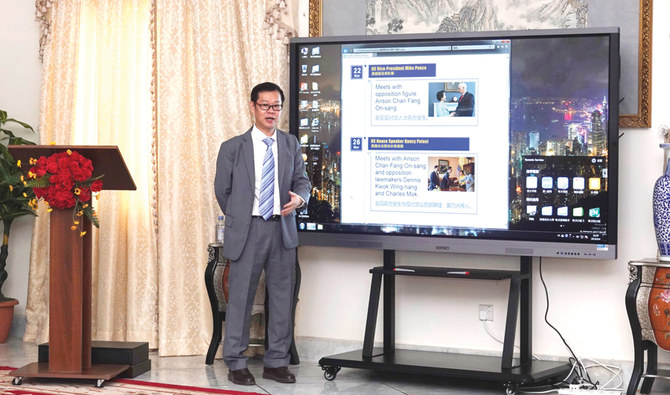
DiplomaticQuarter: Chinese consul general in Jeddah briefs Saudi press on Hong Kong

China’s CG Tan Banglin arranged a meeting with the Saudi press to explain the current situation in Hong Kong. (AN photo by Huda Bashatah)
Updated 05 September 2019
Follow

DiplomaticQuarter: Chinese consul general in Jeddah briefs Saudi press on Hong Kong

  • Banglin said that Hong Kong enjoys a high degree of autonomy and freedom, keeping the capitalist system and way of life unchanged

JEDDAH: China’s Consul General in Jeddah Tan Banglin arranged a meeting on Wednesday with the Saudi press to explain the current situation in Hong Kong.
“Hong Kong has witnessed a series of demonstrations and violent incidents that have caused widespread concern in the international community,” Banglin said.
He added that there are a lot of misconceptions about the situation in Hong Kong and that a broader understanding of it is necessary.
Journalists were briefed on the status of demonstrations that started months ago after the government’s proposed Fugitive Offenders and Mutual Legal Assistance in Criminal Matters Legislation bill.
They watched a video of comments made by politicians and international leaders on the events, as well as clips of riots and violent incidents that took place during demonstrations — including protesters storming parliament and shutting down the airport.
“The proposal by the Hong Kong government was an initiative by the government to deal with a certain criminal case and close a legal gap and was not requested by China. However, the Hong Kong government has accepted the public’s demands and withdrawn its bill.”
During the meeting, Banglin explained the Chinese government’s views on the protests and answered questions from the journalists.
He insisted that Hong Kong affairs are solely the internal affairs of China, and that its government will not allow any foreign interference.
“The Chinese government firmly supports the government of Hong Kong and with that support, its people will be able to develop their region under the leadership of Carrie Lam.
“Beijing has no will to change the system in Hong Kong, it wants it to develop and prosper further,” Banglin told Arab News.
He added that “since China resumed the exercise of sovereignty over Hong Kong on July 1, 1997, the ‘One Country, Two Systems’ approach has proven remarkably successful as the best system to maintain Hong Kong’s prosperity and stability.”
Banglin said that Hong Kong enjoys a high degree of autonomy and freedom, keeping the capitalist system and way of life unchanged.
“Hong Kong enjoys a reputation as the pearl of the Orient,” he said, “And we want it to keep glowing.”


Experimental farm in Al-Lith looks into future of Saudi Arabian agriculture

Updated 01 February 2026
Follow

Experimental farm in Al-Lith looks into future of Saudi Arabian agriculture

  • Research initiative reflects strategic transformation

JEDDAH: An experimental farm in Saudi Arabia’s Al-Lith Governorate is one of the research initiatives reflecting the strategic transformation taking place in the Kingdom’s agricultural sector.

The farm uses highly efficient, sustainable production models that combine scientific research with commercial application, contributing to strengthening the country’s food security system and the sustainability of water resources.

Located in the Ghumaiqa Center on an area of about 10 hectares, the cutting-edge farm is a testing platform for modern agricultural technologies that tackle the challenge of water scarcity.

The farm includes developed open fields and modern greenhouses, supported by smart irrigation encompassing drip and sprinkler irrigation alongside surface and subsurface technologies.

All the systems operate via smart controls that enable the monitoring of water consumption and ensure improved efficiency, thereby achieving a balance between agricultural production and water conservation.

The farm also uses treated and diluted low-salinity seawater.

It aims to diversify agricultural water sources, reduce reliance on freshwater, and open new horizons for agriculture in coastal and semi-arid environments.

The project represents a promising investment opportunity in the field of smart agriculture, enabling the development of commercially scalable production models, particularly for high-value vegetables and fruits, while reducing operational costs associated with water and energy, enhancing the economic feasibility of future agricultural projects.

In addition, the project contributes to transferring and localizing agricultural expertise, supporting local food supply chains, and creating an attractive environment for agricultural investment.

This aligns with Sustainable Development Goals and enhances the efficiency of the private sector in adopting innovative agricultural solutions.

Yahya bin Abdulrahman Al-Mahabi, the director of the Ministry of Environment, Water and Agriculture office in Al-Lith Governorate, told the Saudi Press Agency that the project represented the future of agriculture in the Kingdom.

He explained that the vision was based on investing in technology, enhancing the return on water per unit, and integrating scientific research with investment opportunities.

Al-Mahabi spoke of the experimental farm as a modern, scalable and replicable model applicable in several regions of the Kingdom, particularly in coastal environments.

Al-Mahabi highlighted the Ministry of Environment, Water and Agriculture’s commitment to supporting distinctive projects that contributed to achieving food security while developing rural areas and enhancing agricultural production efficiency, in line with the objectives of the Kingdom’s Vision 2030.