Israeli PM Benjamin Netanyahu makes controversial Hebron visit

1 / 4
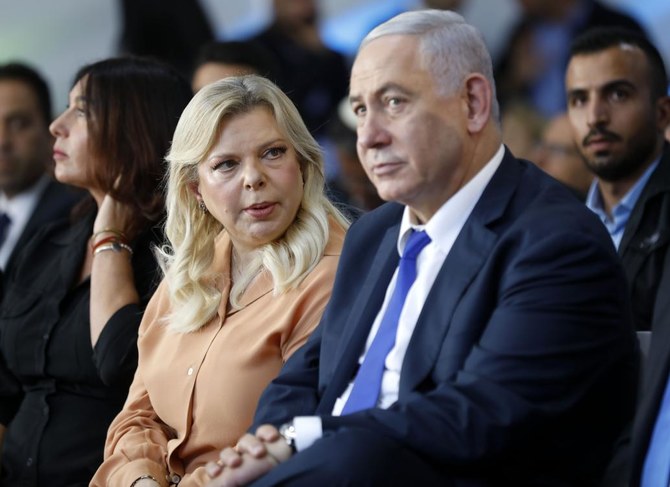
Israeli PM Benjamin Netanyahu delivers a speech during an event in the West Bank town of Hebron, on September 4, 2019. (AFP)
2 / 4
Netanyahu and his wife Sara undertook the controversial visit to the flashpoint West Bank city of Hebron, to commemorate the anniversary of the 1929 killing of Jews there. (AFP)
3 / 4
Palestinian activists from Youth Against Settlements set up a Palestinian flag overlooking the Israeli settlement of Tel Rumeida, the Ibrahimi Mosque (C), or the Tomb of the Patriarch, and the old city of the West Bank town of Hebron. (AFP)
4 / 4
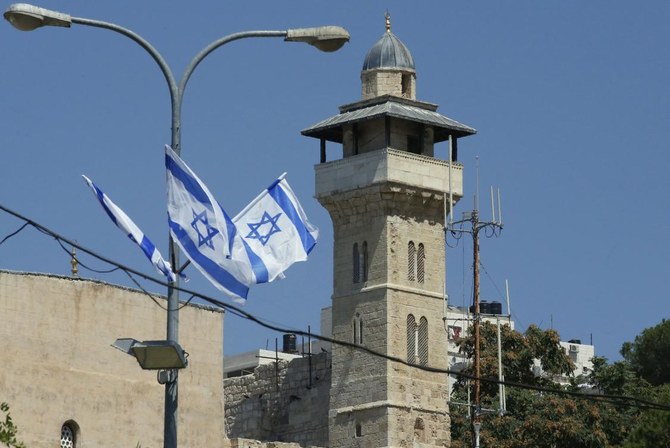
Israeli flags flutter near the Ibrahimi Mosque, in Hebron, a city holy to both Muslims and Jews. (AFP)
Updated 04 September 2019
Follow

Israeli PM Benjamin Netanyahu makes controversial Hebron visit

  • The visit was a rarity and came just ahead of Israel’s September 17 elections
  • 800 Jewish settlers live under hefty Israeli army security in the city, surrounded by around 200,000 Palestinians

HEBRON, Palestinian Territories: Israeli Prime Minister Benjamin Netanyahu undertook a controversial visit to the flashpoint West Bank city of Hebron Wednesday, to commemorate the anniversary of the 1929 killing of Jews there.
The visit was a rarity and came just ahead of Israel’s September 17 elections, with Netanyahu seeking to attract votes from the country’s nationalist right.
He attended a ceremony marking 90 years since 67 Jews were killed by Palestinian rioters in Hebron.
Today around 800 Jewish settlers live under hefty Israeli army security in the city, surrounded by around 200,000 Palestinians.
“We’re not seeking to disinherit anyone, but nobody will disinherit us,” Netanyahu said at the ceremony.
“We’re not strangers in Hebron. We’ll stay in it forever.”
The area was under heavy guard for the ceremony — which also attracted other Israeli politicians — with soldiers, explosives experts and sniffer dogs all present.
The Palestinian Authority condemned his visit — his first since 1998, according to Israeli media — as “provocative” and politically motivated.
“This is a purely colonialist, racist visit that Netanyahu is doing at the height of an election battle in an attempt to win votes from the right and the extreme right,” the PA’s foreign ministry said in a statement.
Palestinian activists from Youth Against Settlements raised a giant Palestinian flag in the area.
Palestinian youths threw stones and firecrackers at soldiers in the city center who responded with rubber bullets, witnesses said.
Israeli President Reuven Rivlin was among those attending and called for Israelis and Palestinians to learn to coexist.
“Hebron is not a barrier to peace,” he said.
“It is a test of our ability to live together, Jews and Arabs, to live decent lives side by side.”
After his address, Rivlin visited the site known to Muslims as the Ibrahimi Mosque and to Jews as the Cave of the Patriarchs — revered by both faiths — where he said a prayer, his office said.
Netanyahu is fighting for reelection in a campaign in which settler votes will be key in his efforts to build a right-wing coalition.
Hebron has seen regular unrest.
In 1994, Israeli settler Baruch Goldstein killed 29 Muslim worshippers there with an assault rifle before being beaten to death by survivors.
Israeli settlements are seen as illegal under international law and a major obstacle to peace, as they are built on land the Palestinians see as part of their future state.


Ceasefire with Kurdish-led force extended for another 15 days, Syrian army says

Updated 25 January 2026
Follow

Ceasefire with Kurdish-led force extended for another 15 days, Syrian army says

  • The defense ministry said the extension was in support of an operation by US forces to transfer accused Daesh militants to Iraq
  • The Kurdish-led Syrian Democratic Forces confirmed the ceasefire extension

RAQQA, Syria: Hours after the expiration of a four-day truce between the Syrian government and Kurdish-led fighters Saturday, Syria’s defense ministry announced the ceasefire had been extended by another 15 days.
The defense ministry said in a statement that the extension was in support of an operation by US forces to transfer accused Daesh militants who had been held in prisons in northeastern Syria to detention centers in Iraq.
The Kurdish-led Syrian Democratic Forces confirmed the ceasefire extension.
“Our forces affirm their commitment to the agreement and their dedication to respecting it, which contributes to de-escalation, the protection of civilians, and the creation of the necessary conditions for stability,” the group said in a statement.
Over the past three weeks, there have been intense clashes between government forces and the SDF, in which the SDF lost large parts of the area they once controlled.
Earlier in the day, the Kurdish-led force called on the international community to prevent any escalation.
The end of the truce came as government forces have been sending reinforcements to Syria’s northeast.
Syria’s interim government signed an agreement last March with the SDF for it to hand over territory and to eventually merge its fighters with government forces. In early January, a new round of talks failed to make progress over the merger, leading to renewed fighting between the two sides.
A new version of the accord was signed last weekend, and a four-day ceasefire was declared Tuesday. Part of the new deal is that SDF members will have to merge into the army and police forces as individuals.
The SDF said in a statement Saturday that military buildups and logistical movements by government forces have been observed, “clearly indicating an intent to escalate and push the region toward a new confrontation.” The SDF said it will continue to abide by the truce.
On Saturday, state TV said authorities on Saturday released 126 boys under the age of 18 who were held at the Al-Aqtan prison near the northern city of Raqqa that was taken by government forces Friday. The teenagers were taken to the city of Raqqa where they were handed over to their families, the TV station said.
The prison is also home to some of the 9,000 members of the Daesh group who are held in northeastern Syria. Most of them remain held in jails run by the SDF. Government forces have so far taken control of two prisons while the rest are still run by the SDF.
Earlier this week, the US military said that some 7,000 Daesh detainees will be transferred to detention centers in neighboring Iraq.
On Wednesday, the US military said that 150 prisoners have been taken to Iraq.