

US slaps sanctions on Iran’s ‘oil for terror’ shipping network

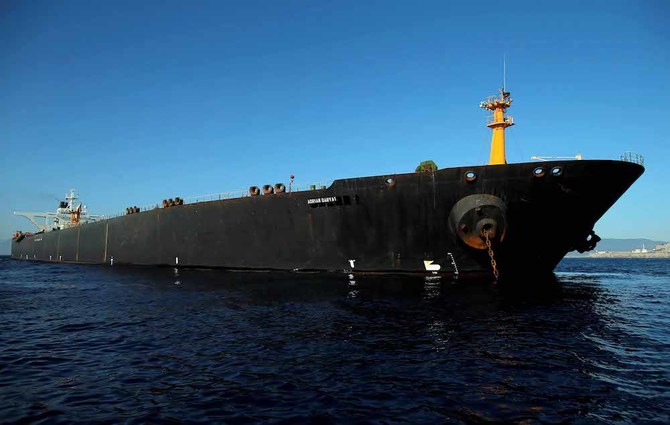
The US sanctioned a sprawling network of firms, ships and individuals allegedly directed by Iran’s Islamic Revolutionary Guard Corps that supplied Syria with oil worth tens of millions of dollars in a breach of US sanctions. (File/Reuters)
Updated 04 September 2019
Follow

US slaps sanctions on Iran’s ‘oil for terror’ shipping network

  • 16 entities, 10 people and 11 vessels were sanctioned
  • Quds Force backed both Assad and Hezbollah through crude oil shipments

LONDON: The United States on Wednesday sanctioned an “oil for terror” network of firms, ships and individuals allegedly directed by Iran’s Islamic Revolutionary Guard Corps that supplied Syria with oil worth hundreds of millions of dollars in breach of US sanctions.
The US action intensified a “maximum pressure” campaign aimed at driving to zero Iran’s oil exports, the country’s main source of income, and almost certainly will increase tensions that erupted when President Donald Trump withdrew last year from an international accord designed to stop Tehran from producing nuclear weapons.

Trump said Iran wants to negotiate and reach an agreement but Washington will not lift sanctions against Tehran
Iran has been gradually reducing its compliance with the 2015 agreement in a bid to pressure European countries to compensate it for the severe damage done to its economy by multiple rounds of US sanctions. Tehran was expected to announce further breaches sometime this month.
The 10 individuals blacklisted on Wednesday included Rostam Qasemi, a former Iranian oil minister, and his son, the US Treasury Department said in a statement.
Also hit were subsidiaries of an Indian company with an interest in the Adrian Darya, the Iranian tanker suspected of carrying oil for Syria that has been cruising the Mediterranean since its release from detention by British authorities off Gibraltar in July, it said.
The Treasury Department’s Office of Foreign Assets Control action froze any assets in the United States of the designated entities and generally prohibited US citizens or companies from doing business with them.
The department said that the Quds Force, the IRGC’s elite foreign paramilitary and espionage arm, and Hezbollah, the Iranian-backed Lebanese militia movement, profited financially by supplying Iranian oil and petroleum products, mostly to Syria, that this spring alone were worth more than $750 million.
“Treasury’s action against this sprawling petroleum network makes it explicitly clear that those purchasing Iranian oil are directly supporting Iran’s militants and terrorist arm, the IRGC-Quds Force,” Treasury Secretary Steven Mnuchin said in the statement.
Mnuchin said in announcing the designation that any companies or individuals conducting transactions with the shipping network could be exposed to punishing US financial measures.
Meanwhile, a senior US official on Wednesday ruled out issuing waivers to Iran sanctions to permit a French-proposed credit line, which Tehran says could bring it back to full compliance with the nuclear deal.
“We can’t make it any more clear that we are committed to this campaign of maximum pressure and we are not looking to grant any exceptions or waivers,” Brian Hook, the State Department coordinator on Iran, told reporters.

He added, however, that he has not yet seen a “concrete” French proposal and could therefore not comment on the idea.
French President Emmanuel Macron has been seeking to ease soaring tensions by bringing some economic relief to Iran and last month appeared to draw President Donald Trump’s interest when Macron said he hoped to arrange a summit between the US leader and his counterpart Hassan Rouhani.
Iran has been threatening to take new actions to curb its compliance with a 2015 denuclearization deal, from which Trump withdrew last year as he reimposed punishing sanctions.
Iran is upset that it did not reap greater dividends from compliance but said it would be satisfied if it receives $15 billion in credit, which it would pay back through future oil sales.
Hook was speaking to reporters in Washington to discuss the latest volley of US sanctions on Iran.
Hook noted that the US also imposed other sanctions on Iran on Friday and Tuesday and warned, “There will be more sanctions coming.”
Hook also announced that the Trump administration is offering “up to $15 million for information that can help disrupt the financial apparatus of Iran’s Islamic Revolutionary Guards Corps,” including on the revenue sources of the military unit, illicit oil-for-money schemes; entities or individuals that assist in evading US or international sanctions; financial institutions working with the IRGC and other measures related to its financial mechanisms.
US officials said that the Quds Force used the network to hide its involvement in the oil sales to Syrian President Bashar Assad’s government and other unidentified “illicit actors” and relied heavily on Hezbollah officials and front companies to broker the contracts.
The Quds Force and Hezbollah have been major backers of Damascus in the civil war that erupted in 2011 against decades of Assad family rule. The Quds Force and Hezbollah are on the US list of foreign terrorist organizations.
“This vast oil-for-terror shipping network demonstrates how economically reliant Tehran is on the IRGC-QF and Hezbollah as financial lifelines,” said Sigal Mandaker, the senior Treasury official who oversees sanctions.


Kuwait airport targeted as Iran presses on with attacks on Gulf states

Updated 5 sec ago
Follow

Kuwait airport targeted as Iran presses on with attacks on Gulf states

KUWAIT CITY/DUBAI: Gulf nations on Sunday reported new missile and drone attacks, while Iran vowed to press on with strikes against neighboring countries as the war entered its second week.
Kuwait’s defense ministry and Kuwait's Public Authority for Civil Aviation said that the country’s forces were “responding to a wave of hostile drones” that penetrated the country’s airspace.
“The fuel tanks of Kuwait International Airport were attacked by drones in a direct targeting of vital infrastructure,” the defense ministry spokesman said, according to a post by the Kuwaiti military on X.

Saudi Arabia's Ministry of Defense was also reporting a wave of drone attacks, saying 21 unmanned aerial vehicles were intercepted and destroyed in the last four hours.

Major General Turki Al-Maliki, spokesman for the Defense Ministry, said in separate posts on X that 13 drones were intercepted and destroyed east of the national capital, Riyadh city, while eight drones were shot down just after entering Saudi air space.

Before midnight on Saturday, loud explosions were heard in Dubai, the Qatari capital Doha and Bahrain’s Manama, with attacks reported in the UAE, Saudi Arabia, Qatar and Kuwait, where the national oil company announced a “precautionary” cut to production.
The attacks came despite Iran’s president earlier apologizing to Gulf countries for earlier strikes. He had said they would no longer be targeted unless strikes were launched from their territory first.
Hours later, Iran said it would continue conducting strikes on sites in Gulf countries which were “at the disposal of the enemy.”
UAE President Mohammed bin Zayed Al Nahyan said in a rare televised address that the Emirates were in “a period of war” and “will emerge stronger” from it.
Dubai authorities said Saturday evening one person had been killed by debris from an “aerial interception,” adding they were a Pakistani national.

Dubai airport closed, reopens 

Earlier in the day, Dubai closed its main airport — the world’s busiest for international traffic — after authorities said an unidentified object was intercepted nearby.
The government said there had been “a minor incident resulting from the fall of debris after an interception,” without directly mentioning the airport. It said there were no injuries.
The Flightradar24 tracking website earlier showed planes circling above the airport in an apparent holding pattern.
In a statement since deleted from X, Emirates, the largest airline in the Middle East, had announced it was suspending all flights to and from Dubai until further notice, but later said it had resumed operations.
The UAE, a US ally and home to American military installations, has been the most heavily targeted nation in the Gulf during the war.
Earlier in the day, the Ministry of Defense said that of the 16 ballistic missiles fired at the country on Saturday, all but one had been intercepted, with that missile falling into the sea.
Of the 121 drones detected, 119 were brought down, while two fell within Emirati territory.
The barrage brings the number of ballistic missiles detected by the UAE since the start of the war last Saturday to 221, the defense ministry said, with the number of drones surpassing 1,300.
Flights from Dubai’s main airport had partially resumed on Monday despite daily drone attacks targeting sites in the UAE.
Last Saturday, four employees were injured and an airport terminal damaged as the war broke out following US-Israeli strikes on Iran.
Iranian attacks have also hit Abu Dhabi airport, the upmarket Palm Jumeirah development and the Burj Al Arab luxury hotel over the past week, while drone debris caused a fire at the US consulate in Dubai on Tuesday.

Relentless air threats

Elsewhere in the Gulf on Saturday, Qatar’s defense ministry said its military had intercepted two missile attacks targeting the country.

Kuwait said Saturday night it had intercepted seven drones since dawn, with the attacks resulting “only in material damage from falling debris.”
And Bahrain said it has intercepted and 92 missiles and 151 drones since the start of the “brutal Iranian aggression.”
AFP journalists heard an explosion Saturday night in Manama, Bahrain’s capital, as authorities said one person was injured after rocket shrapnel fell in a public street.
In Saudi Arabia, the defense ministry said it had destroyed three ballistic missiles heading toward Prince Sultan Air Base, which hosts American troops, as well as 17 drones over the Shaybah oil field in the southeast.
Kuwait also reported intercepting a drone, while the country’s national oil company announced a “precautionary” cut to its production of crude due to Iranian attacks and threats to the Strait of Hormuz, a key transit point for Gulf hydrocarbons.
Further north, Jordan accused Iran of directly targeting sites in the kingdom, saying Tehran had fired 119 missiles and drones in the past week.
“These missiles and drones were targeting vital installations inside Jordan and were not passing through our territories,” said military spokesman Brig. Gen. Mustafa Hayari.

(With AFP)