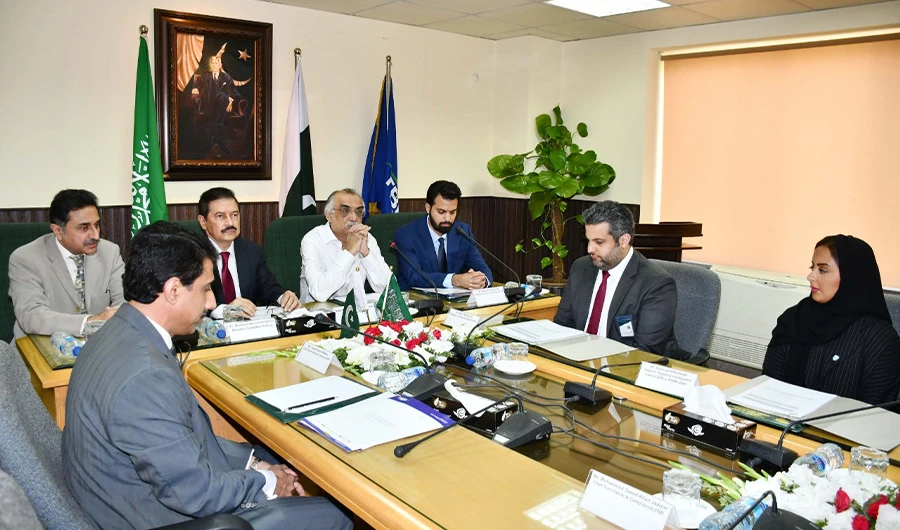
ISLAMABAD: A five-member delegation of the Saudi Customs Authority visited the Federal Board of Revenue (FBR) in Islamabad on Tuesday to discuss the importance of customs cooperation between two countries, the FBR said in a statement released late yesterday.
The Saudi delegation was headed by Muhammad AlNuaim, Deputy Governor of Security Affairs while FBR Chairman Shabbar Raza Zaidi led the Pakistani side in the talks.
Both groups shared their experiences in the law enforcement domain and further explored avenues of future cooperation for the “exchange of information on a real-time basis,” in addition to discussing measures for the exchange of “intelligence-based information to effectively control illicit flow of currency.”
“Profiling of advance passenger information. Cooperation between Saudi Customs and Pakistani Customs in order to arrest the senders and recipients of drugs and [matters related] exchange of post seizure and arrest investigations [were also in the meeting],” the statement said.
It was mutually agreed that “no country can cope with these cross border challenges without ensuring international cooperation,” in addition to the fact that there was a dire need for both countries to support each other through international forums, customs cooperation and Mutual Assistance Agreements.
“AlNuaim said that the Saudi government gives great value to its brotherly relations with the government of Pakistan,” the statement said, adding that the Kingdom had recently introduced new monetary limits on currencies which so far are not well-known to visitors from Pakistan, urging for the launch of a public awareness campaign to share this information.
Pakistani representatives, for their part, informed the visiting delegation that limiting currency smuggling was one of the prime priorities of the current government.
“Declaration of currency has now been made mandatory and the FBR has taken various legal and administrative actions to improve interdictory regime against currency smuggling,” the statement said.
Saudi delegation discusses customs cooperation with Pakistan
- Pakistan seeks to control illicit flow of currency in an effective manner
- The two sides emphasized exchange of information on real-time basis
Pakistan says CPEC has helped bridge cultural and language barriers with China
- Ataullah Tarar suggests Pakistan-China digital platform to counter ‘disinformation’ around CPEC
- People-to-people ties have remained limited between the two states despite strong official relations
ISLAMABAD: Federal Minister for Information and Broadcasting Ataullah Tarar said on Wednesday the China-Pakistan Economic Corridor (CPEC) has brought about a “cultural change,” helping break barriers of language and bringing the two countries closer together.
Pakistan and China have longstanding strategic relations, though much of their interactions have traditionally occurred at the government-to-government level through diplomatic, strategic and economic engagements. People-to-people ties between them have mostly remained limited, though the Pakistani minister said there was a gradual shift in the trend in the wake of the multibillion-dollar economic, infrastructure development and regional connectivity initiative.
Launched in 2015, CPEC includes investments in energy, transport, and industrial zones, and has since become a cornerstone of bilateral ties and Pakistan’s long-term development strategy.
“CPEC in Pakistan has broken a lot of barriers. It has broken the barrier of language, and it has broken the barriers of division. It has brought harmony,” Tarar said while addressing a ceremony organized by the Pakistan-China Institute, a local think tank.
“This corridor brought about a cultural change where we had investments coming in, where we had infrastructure being built, where we had industry being built, where we had airports and seaports being developed.”
He said it was “heartening” to see cultural change in Pakistan, such as a Chinese citizen speaking fluent Urdu or a Pakistani citizen speaking Mandarin.
Tarar said the cultural shift had become part of Pakistan’s ethos as the two countries move forward, describing Chinese President Xi Jinping’s 2015 visit as a turning point in reviving the economy.
He also maintained CPEC was targeted by a disinformation campaign, suggesting a digital media platform between Pakistan and China to counter the problem.
“I would suggest that maybe the Pakistan-China Institute can come up with a digital media platform to call out fake news and to label fake news circulating around CPEC,” he said, adding the government would fully support the endeavor.
“I think that will go a long way in not only strengthening the media cooperation but also in getting rid of misinformation and stating the correct facts in a very timely manner,” he added.
Tarar said the initiative will help promote a positive narrative around CPEC 2.0, referring to the next phase of the initiative that aims to focus on industrial development in Pakistan.