

Daesh mines turn Baiji farms into killing fields

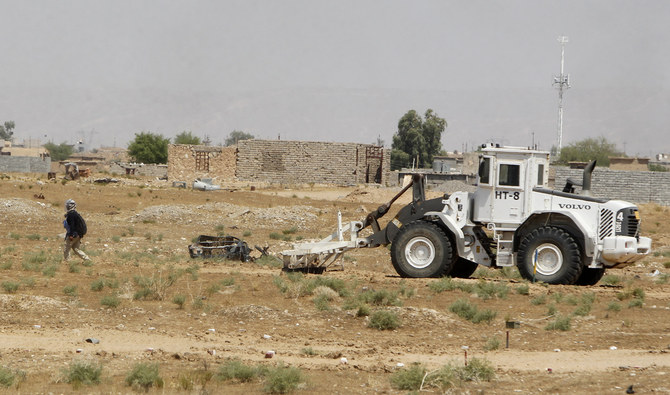
Baiji farmers complain of mines left behind by Daesh. (AFP)
Updated 03 September 2019
Follow

Daesh mines turn Baiji farms into killing fields

  • The mines have discouraged scores of families from returning
  • 25 IEDs are uncovered daily

BAIJI, IRAQ: Farmers and herders in Iraq’s Baiji say mines left by Daesh turned their beloved orchards into killing fields.

The improvised explosive devices (IEDs), planted by militants trying to fend off Iraqi troops in 2015, have also discouraged scores of families from returning to their battered farming towns around Baiji, in the north of the country.

“Daesh’s ghosts are still here. Their crimes are still there, under the earth,” said local official Abu Bashir. His thin face contorted into a grimace as he recalled his loss to those “ghosts” — both his sons.

Lahib, 21, has also been touched by Daesh’s deadly legacy.

“We got our houses back but the remnants of war are still there. Daesh left us with booby-trapped homes,” he said. “One of these homes blew up on my uncle. I saw it with my own eyes.”

The loss pushed him to join Halo Trust, a nonprofit group clearing unexploded ordnance in Baiji since June as part of the UN Mine Action Service (UNMAS). In temperatures reaching 50 degrees Celsius, Halo Trust mine searchers scanned a field near Baiji for a Daesh specialty: Plastic jerrycans packed with explosives and rigged to pressure plates.

Mine searchers used excavators to map out the bombs, then mechanically defused them so Iraqi troops could take the components away.

In Baiji alone, 340 explosive hazards were removed since UNMAS operations began, with up to 25 IEDs uncovered daily.

UNMAS says the scope and complexity of IED contamination in Daesh-controlled areas is “unprecedented,” with tripwires painted to blend in with surroundings
and even Iraqi currency turned into bombs. 

The fear of undiscovered threats has kept around 100 families away from the area, said Abu Mohammad, another local official.

Israel becomes first country to formally recognize Somaliland as independent state

Israel on Friday formally recognised Somaliland as an “independent and sovereign state.”
Updated 36 min 17 sec ago
Follow

Israel becomes first country to formally recognize Somaliland as independent state

  • Netanyahu said the declaration “is in the spirit of the Abraham Accords, signed at the initiative of President ‌Trump”
  • Somalia, Egypt, Turkey and Djibouti condemn Israel’s recognition of Somaliland, Egypt says

JERUSALEM: Israel became the first country to formally recognize the self-declared Republic of Somaliland as an independent and sovereign state on Friday — a decision that could reshape ​regional dynamics and test Somalia’s longstanding opposition to its secession.
Prime Minister Benjamin Netanyahu said Israel would seek immediate cooperation with Somaliland in agriculture, health, technology and the economy. In a statement he congratulated Somaliland’s president, Abdirahman Mohamed Abdullahi, praised his leadership and invited him to visit Israel.
Netanyahu said the declaration “is in the spirit of the Abraham Accords, signed at the initiative of President ‌Trump.”
The 2020 accords ‌were brokered by Trump’s first administration and ‌included ⁠Israel ​formalising ‌diplomatic relations with the United Arab Emirates and Bahrain, with other countries joining later.
Netanyahu, Foreign Minister Gideon Saar and Somaliland’s president signed a joint declaration of mutual recognition, the Israeli statement said.
Abdullahi said in a statement that Somaliland would join the Abraham Accords, calling it a step toward regional and global peace. He said Somaliland was committed to ⁠building partnerships, boosting mutual prosperity and promoting stability across the Middle East and Africa.
Egypt ‌meanwhile said Foreign Minister Badr Abdelatty held phone ‍calls on Friday with his ‍counterparts from Somalia, Turkiye and Djibouti to discuss what they ‍described as dangerous developments in the Horn of Africa following Israel’s announcement.
The ministers condemned Israel’s recognition of Somaliland, reaffirmed their full support for Somalia’s unity and territorial integrity, and warned that recognizing breakaway regions poses a threat to ​international peace and security, Egypt’s foreign ministry said.
Somaliland has enjoyed effective autonomy — and relative peace and stability — since 1991 ⁠when Somalia descended into civil war, but the breakaway region has failed to receive recognition from any other country.
Over the years, Somalia has rallied international actors against any country recognizing Somaliland.
The former British protectorate hopes that recognition by Israel will encourage other nations to follow suit, increasing its diplomatic heft and access to international markets.
In March, Somalia and its breakaway region of Somaliland also denied receiving any proposal from the United States or Israel to resettle Palestinians from Gaza, with Mogadishu saying it categorically rejected any such move.