

Centuries-old statues discovered at ancient Hindu temple in Karachi

1 / 6
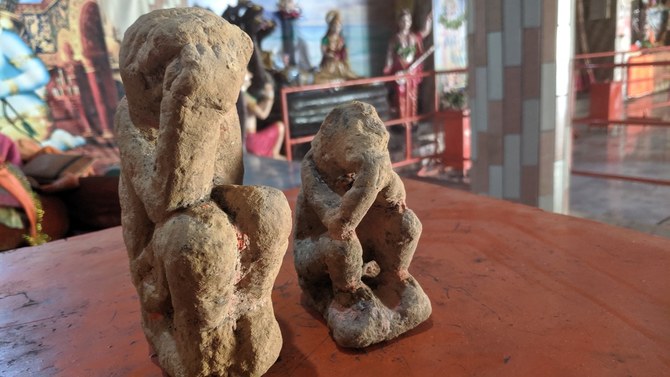
Newly discovered statues of the Hindu god Vanar at the Panchmukhi Hanuman Mandir, situated in the Solider Bazar area of Karachi. Photograph taken on Sept. 3, 2019. (AN Photo)
2 / 6
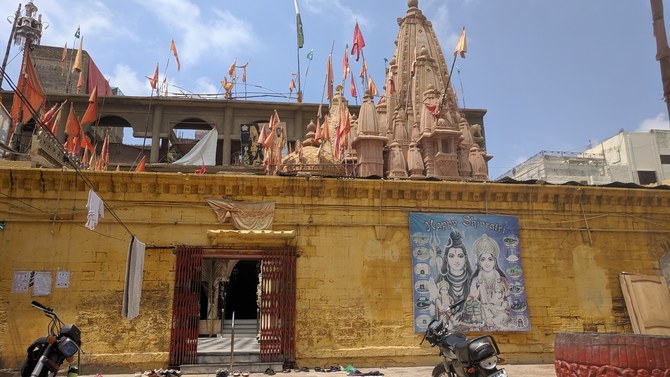
The Panchmukhi Hanuman Mandir, situated in the Solider Bazar area of Karachi, Pakistan is being renovated this year following a tough legal battle. Photograph taken on Sept. 3, 2019. (AN Photo)
3 / 6
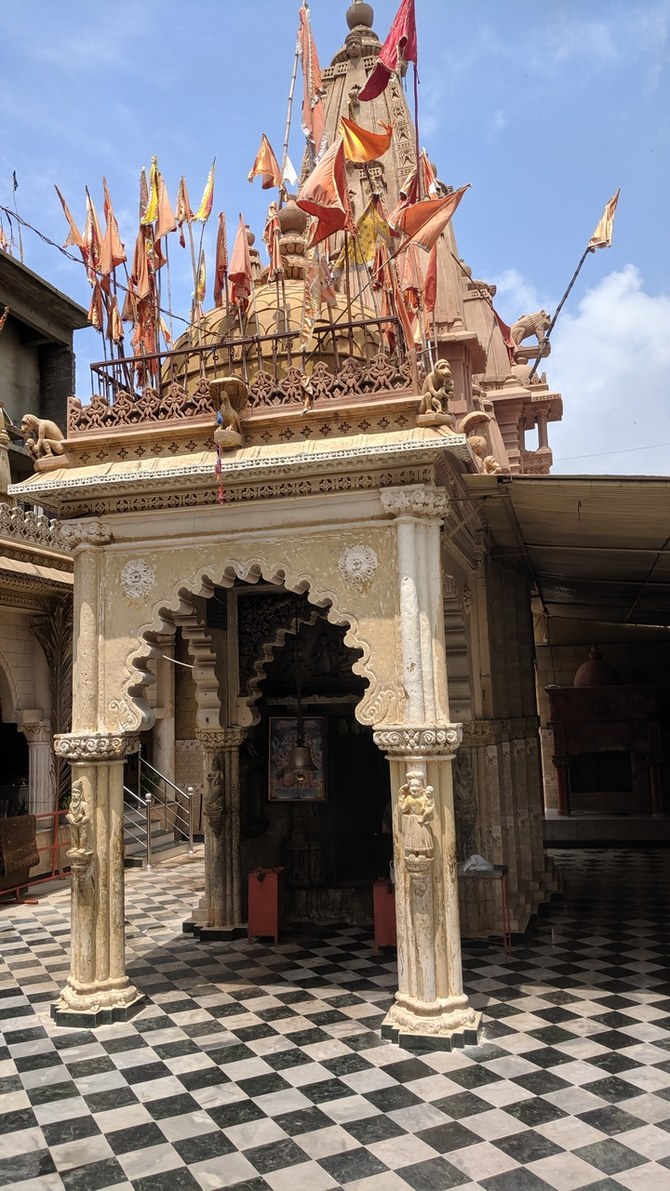
The Panchmukhi Hanuman Mandir, situated in the Solider Bazar area of Karachi, Pakistan, is being renovated this year following a tough legal battle. Photograph taken on Sept. 3, 2019. (AN Photo)
4 / 6
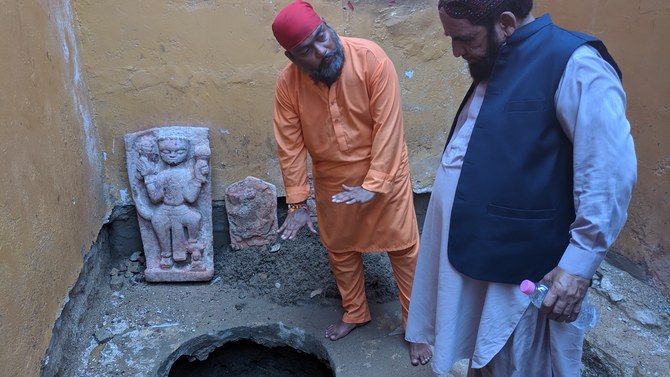
The caretaker of Karachi city’s Panchmukhi Hanuman Mandir, Shri Ram Nath Maharaj (R), briefs the director of the heritage department for Sindh province, Muhammad Shah Bukhari, who examines newly discovered statues. Photograph taken on Sept. 3, 2019. (AN Photo)
5 / 6
The caretaker of Karachi city’s Panchmukhi Hanuman Mandir, Shri Ram Nath Maharaj (R), briefs the director of the heritage department for Sindh province, Muhammad Shah Bukhari, who examines newly discovered statues. Photograph taken on Sept. 3, 2019. (AN Photo)
6 / 6
Expansion work is ongoing at the Panchmukhi Hanuman Mandir in the Solider Bazar area of Karachi, Pakistan. Photograph taken on Sept. 3, 2019. (AN Photo)
Updated 03 September 2019
Follow

Centuries-old statues discovered at ancient Hindu temple in Karachi

  • Panchmukhi Hanuman Mandir in the port city’s Soldier Bazar area is said to be at least 1,500 years old
  • Statues of major Hindu deities were discovered during expansion work at the temple last week

KARACHI: Last week, during expansion work at an ancient Hindu temple in Pakistan’s port city of Karachi, caretakers discovered a rare treasure: up to three-hundred-year-old statues of the Hindu deities Hanuman, Ganesh Bhagwan, Shri Mata, Vanar and Shiva Linga.
A reflection of the diverse history and culture of the South Asian country, the Panchmukhi Hanuman Mandir in Karachi’s Soldier Bazar area is said to be at least 1,500 years old and was declared a national heritage under the Sindh Cultural Heritage (Preservation) Act 1994. The temple holds special significance as the only shrine in the world that houses what Hindus believe to be a divinely-revealed statue of Hanuman that is not man-made.
Expansion works at the 2,600-square-feet property first began in 2006 but resumed this year, leading to the discovery of the new statues.
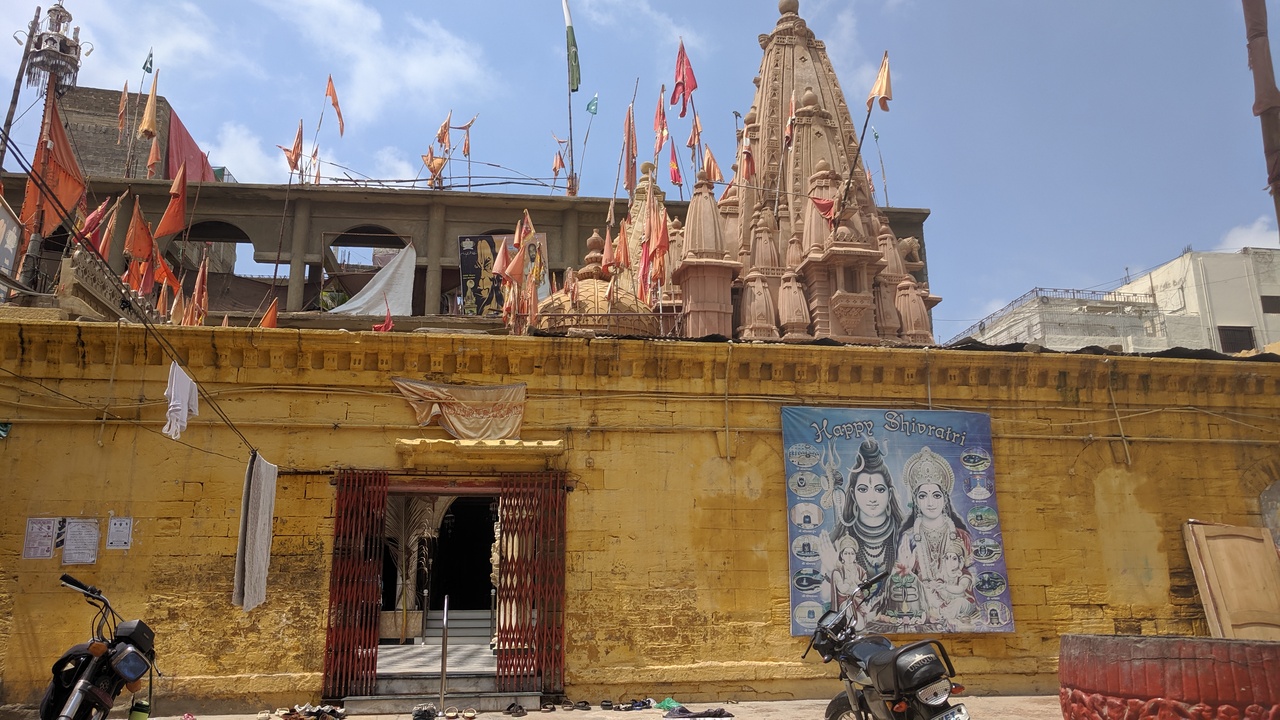


The Panchmukhi Hanuman Mandir, situated in the Solider Bazar area of Karachi, Pakistan is being renovated this year following a tough legal battle. Photograph taken on Sept. 3, 2019. (AN Photo)

“Our team will determine the exact age of the artifacts; however the usage of gizri stones tells us that they are at least 300 years old,” Sindh Director Heritage Muhammad Shah Bukhari told Arab News. “Archaeologists can determine the accurate age of the statues by studying the stone, its size and other specifications.”
Shri Ram Nath Maharaj, the caretaker of the temple, said he discovered the statues while digging the land adjacent to the temple during expansion.
“Experts can better tell us about the age but these statues can be as old as the temple itself,” Nath said.
Minority communities in Pakistan are often targeted by right-wing groups and successive governments have in the past been reluctant to embrace the country’s non-Muslim heritage.
But recent attempts to improve Pakistan’s image and open the country to tourism and pilgrimages have included overtures to minority communities by the past government of Prime Minister Nawaz Sharif and the new government of cricketer-turned-politician Imran Khan.
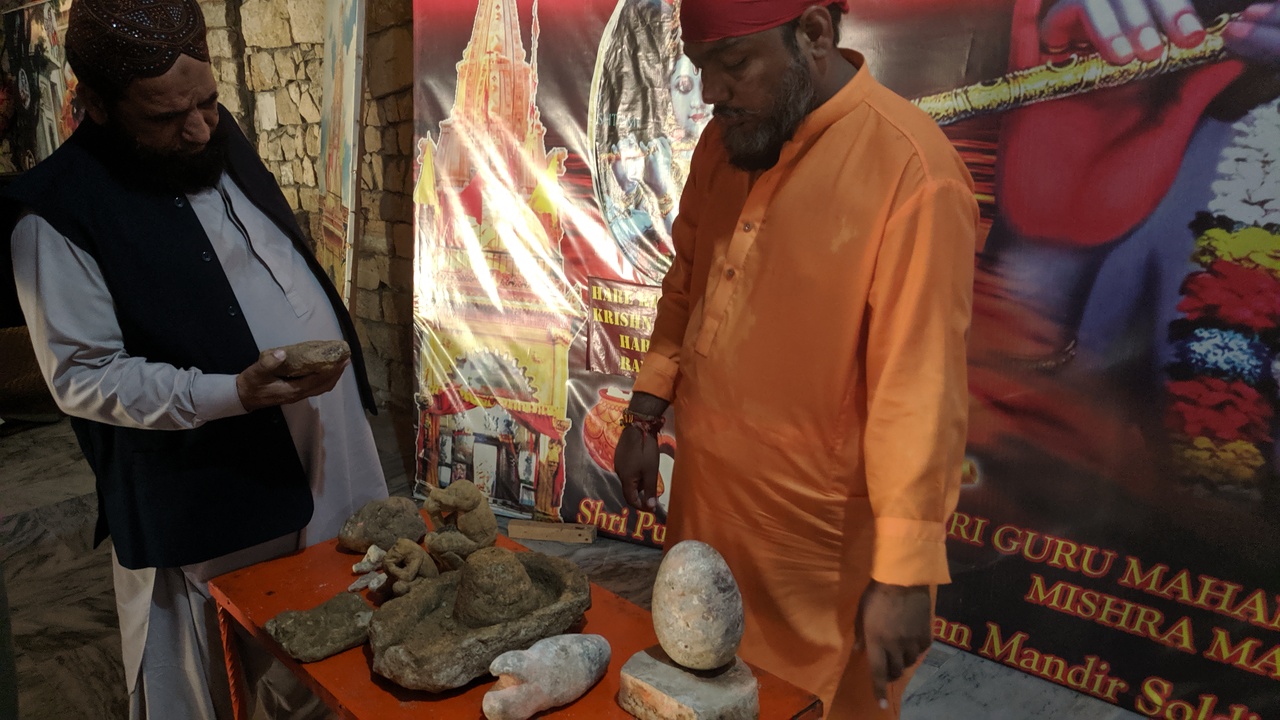


The caretaker of Karachi city’s Panchmukhi Hanuman Mandir, Shri Ram Nath Maharaj (R), briefs the director of the heritage department for Sindh province, Muhammad Shah Bukhari, who examines newly discovered statues. Photograph taken on Sept. 3, 2019. (AN Photo)

In January 2017, Sharif inaugurated the restoration of Hindu temples at Katas Raj in Punjab province. In November that year, Khan inaugurated the remains of a 1,700-year-old sleeping Buddha image in Haripur in Khyber Pakhtunkhwa, a northwestern province his political party had ruled under the previous government. The region was once the center of Buddhist civilization that took root under the Mauryan king Ashoka 2,300 years ago.
Nath said the Sindh heritage department would help in the proper restoration and perseveration of the recovered statues and hoped they would complete their work before September 29 when the annual, nine-night Navratri Hindu festival kicks off at the temple, marked with celebrations involving prayer, music and dance among men and women.
The festival is famous for being high-spirited and Christians and Muslims are also known to take part.
“The people are eager to see their gods,” Nath said. “Navratri will be a great occasion to behold them.”


Pakistan party calls Sindh resolution against new provinces ‘unconstitutional’

Updated 5 sec ago
Follow

Pakistan party calls Sindh resolution against new provinces ‘unconstitutional’

  • The development follows calls to separate Karachi from Sindh amid governance concerns intensified by a deadly mall fire last month
  • Muttahida Qaumi Movement-Pakistan calls for a referendum in urban areas of Sindh for the establishment of a new administrative unit

ISLAMABAD: The Muttahida Qaumi Movement-Pakistan (MQM-P) political party on Sunday criticized the Sindh provincial government for adopting a resolution in the provincial assembly against the creation of new provinces, describing it as “illegal, unconstitutional.”

The resolution was adopted on Saturday after fresh demands by the MQM-P and other voices to grant Karachi a provincial or federal status following governance challenges highlighted by a deadly mall fire earlier this year that killed 80 people.

Karachi, Pakistan’s largest city that is home to more than 20 million, is the country’s main commercial hub and contributes a significant share to the national economy.

Speaking at a press conference, MQM-P’s Khalid Maqbool Siddiqui said the Constitution of Pakistan provided procedure for establishing new provinces, but a province had “carried itself as if it were a separate country,” referring to Saturday’s resolution.

“Anything in contrast with the constitution cannot be adopted. This is illegal, unconstitutional, undemocratic,” he said, calling for a referendum in urban areas of Sindh for the establishment of a new administrative unit in the region.

Sindh Chief Minister Syed Murad Ali Shah had tabled the resolution in the assembly on Saturday, condemning what he described as “divisive statements” about breaking up Sindh or detaching Karachi.

“The province that played a foundational role in the creation of Pakistan cannot allow the fragmentation of its own historic homeland,” Shah told lawmakers, citing Article 239 of Pakistan’s 1973 Constitution, which requires the consent of not less than two-thirds of a provincial assembly to alter provincial boundaries.

“If any such move is attempted, it is this Assembly — by a two-thirds majority — that will decide,” he said.

The resolution reaffirmed that Karachi would “forever remain” an integral part of Sindh and directed the provincial government to forward the motion to the president, prime minister and parliamentary leadership for record.

Calls to alter Karachi’s status have periodically surfaced amid longstanding complaints over governance, infrastructure and administrative control in the megacity, though no formal proposal to redraw provincial boundaries has been introduced at the federal level.

Taha Ahmed Khan, a senior MQM-P member, acknowledged that his party had “presented its demand openly on television channels with clear and logical arguments” to separate Karachi from Sindh.

“It is a purely constitutional debate,” he told Arab News on Saturday. “We are aware that the Pakistan Peoples Party, which rules the province, holds a two-thirds majority and that a new province cannot be created at this stage. But that does not mean new provinces can never be formed.”