In bid to bolster tourism, Pakistan to host World Tourism Forum in May 2020

1 / 2
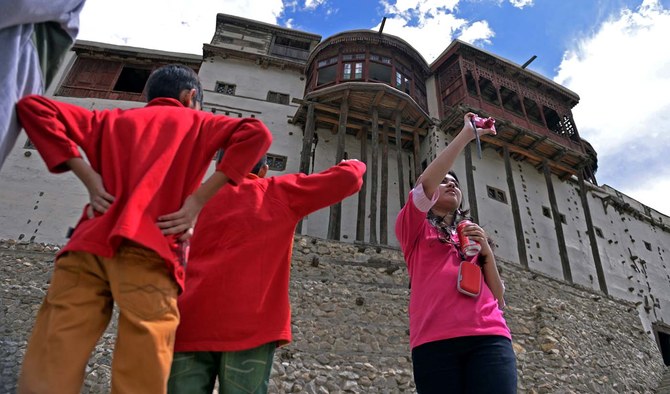
Tourists visit Baltit fort in Karimabad, a town in the northern Hunza valley in Pakistan, on Aug. 3, 2014. (AFP/File)
2 / 2
Tourists gather on the roof of Baltit fort in Karimabad, a town in the northern Hunza valley, in Pakistan, on Aug. 3, 2014. (AFP/File)
Updated 03 September 2019
Follow

In bid to bolster tourism, Pakistan to host World Tourism Forum in May 2020

  • Government has set up endowment fund with seed money of Rs1 billion to promote historic sites and resorts
  • World Tourism Forum takes place four times a year in global centers to bring together tourism leaders and industry representatives

ISLAMABAD: Pakistan is all set to host the next edition of the World Tourism Forum in May next year in Islamabad, the Pakistan Tourism Development Corporation said on Tuesday, in a bid to revive tourism that was devastated by militant violence in the fallout from the 9/11 attacks in the United States.
Potentially restarting tourism has been one of the most talked-about parts of Prime Minister Imran Khan’s push to create an Islamic welfare state in Pakistan. Earlier this year, Khan’s government announced it was planning to ease visa restrictions for visitors from 55 countries, including most European nations.
“Organizers of the World Tourism Forum are expected to share a broad plan for organizing the event in Islamabad with us by the end of this month,” Syed Intikhab Alam, managing director of the Pakistan Tourism Development Corporation (PTDC), told Arab News in an interview on Tuesday.
“We hope to organize the forum in May next year which will be attended by foreign delegates and professionals,” he said, adding: “We are doing our best to pitch Pakistan as one of the best tourism places on earth to foreign tourists.”
The World Tourism Forum takes place four times a year in global centers around the world to bring together world tourism leaders and industry representatives. The event pays particular attention to the relationship between local and global tourism trends, as well as strategies for more sustainable tourism growth.
A World Tourism Forum delegation headed by the president of its executive board, Bulut Bagci, called on PM Khan last week to discuss ways to promote tourism opportunities in Pakistan.
Alam said the government had created an endowment fund with seed money of Rs1 billion ($6.4 million) to execute marketing plans to promote unexplored historic sites and resorts for local and foreign travelers.
“We are getting extremely positive feedback from foreign tourists due to our online visa facility and peace across the country,” he said, adding that around 2.5 million tourists had visited Pakistan last year and the corporation’s goal was to double that number to 5 million in the next three years.
Pakistan was last a prominent tourist destination in the 1970s when the “hippie trail” brought Western travelers through the apricot and walnut orchards of the Swat Valley and Kashmir on their way to India and Nepal.
Since then, deteriorating security and the imposition of a harsh interpretation of Islamic laws, particularly in the country’s northwestern belt, have chipped away at the number of visitors. But law and order have improved dramatically in recent years, with militant attacks down sharply in the mainly Muslim country of 208 million people.
Tourism currently contributes less than one percent to Pakistan’s GDP.
“We are struggling to increase the contribution of travel and tourism to our GDP and for that we are trying to explore all avenues, including religious tourism for Sikhs, Christians and Buddhists,” Alam said.


Pakistan president meets UAE counterpart, explores trade, investment opportunities

Updated 27 January 2026
Follow

Pakistan president meets UAE counterpart, explores trade, investment opportunities

  • Asif Ali Zardari is in UAE on four-day visit to strengthen bilateral ties, review bilateral cooperation
  • Both sides discuss regional, international developments, reaffirm commitment to promote peace

ISLAMABAD: President Asif Ali Zardari met his UAE counterpart Sheikh Mohammed bin Zayed Al-Nahyan in Abu Dhabi on Tuesday during which both sides explored new opportunities in trade, investment, energy and other sectors, Zardari's office said. 

Zardari arrived in Abu Dhabi on Monday evening with a high-level delegation on a four-day official visit to the UAE to review trade, economic and security cooperation. 

"The leaders discussed ways to further deepen the longstanding and brotherly relations between Pakistan and the UAE," a statement from Zardari's office said about his meeting with the UAE president. 

"They reviewed the full spectrum of bilateral cooperation and explored new opportunities in trade, investment, energy, infrastructure, technology, and people-to-people exchanges, highlighting the significant potential for expanding economic and strategic partnership.

Zardari highlighted the significance of Al-Nayhan's visit to Pakistan last month, the statement said, expressing appreciation for the UAE's continued support for strengthening bilateral ties.

It said both sides also exchanged views on a range of regional and international developments, reaffirming their commitment to promoting peace, stability and sustainable development.

The meeting was also attended by Pakistan's First Lady Aseefa Bhutto-Zardari, the Pakistani president's son Bilawal Bhutto-Zardari, who is also the chairman of the Pakistan Peoples Party, Interior Minister Mohsin Naqvi and Pakistan's ambassador to the UAE. 

ZARDARI MEETS AD PORTS CEO

Zardari earlier met AD Ports Group CEO Captain Mohamed Juma Al-Shamisi to discuss the group's investment initiatives in Karachi. 

"Both sides agreed that the expansion and modernization of port infrastructure would strengthen trade flows and support Pakistan’s broader economic development and country’s seaborne trade," the President's Secretariat said in a statement.

It added that Zardari described the AD Ports Group's long-term investment and expanding role in Pakistan's maritime and logistics sector as a key pillar of Pakistan–UAE economic cooperation.

Pakistan and the UAE maintain close political and economic relations, with Abu Dhabi playing a pivotal role in supporting Islamabad during periods of financial stress through deposits, oil facilities and investment commitments. 

The UAE is Pakistan's third-largest trading partner, after China and the United States, and a key destination for Pakistani exports, particularly food, textiles and construction services.

The Gulf state is also home to more than 1.5 million Pakistani expatriates, one of the largest overseas Pakistani communities in the world, who contribute billions of dollars annually in remittances, a crucial source of foreign exchange for Pakistan’s economy.

Beyond trade and labor ties, Pakistan and the UAE have steadily expanded defense and security cooperation over the years, including military training, joint exercises and collaboration in counter-terrorism and regional security matters.