

Hong Kong leader insists she will stay on

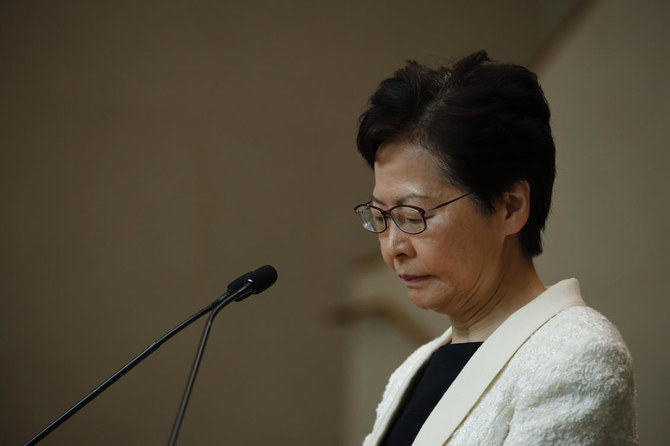
Lam said she had not contemplated discussing her resignation with the Chinese government. (AP)
Updated 03 September 2019
Follow

Hong Kong leader insists she will stay on

  • Reuters released an audio recording of Chief Executive Carrie Lam telling business leaders last week that she wanted to step down
  • On the first day of the university term on Monday, some students began a two-week boycott in an attempt to pile pressure on the city’s leaders

HONG KONG: Hong Kong’s embattled leader insisted Tuesday she had no intention of stepping down after an audio recording emerged of her saying she wanted to quit over three months of unrest in the southern Chinese city.

Hong Kong has endured dozens of sometimes violent pro-democracy protests triggered by opposition to Chief Executive Carrie Lam’s bid to push through a law allowing extraditions to mainland China. The protests have evolved into a wider democracy campaign involving clashes between protesters and police, in the biggest challenge to China’s rule of Hong Kong since its 1997 handover from the British.

“I told myself repeatedly in the last three months that I and my team should stay on to help Hong Kong,” Lam told a press conference on Tuesday morning. Lam said she had “not even contemplated” discussing her resignation with the Chinese government, which gives Hong Kong a restricted form of autonomy.

“The conflict that I myself want to quit but cannot quit does not exist,” she said. Lam was speaking after Reuters news agency released an audio recording of her telling business leaders last week that she wanted to step down and take responsibility for the unrest.

“For a chief executive to have caused this huge havoc to Hong Kong is unforgivable,” an emotional Lam said in the audio recording. “If I have a choice,” she said, speaking in English, “the first thing is to quit, having made a deep apology.”

Lam told the business leaders she had “very limited” room to resolve the crisis because it had become a national security and sovereignty issue for Beijing. She described the leak of the recording as “quite unacceptable,” and denied that she or her government had orchestrated it.

Protesters online have accused the leader of trying to drum up sympathy for her position. “I think she wanted this recording to come out, she wants to give the impression she’s innocent and apologetic about what’s happening,” said Bonnie Leung from the Civil Human Rights Front, which this summer has organized some of the largest rallies the city has ever seen.

“Either Carrie Lam lied to the business leaders last week or to the public of Hong Kong this morning,” added pro-democracy lawmaker Lam Cheuk-ting. Rallies over the weekend saw some of the worst violence of the crisis, with protesters throwing bricks and petrol bombs at police, who responded with tear gas, water cannon and baton charges.

On the first day of the university term on Monday, some students began a two-week boycott in an attempt to pile pressure on the city’s leaders. Pupils formed human chains around secondary schools and nurses carrying pro-democracy placards lined hospital corridors in flash protests to show support for the anti-government movement.

More than 1,100 people have been arrested since June when the unrest began, including a swoop of key pro-democracy leaders and politicians late last week. China has responded to the crisis by ramping up threats and intimidation, including by warning its security forces could intervene.

Chinese state media have released videos showing mainland security forces deployed just across the border. An editorial by China’s state news agency on Sunday warned the protesters that “the end is coming.”


Afghan returnees in Bamiyan struggle despite new homes

Updated 8 sec ago
Follow

Afghan returnees in Bamiyan struggle despite new homes

  • More than five million Afghans have returned home since September 2023, according to the International Organization for Migration
BAMIYAN, Afghanistan: Sitting in his modest home beneath snow-dusted hills in Afghanistan’s Bamiyan province, Nimatullah Rahesh expressed relief to have found somewhere to “live peacefully” after months of uncertainty.
Rahesh is one of millions of Afghans pushed out of Iran and Pakistan, but despite being given a brand new home in his native country, he and many of his recently returned compatriots are lacking even basic services.
“We no longer have the end-of-month stress about the rent,” he said after getting his house, which was financed by the UN refugee agency on land provided by the Taliban authorities.
Originally from a poor and mountainous district of Bamiyan, Rahesh worked for five years in construction in Iran, where his wife Marzia was a seamstress.
“The Iranians forced us to leave” in 2024 by “refusing to admit our son to school and asking us to pay an impossible sum to extend our documents,” he said.
More than five million Afghans have returned home since September 2023, according to the International Organization for Migration (IOM), as neighboring Iran and Pakistan stepped up deportations.
The Rahesh family is among 30 to be given a 50-square-meter (540-square-foot) home in Bamiyan, with each household in the nascent community participating in the construction and being paid by UNHCR for their work.
The families, most of whom had lived in Iran, own the building and the land.
“That was crucial for us, because property rights give these people security,” said the UNHCR’s Amaia Lezertua.
Waiting for water
Despite the homes lacking running water and being far from shops, schools or hospitals, new resident Arefa Ibrahimi said she was happy “because this house is mine, even if all the basic facilities aren’t there.”
Ibrahimi, whose four children huddled around the stove in her spartan living room, is one of 10 single mothers living in the new community.
The 45-year-old said she feared ending up on the street after her husband left her.
She showed AFP journalists her two just-finished rooms and an empty hallway with a counter intended to serve as a kitchen.
“But there’s no bathroom,” she said. These new houses have only basic outdoor toilets, too small to add even a simple shower.
Ajay Singh, the UNHCR project manager, said the home design came from the local authorities, and families could build a bathroom themselves.
There is currently no piped water nor wells in the area, which is dubbed “the dry slope” (Jar-e-Khushk).
Ten liters of drinking water bought when a tanker truck passes every three days costs more than in the capital Kabul, residents said.
Fazil Omar Rahmani, the provincial head of the Ministry of Refugees and Repatriation Affairs, said there were plans to expand the water supply network.
“But for now these families must secure their own supply,” he said.
Two hours on foot
The plots allocated by the government for the new neighborhood lie far from Bamiyan city, which is home to more than 70,000 people.
The city grabbed international attention in 2001, when the Sunni Pashtun Taliban authorities destroyed two large Buddha statues cherished by the predominantly Shia Hazara community in the region.
Since the Taliban government came back to power in 2021, around 7,000 Afghans have returned to Bamiyan according to Rahmani.
The new project provides housing for 174 of them. At its inauguration, resident Rahesh stood before his new neighbors and addressed their supporters.
“Thank you for the homes, we are grateful, but please don’t forget us for water, a school, clinics, the mobile network,” which is currently nonexistent, he said.
Rahmani, the ministry official, insisted there were plans to build schools and clinics.
“There is a direct order from our supreme leader,” Hibatullah Akhundzada, he said, without specifying when these projects will start.
In the meantime, to get to work at the market, Rahesh must walk for two hours along a rutted dirt road between barren mountains before he can catch a ride.
Only 11 percent of adults found full-time work after returning to Afghanistan, according to an IOM survey.
Ibrahimi, meanwhile, is contending with a four-kilometer (2.5-mile) walk to the nearest school when the winter break ends.
“I will have to wake my children very early, in the cold. I am worried,” she said.