

Refined jewelry line reflects beauty of traditional Egyptian doorways

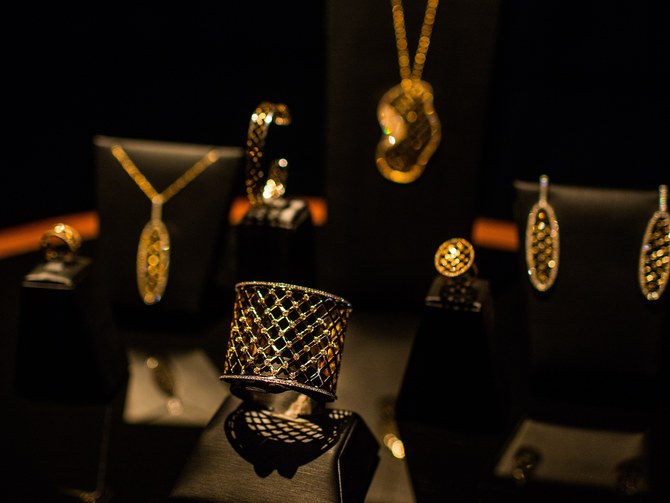
The jewelry brand is inspired by traditional Egyptian architecture. (Supplied)
Updated 02 September 2019
Follow

Refined jewelry line reflects beauty of traditional Egyptian doorways

LONDON: Inspired by traditional Egyptian architecture from the 1930s, jewelry designer Doaa Mohsen showed off her latest collection at an exclusive event in London on Thursday, treating the well-heeled crowed to a showcase of her unique pieces.

Dubbed The Roshan Collection, the new line draws inspiration from the geometric lattice work of traditional Mashrabiya doorways — stained glass plates held together between delicately carved wooden doorways that were common elements of Egyptian architecture in the 1930s and earlier.

“It protects the women, people cannot see in from the outside, but light and air can come in. It’s like protecting precious gems,” Mohsen, whose brand is called Dalseen Jewelry, told Arab News.
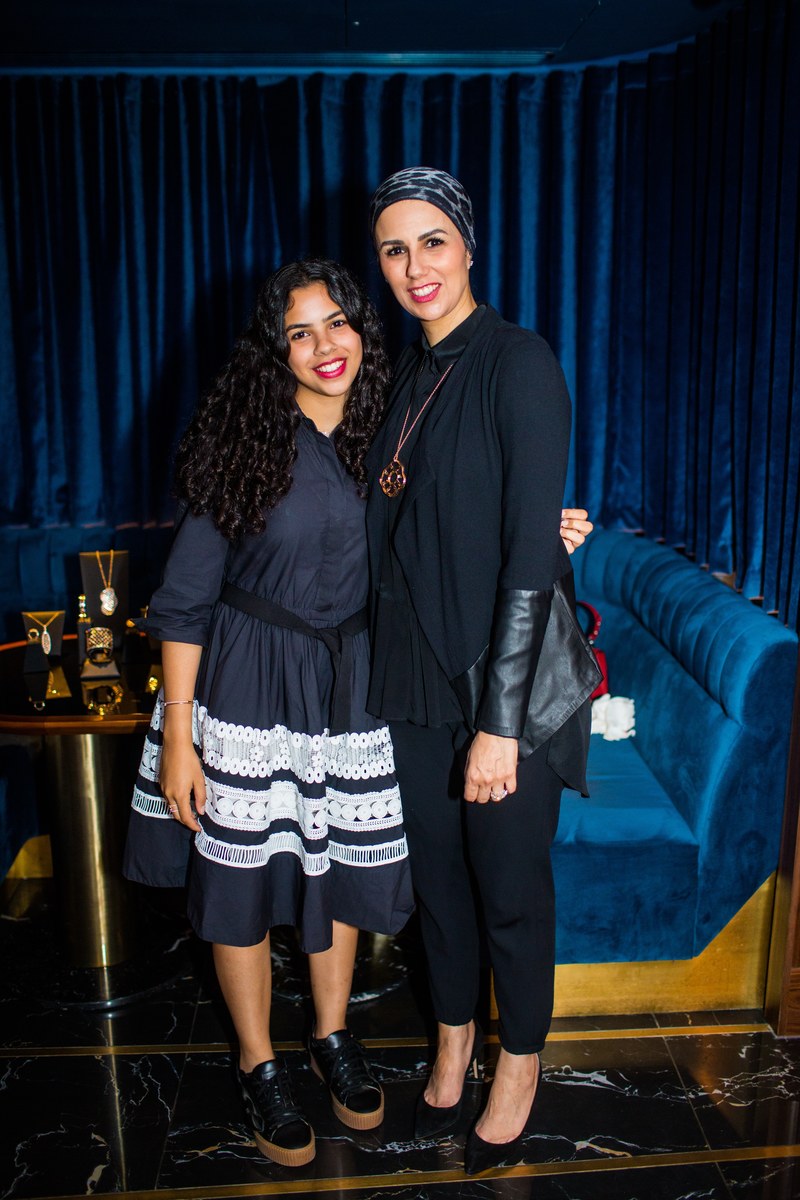


Doaa Mohsen's latest collection is dubbed The Roshan Collection. (Supplied)

The collection is marked by delicate lattice work in 18 karat gold — one of the designer’s favorite materials to work with — and features tiny diamonds at the intersections. Bracelets, pendants and statement-making rings make up the new collection.

The Egyptian designer drew inspiration from her home country, but her path to success has been an international one.
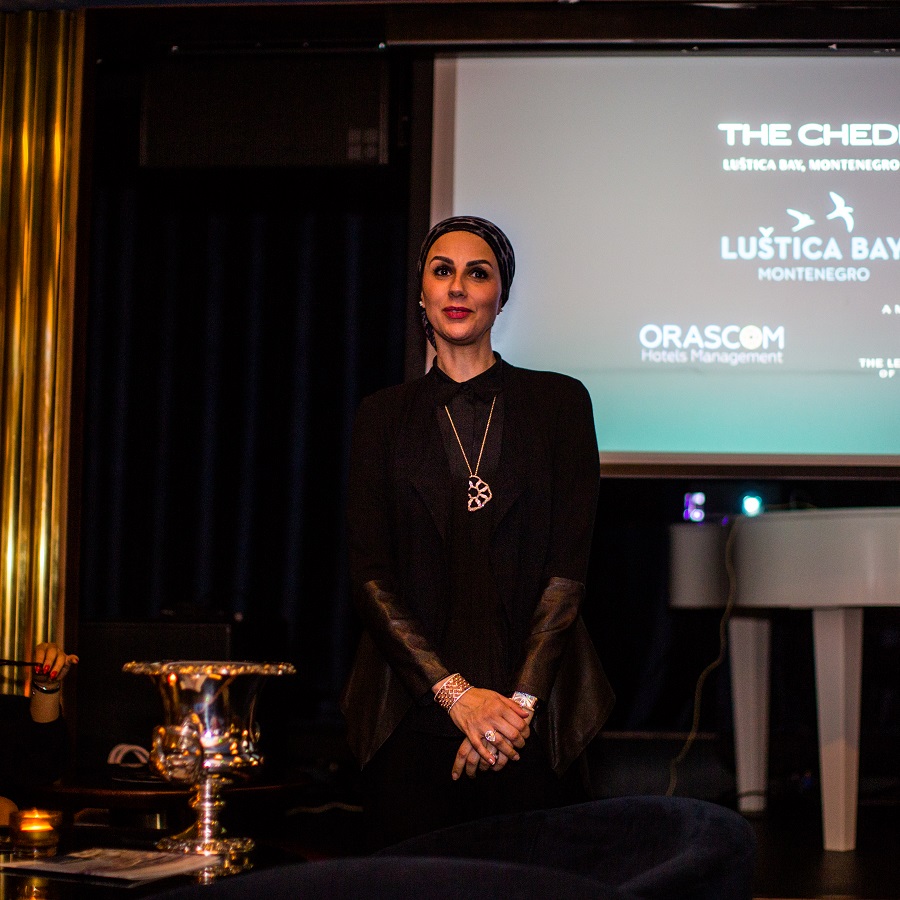


Doaa Mohsen spoke about her new collection at The Luxury Network event. (Supplied)

“I started four or five years ago and the thing is I always liked jewelry but I never thought of it as a business or a career or anything,” she said. “One day I was working on something — I always designed my own stuff — and my jeweler told me, ‘Why don’t you go and study and become a jewelry designer… in London or San Francisco?’”

Due to her young children and responsibilities, the idea never got off the ground, but a few years later, things converged to make it all possible.

“After a couple of years, we moved to London as a family and this is when I started taking my courses, I opened my own company. Then we moved back to Egypt and I started producing.”
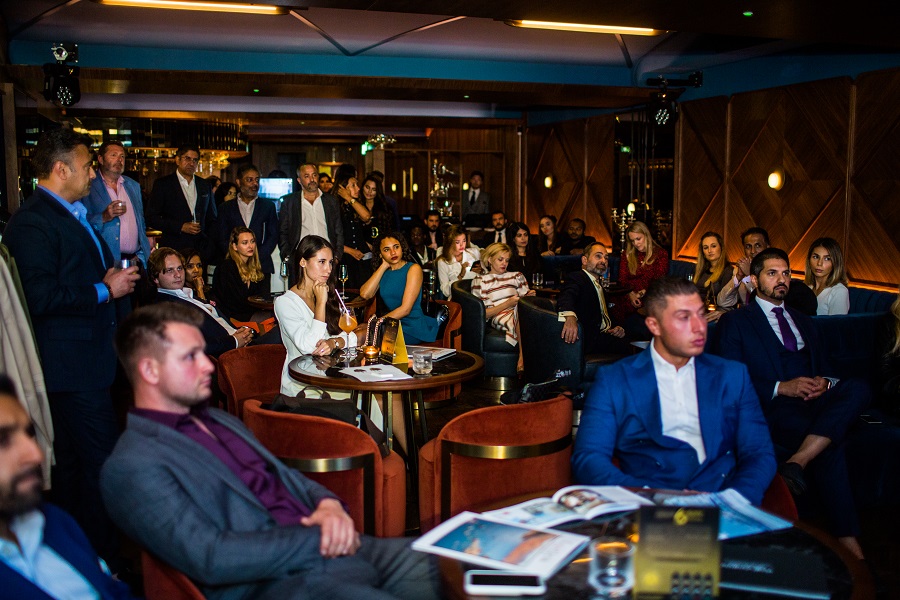


Guests gathered as The Luxury Network hosted a showcase of Dalseen Jewelry's new line. (Supplied) 

Mohsen sources all her own gems, flying to conventions in Zurich and around the world to handpick the precious stones before heading back to Egypt where her workshop is based.

“I usually work with 18 karat gold and the highest quality of diamonds and I work with lots of stones. I’m in love with opals — they come in so many different shapes, sizes and colors,” she said.

“I work with different types of stones, not the typical or standard (stones) and I like different shapes, not the standard ones. I’m looking for uniqueness,” Mohen added. 


At Jazan festival, Suad Al-Asiri paints memory, land and leadership

Updated 13 January 2026
Follow

At Jazan festival, Suad Al-Asiri paints memory, land and leadership

  • Local artist channels personal hardship into works that reflect Jazan’s identity, heritage
  • Jazan: A Nation and a Prince, places region at the heart of a composition featuring Prince Mohammed bin Abdulaziz and Prince Nasser bin Mohammed bin Abdullah bin Jalawi

RIYADH: At the Ahad Al-Masarihah pavilion at Jazan Festival 2026, Suad Al-Asiri’s paintings blend memory, place and personal history, offering visual narratives shaped by beauty and hardship. 

A novelist and visual artist, Al-Asiri has long used art as a storytelling tool. After a near-fatal car accident in March 2024, her work took on a new urgency. Bedridden for 11 months, cut off from the public world for more than a year, she describes that period as one of the most painful in her life — yet also transformative. 

“First of all, praise be to God for granting me life, as the accident was extremely severe,” she said. “By God’s grace, I was given a new life. All my thinking after the accident was about becoming an inspiration to others — about enduring pain and obstacles, and still leaving an impact.” 

Her return to public life came in 2025, when she participated in National Day celebrations with the ministry of interior. By the time she arrived at Jazan Festival, she was ready to channel that experience into her art. 

The centerpiece of her display, “Jazan: A Nation and a Prince,” places the region at the heart of a composition featuring Prince Mohammed bin Abdulaziz and Prince Nasser bin Mohammed bin Abdullah bin Jalawi, governor and deputy governor of Jazan respectively. 

Visitors linger over the details: the painting incorporates coffee beans, sesame and khudair — materials drawn from local products.

“I wanted people to recognize these products immediately,” she said. “They are part of Jazan’s daily life, and using them makes the work more tangible, more connected to everyday experience.” 

The painting sparks conversation. Visitors discuss leadership, identity, and the intimate relationship between people and their environment. 

Beyond the central piece, Al-Asiri presents individual portraits of the two princes, expanding the dialogue into a broader exploration of heritage and memory.  

Her journey into art is tied to her life as a storyteller. Early experiments with charcoal and pencil evolved into abstract art, drawn by its expressive freedom. 

From there, she explored realism, surrealism, and eventually modern art, particularly pop art, which has earned her wide recognition in artistic circles. Her novels and media work complement her visual practice, earning her the title “the comprehensive artist” from the governor.

Yet what stands out most in this exhibition is how Al-Asiri’s personal resilience flows through each piece. Her experience of surviving a devastating accident, enduring months of immobility, and returning to the public eye informs every brushstroke. 

Visitors sense not just her artistic skill, but her determination to turn life’s hardships into inspiration for others. 

Walking through the pavilion, one can see it in the way she blends heritage symbols, southern landscapes, and scenes of daily life. 

Each painting becomes both a document and a dialogue — a celebration of Jazan’s culture, a reflection on identity, and a testament to the power of human perseverance. 

At Jazan Festival 2026, Suad Al-Asiri’s art is a quiet, persistent inspiration for anyone who pauses long enough to listen.