

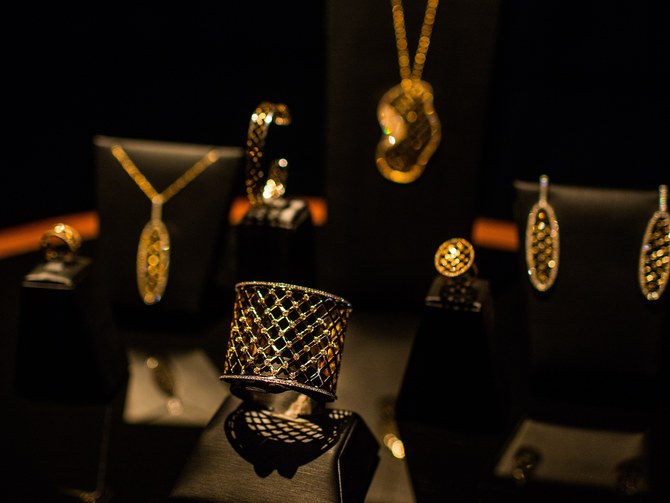
Refined jewelry line reflects beauty of traditional Egyptian doorways

The jewelry brand is inspired by traditional Egyptian architecture. (Supplied)
Updated 02 September 2019
Follow

Refined jewelry line reflects beauty of traditional Egyptian doorways

LONDON: Inspired by traditional Egyptian architecture from the 1930s, jewelry designer Doaa Mohsen showed off her latest collection at an exclusive event in London on Thursday, treating the well-heeled crowed to a showcase of her unique pieces.

Dubbed The Roshan Collection, the new line draws inspiration from the geometric lattice work of traditional Mashrabiya doorways — stained glass plates held together between delicately carved wooden doorways that were common elements of Egyptian architecture in the 1930s and earlier.

“It protects the women, people cannot see in from the outside, but light and air can come in. It’s like protecting precious gems,” Mohsen, whose brand is called Dalseen Jewelry, told Arab News.
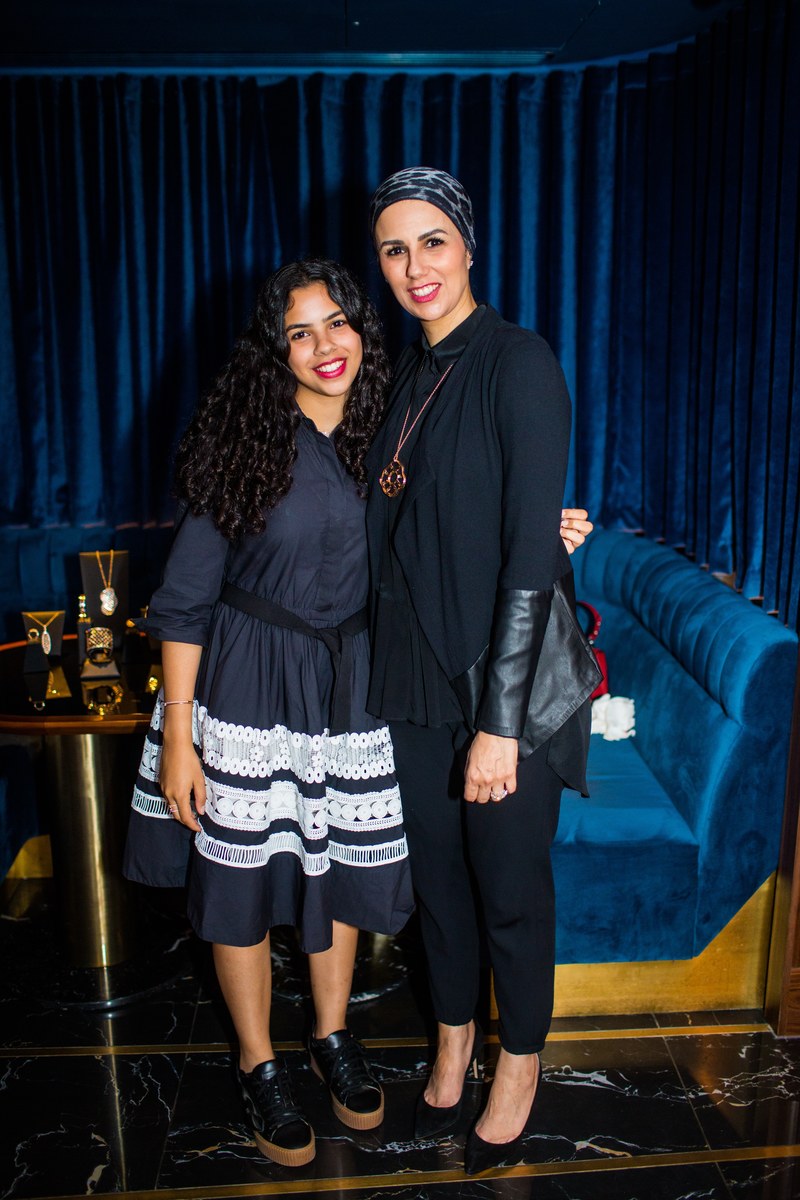


Doaa Mohsen's latest collection is dubbed The Roshan Collection. (Supplied)

The collection is marked by delicate lattice work in 18 karat gold — one of the designer’s favorite materials to work with — and features tiny diamonds at the intersections. Bracelets, pendants and statement-making rings make up the new collection.

The Egyptian designer drew inspiration from her home country, but her path to success has been an international one.
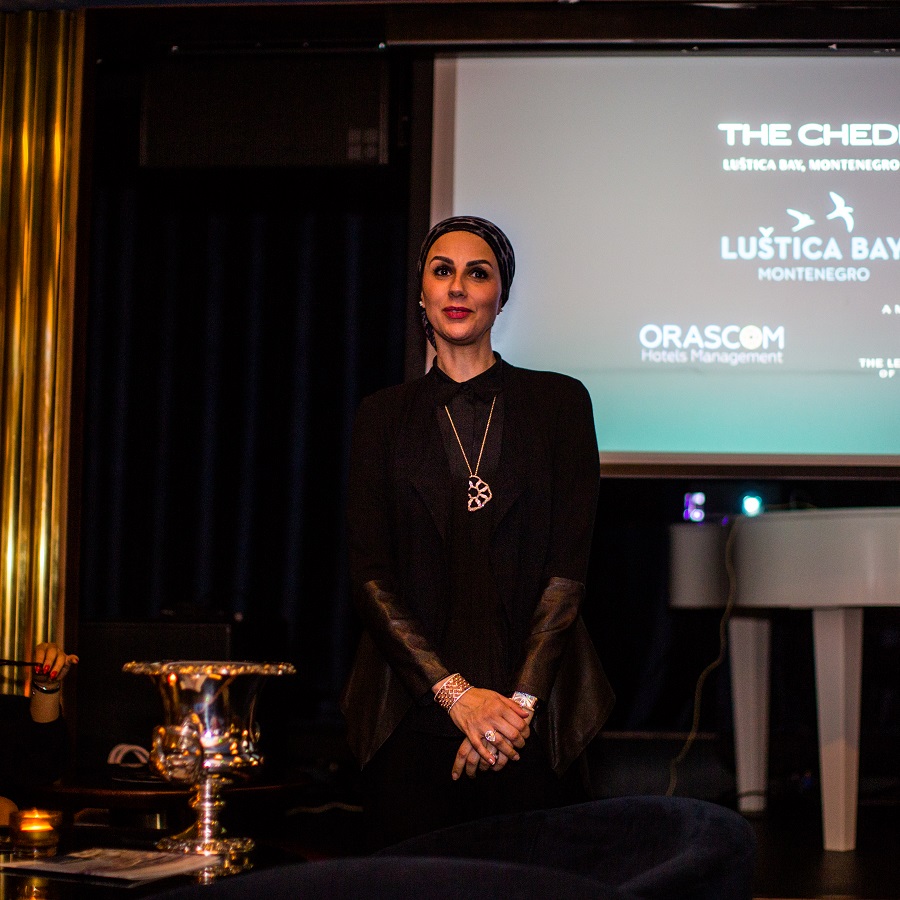


Doaa Mohsen spoke about her new collection at The Luxury Network event. (Supplied)

“I started four or five years ago and the thing is I always liked jewelry but I never thought of it as a business or a career or anything,” she said. “One day I was working on something — I always designed my own stuff — and my jeweler told me, ‘Why don’t you go and study and become a jewelry designer… in London or San Francisco?’”

Due to her young children and responsibilities, the idea never got off the ground, but a few years later, things converged to make it all possible.

“After a couple of years, we moved to London as a family and this is when I started taking my courses, I opened my own company. Then we moved back to Egypt and I started producing.”
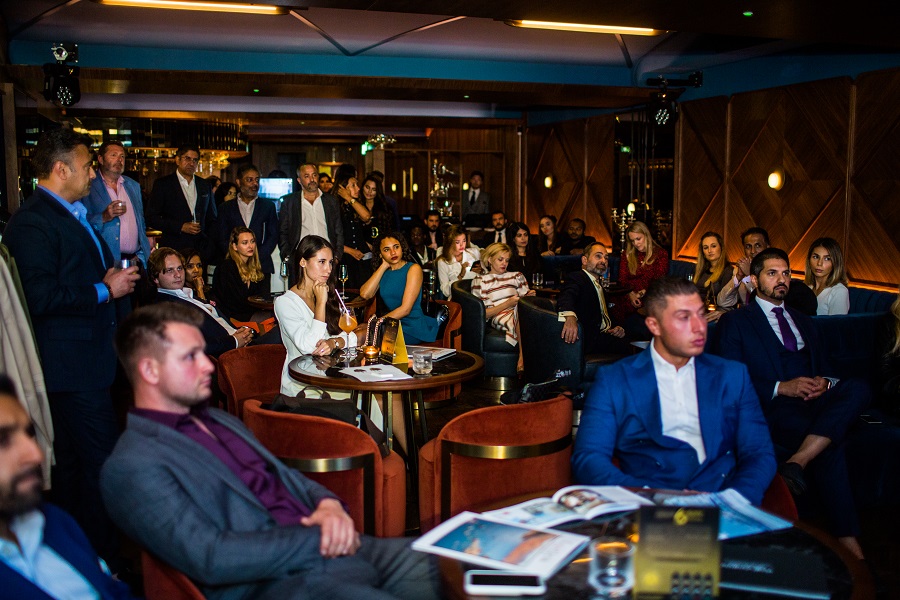


Guests gathered as The Luxury Network hosted a showcase of Dalseen Jewelry's new line. (Supplied) 

Mohsen sources all her own gems, flying to conventions in Zurich and around the world to handpick the precious stones before heading back to Egypt where her workshop is based.

“I usually work with 18 karat gold and the highest quality of diamonds and I work with lots of stones. I’m in love with opals — they come in so many different shapes, sizes and colors,” she said.

“I work with different types of stones, not the typical or standard (stones) and I like different shapes, not the standard ones. I’m looking for uniqueness,” Mohen added. 


Riyadh takes shape at Tuwaiq Sculpture Symposium 2026

Updated 5 sec ago
Follow

Riyadh takes shape at Tuwaiq Sculpture Symposium 2026

RIYADH: This season, one of Riyadh’s busiest streets has taken on an unexpected role.

Under the theme “Traces of What Will Be,”sculptors are carving granite and shaping reclaimed metal at the seventh Tuwaiq Sculpture Symposium, running from Jan. 10 to Feb. 22.

The symposium is unfolding along Prince Mohammed bin Abdulaziz Road, known locally as Al‑Tahlia, a name that translates to desalination. The choice of location is deliberate.

The area is historically linked to Riyadh’s early desalination infrastructure, a turning point that helped to shift the city from water scarcity toward long‑term urban growth.

Twenty‑five artists from 18 countries are participating in this year’s event, producing large‑scale works in an open‑air setting embedded within the city.

The site serves as both workplace and eventual exhibition space, with sculptures remaining in progress throughout the symposium’s duration.

In her opening remarks, Sarah Al-Ruwayti, director of the Tuwaiq Sculpture Symposium, said that this year new materials had been introduced, including recycled iron, reflecting a focus on sustainability and renewal.

She added that the live-sculpting format allowed visitors to witness the transformation of raw stone and metal into finished artworks.

Working primarily with local stone and reclaimed metal, the participating artists are responding to both the material and the place.

For Saudi sculptor Wafaa Al‑Qunaibet, that relationship is central to her work, which draws on the physical and symbolic journey of water.

“My work … presents the connection from the salted water to sweet water,” Al‑Qunaibet told Arab News.

Using five pieces of granite and two bronze elements, she explained that the bronze components represented pipes, structures that carry saline water and allow it to be transformed into something usable.

The sculpture reflected movement through resistance, using stone to convey the difficulty of that transition, and water as a force that enables life to continue.

“I throw the stone through the difficult to show how life is easy with the water,” she said, pointing to water’s role in sustaining trees, environments and daily life.

Formally, the work relies on circular elements, a choice Al‑Qunaibet described as both technically demanding and socially resonant.

“The circle usually engages the people, engages the culture,” she said. Repeated circular forms extend through the work, linking together into a long, pipe‑like structure that reinforces the idea of connection.

Sculpting on site also shaped the scale of the piece. The space and materials provided during the symposium allowed Al‑Qunaibet to expand the work beyond her initial plans.

The openness of the site pushed the sculpture toward a six‑part configuration rather than a smaller arrangement.

Working across stone, steel, bronze and cement, American sculptor Carole Turner brings a public‑art perspective to the symposium, responding to the site’s historical and symbolic ties to desalination.

“My work is actually called New Future,” Turner told Arab News. “As the groundwater comes up, it meets at the top, where the desalination would take place, and fresh water comes down the other side.”

Her sculpture engages directly with the symposium’s theme by addressing systems that often go unseen. “Desalination does not leave a trace,” she said. “But it affects the future.”

Turner has been sculpting for more than two decades, though she describes making objects as something she has done since childhood. Over time, she transitioned into sculpture as a full‑time practice, drawn to its ability to communicate across age and background.

Public interaction remains central to her approach. “Curiosity is always something that makes you curious, and you want to explore it,” she said. Turner added that this sense of discovery is especially important for children encountering art in public spaces.

Saudi sculptor Mohammed Al‑Thagafi’s work for this year’s symposium reflects ideas of coexistence within Riyadh’s evolving urban landscape, focusing on the relationships between long‑standing traditions and a rapidly changing society.

The sculpture is composed of seven elements made from granite and stainless steel.

“Granite is a national material we are proud of. It represents authenticity, the foundation, and the roots of Saudi society,” Al‑Thagafi told Arab News.

“It talks about the openness happening in society, with other communities and other cultures.”

That dialogue between materials mirrors broader social shifts shaping the capital, particularly in how public space is shared and experienced.

Because the sculpture will be installed in parks and public squares, Al‑Thagafi emphasized the importance of creating multi‑part works that invite engagement.

Encountering art in everyday environments, he said, encouraged people to question meaning, placement, simplicity and abstraction, helping to build visual‑arts awareness across society.

For Al‑Thagafi, this year marked his fifth appearance at the symposium. “I have produced more than 2,600 sculptures, and here in Riyadh alone, I have more than 30 field works.”

Because the works are still underway, visitors can also view a small on‑site gallery displaying scaled models of the final sculptures.

These miniature models offer insight into each artist’s planning process, revealing how monumental forms are conceived before being executed at full scale.

As the symposium moves toward its conclusion, the completed sculptures will remain on site, allowing the public to encounter them in the environment that shaped their creation.