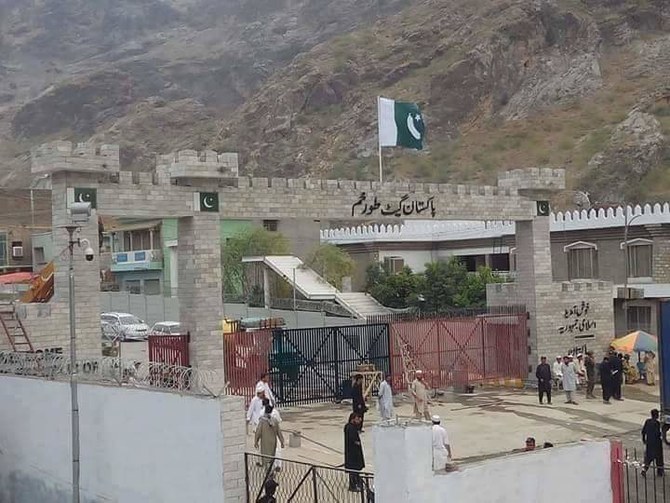
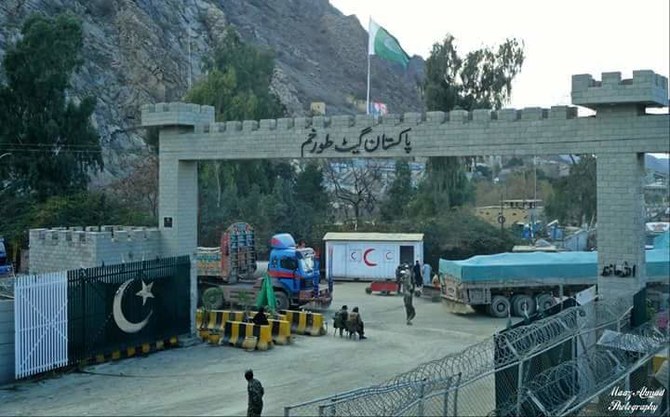
PESHAWAR: The provincial government of Pakistan’s northwestern Khyber Pakhtunkhwa (KP) province has decided to initiate round-the-clock operations at the Torkham border crossing between Pakistan and Afghanistan on a trial basis from Monday, a senior official told Arab News on Sunday.
One of the busiest ports of entry between the two neighboring countries, Torkham is located along the 2,500 km international border that separates Pakistan and Afghanistan and serves as a major transportation and shipping site.
“The Torkham border crossing will become functional 24/7 from Monday,” KP’s Information Minister Shaukat Yousafzai told Arab News.
“This will be done on a trial basis which will continue for two to three weeks. The idea is to identify and remove all inadequacies in the system before Prime Minister Imran Khan formally inaugurates it,” he said.
He added that KP’s Chief Minister Mahmood Khan had instructed all relevant departments to begin a night shift at the border crossing from Monday to facilitate traders in both countries.
Kiftan Bacha, an Afghan merchant who frequently crosses through Torkham for business purposes, told Arab News that the provincial administration’s decision was “a source of encouragement” for members of his community.
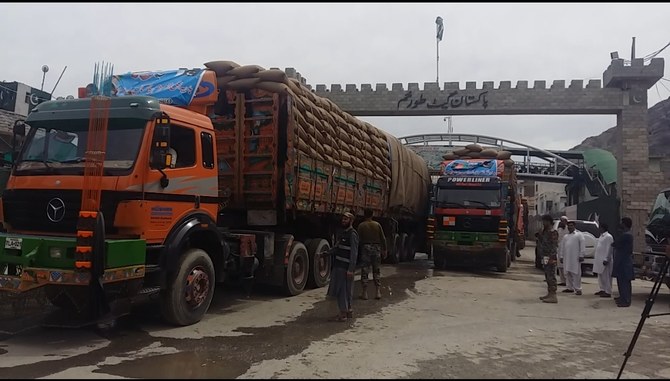
“The new mechanism will help resolve some of the vexing issues we have been facing,” he said. “We have some 600 heavy trucks parked on the Afghan side due to delays and unnecessary official procedures.”
“Since a large number of traders from our country bring fresh fruits and vegetables to Pakistan, the round-the-clock operations will make it easier for them to supply these products to the market on time. We also expect it will streamline the immigration procedure at the border crossing and passengers will not have to wait for their turn in long queues,” he said.
Faiz Muhammad, President of Peshawar’s Sarhad Chamber of Commerce and Industry, told Arab News that bilateral trade between Pakistan and Afghanistan had remained under a billion dollars during the current fiscal year, and said that certain trade barriers at Torkham were among the factors causing a decrease in the commercial activities between the two countries.
“Unstable political ties and some administrative issues are behind the shrinking trade volume between the two states,” he said and added that 24/7 border crossing operations would result in an increase in bilateral trade.
Information Minister Yousafzai, however, said that it was premature to predict the quantum of business increasing at this stage, but added there was room for significant growth.
In 2016, Pakistan’s attempt to build a barrier on the Torkham crossing ended in brief cross-border skirmishes.


![]()
![]()
![]()

Pak-Afghan Torkham border crossing to remain operational round-the-clock
Pak-Afghan Torkham border crossing to remain operational round-the-clock
- Experts say the development could increase the quantum of trade between the two countries
- Prime Minister Khan is likely to inaugurate the new system once it completes its trial period
Latest updates





© 2026 SAUDI RESEARCH & PUBLISHING COMPANY, All Rights Reserved And subject to Terms of Use Agreement.