KARACHI: Nearly 17 years after Dr. Soniya Arshad quit her job as a specialist in speech pathology and audiology, she is excited about finally being able to return to work.
The 41-year-old resident of Karachi, who, recently moved to Dammam, Saudi Arabia, said she chose family over her career when she took the decision in 2002.
Now, thanks to the eDoctor initiative – a refresher program for out-of-work women doctors, initiated by the Dow University of Health Sciences (DUHS) in Pakistan in April last year – Arshad said she’s grateful for getting a second chance at living her dream.
“I recently moved to Saudi Arabia after marriage as my husband got a job here and am not employed yet. With the launch of the eDoctor program, I will be able to resume work without going out of my home or investing [in a private clinic of my own],” she told Arab News by phone.
Dr. Arshad is one among more than 35,000 women doctors who quit the profession after graduating in the field, mainly due to family and societal pressures, according to statistics provided by the DUHS.
“Most female doctors quit their profession after marriage or due to other social issues and then they lose touch and confidence. To bring them back into the profession, the eDoctor program has been launched which will enable them to be a part of E-consultants through modern technology,” Prof. Dr. Zarnaz Wahid, pro-Vice Chancellor DUHS and chairperson of the eDoctor project told Arab News.
Through the program, students can take the classes from anywhere in the world and join the medical field in their host country.
The process requires participants to attend e-lectures, following which they can provide online consultation to patients from any clinic that employs them.
The initiative, experts say, is a win-win for all.
With Pakistan being a male-dominated society – where the female to male enrollment ratio in medical universities stands at 70:30 – it’s a sorry state of affairs when 80 percent of women doctors choose to opt out of the field.
“Around 50 percent of the male doctors leave the country for better job opportunities and due to mistreatment at the hospitals. The country needs around 0.8 to 0.9 million doctors,” Dr. S.M Qaiser Sajjad, Secretary General of the Pakistan Medical Association (PMA) told Arab News.
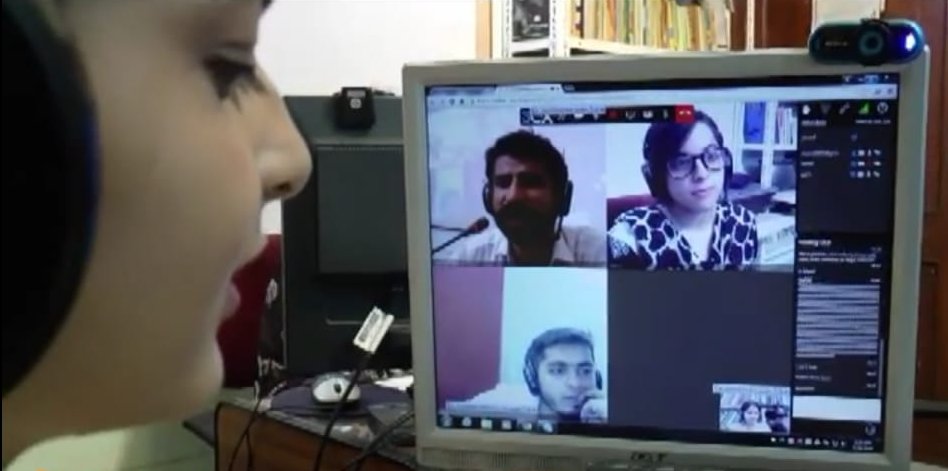
This photo shows an online class in session. The program was launched as part of the eDoctor project which aims to bring back out-of-practice women doctors. (Photo courtesy: DUHS)
The shortage is such that there’s only one doctor available – from among a pool of 232,358 registered medical practitioners – to treat 895 persons, despite the country producing 8,000 doctors every year, according to data provided by the Pakistan Medical and Dental Council (PMDC) which acts as a regulatory body.
“Pakistan is facing an acute shortage of qualified doctors as female doctors who get admission on open merit get higher seats in colleges and universities, following the abolishment of the quota back in 1989,” Dr. Sajjad said.
Add to that the government spending around Rs5 million ($69,000) on each doctor as part of their five-year education and house job program, which amounts to a loss of Rs 175 billion ($2.3 billion) – based on 35,000 women doctors quitting the profession – to the exchequer since 1989, DUHS data shows.
Therefore, with the help of a Virtual Training and TeleHealth platform named Educast – which is a joint venture by overseas Pakistanis in Saudi Arabia and those within Pakistan – the eDoctor program id “expected to recoup some of the losses in the long run by bringing back these female doctors in to the services,” Dr. Wahid said.
“EduCast is an organization formed by Pakistanis in Saudi Arabia and those in Pakistan for the educational growth of Pakistani children enrolled in gulf countries. For the eDoctor program, Dow University provides academic material while EduCast offers technological operations,” Abdullah Butt, CEO of EduCast told Arab News.
“I’ve been out of practice for the past 10 years and now I have got an opportunity. We cannot apply here due to lack of experience even for participating in exams. I have joined to refresh and to apply here. Lectures attended have boosted my confidence that I can make a comeback,” Dr. Uzma Qazi, a 39-year-old resident of Abu Dhabi, who graduated in 2003, told Arab News.
The program is also helping those who are already employed elsewhere to attain higher excellence.
“I moved to Saudi Arabia back in 2009 after marriage. I am already working in the medical sector here but need academic update to appear in exams because it is requirement,” Dr, Ghania Nadeem, a 38-year-old GP in Jeddah told Arab News.
Prior to the launch of the program, all participants are given a 15-day online crash course at home, following which they are trained to give first line of treatment – including writing prescriptions, advising patients online and even specializing in their field of interest.
“There exists huge potential for such doctors,” Dr. Zarnaz said adding, “We are planning to open E-consultant clinics from where these doctors will take calls from their homes and advise accordingly. They will have financial benefit as well.”