NEW YORK: Rafael Nadal launched his tilt at a fourth US Open title Tuesday with a swift defeat of John Millman as other leading seeds in his half of the draw tumbled out in the first round.
Four players in the world’s top 10 — Dominic Thiem, Stefanos Tsitsipas, Karen Khachanov and Roberto Bautista Agut — lost Tuesday to ease Nadal’s potential path to the final.
The Spanish second seed — US Open champion in 2010, 2013 and 2017 — needed barely two hours to see Millman off 6-3, 6-2, 6-2 at Arthur Ashe Stadium with the world number 60 from Australia unable to reproduce the magic that saw him stun Roger Federer here a year ago.
“The beginning, the first match, is always a little bit new even if I’ve played here plenty of times,” said Nadal, who meets Aussie Thanasi Kokkinakis next. “I think I played well and in general am very happy with the way I started.
“He (Millman) showed last year what he’s able to do when he’s doing well and I came on court with a lot of respect.”
Two-time French Open runner-up Thiem was upset by Italian giant-killer Thomas Fabbiano 6-4, 3-6, 6-3, 6-2, the Austrian fourth seed slumping to another first-round exit, having lost at the same stage at Wimbledon.
“I got very tired and exhausted after two sets. I’m far away from 100 percent,” an ailing Thiem said. “It was not the real me there on the court.”
Greek eighth seed Tsitsipas struggled with cramps and accused umpires of having “preferences” after he fell to a 6-4, 6-7 (5/7), 7-6 (9/7), 7-5 defeat by Next Gen rival Andrey Rublev in a gruelling four-hour slog.
Tsitsipas, for whom it was also a second successive Grand Slam opening-round defeat, was hit with a point penalty for a time violation in the final set.
“This chair umpire, I don’t know, he has something against me. I don’t know why,” said Tsitsipas, who snapped “you’re all weirdos” at French official Damien Dumusois during his match.
“I wish that all the chair umpires were like Mohamed Lahyani because I believe he’s the best out in the game, and we need more like him in tennis because he’s fair to everyone. I feel like some of them have preferences when they are on the court.”
Russian ninth seed Khachanov lost to Canada’s Vasek Pospisil in five sets, with 10th seed Bautista Agut of Spain succumbing in similar fashion to Mikhail Kukushkin of Kazakhstan to leave that quarter of the draw wide open for Nick Kyrgios.
The volatile Australian eased past American Steve Johnson 6-3, 7-6 (7/1), 6-4 in a match that finished at 1:12 a.m. local time.
Alexander Zverev, seeded sixth, outlasted Moldova’s Radu Albot 6-1, 6-3, 3-6, 4-6, 6-2, while Marin Cilic, the 2014 champion, advanced in straight sets over Slovakia’s Martin Klizan.
Reigning women’s US Open champion Naomi Osaka confronted severe nerves as she overcame Russia’s Anna Blinkova, the world number 84.
Osaka suffered a first-round exit last month at Wimbledon and the Japanese star struggled to put away Blinkova before prevailing 6-4, 6-7 (5/7), 6-2.
“I have a lot of really good memories here because I grew up in this area. I don’t think I’ve ever been this nervous in my life,” said Osaka, sporting a black brace on her left knee.
“You want to do well after you did well last year. I definitely didn’t want to lose in the third set.”
The top seed goes on to face Poland’s Magda Linette.
Osaka must retain her US Open crown to have a chance of remaining world number one and was tested extensively by 2015 Wimbledon junior finalist Blinkova, who raced 4-1 ahead in the first set and saved a match point in the second to force a decider.
Wimbledon champion Simona Halep, ousted in the opening round the past two years at Flushing Meadows, beat US lucky loser Nicole Gibbs 6-3, 3-6, 6-2.
“I feel much better that I could win a match finally in this tournament,” Halep said. “I feel like my game, it’s there.”
Sloane Stephens, the 2017 champion, slid to a 6-3, 6-4 loss to Russian qualifier Anna Kalinskaya, while 15-year-old Wimbledon sensation Coco Gauff edged past Anastasia Potapova, 18, in three sets on her US Open debut.

Nadal rampant at US Open as Thiem, Tsitsipas lead exodus
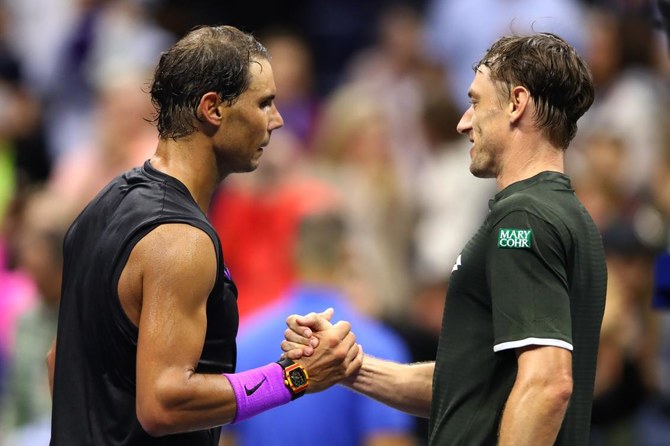
- Four players in the world’s top 10 — Dominic Thiem, Stefanos Tsitsipas, Karen Khachanov and Roberto Bautista Agut — lost Tuesday to ease Nadal’s potential path to the final
- The Spanish second seed — US Open champion in 2010, 2013 and 2017 — needed barely two hours to see Millman off 6-3, 6-2, 6-2 at Arthur Ashe Stadium
MESIF 2026 wraps up in Riyadh with spotlight on legacy, fans and sustainable sports growth
- A recurring theme in panel discussions was the importance of moving beyond siloed planning toward connected strategies
- Abdullah Aldrees: I believe Saudi is a sleeping giant within the football ecosystem because of the high demand that exists
RIYADH: The sixth edition of the Middle East Sports Investment Forum concluded on Jan. 28 in Riyadh, reinforcing the need for long-term legacy planning, integrated infrastructure development and fan-centric strategies as the region’s sports ecosystem continues to mature.
Held over two days — Jan. 27-28 — at the ministry of investment headquarters and the Kingdom Arena, the forum brought together senior government officials, global sports executives, investors and technology leaders to assess how the Middle East — and Saudi Arabia in particular — can translate major event hosting and increased investment into sustainable impact.
A recurring theme in panel discussions was the importance of moving beyond siloed planning toward connected strategies that link infrastructure, finance, fan engagement and legacy from the earliest stages of project development.
Dr. Sakis Batsilas, deputy CEO of FIFA World Cup Qatar 2022, stressed that while international expertise has played a key role in the region’s rapid progress, long-term success depends on knowledge transfer and talent development.
“Yes, we do need experts and consultants and expatriates to help,” he said. “But the main, I would say, focus, is how we ensure that we transfer this knowledge and we build talent … to make sure we have the right talent.”
Drawing on his experience delivering major global events, Batsilas highlighted the need to embed legacy considerations during the bidding phase.
“Talking now from an operational point of view … I think everything starts with a bidding phase,” he said, adding that stronger legacy metrics would encourage greater long-term planning from host nations and rights holders alike.
Fan experience and commercialization also featured prominently, particularly as Saudi Arabia continues to expand its domestic leagues and host major international competitions. David Davies, chief experience officer of Catapult, said the Kingdom’s challenge lies in converting strong digital fandom into sustained in-stadium engagement.
“Saudi Arabia is … ranked consistently in the highest in the world” in terms of football fandom, Davies said. “However, attendance in-stadium is still developing.” He noted that younger, digitally native audiences require tailored engagement strategies. “The days of being able to ask them to come to you have gone,” he said.
From a government and delivery perspective, Abdullah Aldrees, chief of staff at the vice minister’s executive office at the ministry of sport, said MESIF highlighted the scale of opportunity ahead — and the importance of a joined-up approach.
“I believe Saudi is a sleeping giant within the football ecosystem because of the high demand that exists, the government support and the anchor IPs that we’re hosting,” Aldrees said. “So all of this can create a lot of opportunities for football to grow in Saudi.”
He said the Kingdom has entered a critical preparation phase as it gears up for a packed calendar of major events. “We are now living in the preparation phase. We’re preparing for all these IPs, we’re preparing for all these big events coming up,” Aldrees said. “So how do you make sure that you really reap the right benefit from them and have the right legacy?”
Pointing to upcoming milestones such as the AFC Asian Cup Saudi Arabia 2027 and the FIFA World Cup 2034, Aldrees emphasized the need to think beyond hosting.
“Yes, we’re hosting World Cup. We’re hosting Asia 2027, but how do you make sure that they have a long, lasting impact on the ecosystem?” he said.
Echoing a key message from the forum, Aldrees concluded: “The effective strategy is to be looking at these things together. We no longer can be looking at them as silos and test cycles.”
The transformation of Saudi football was also highlighted as a reflection of broader cultural and structural change. Juan Esteban Gomez, a football expert specializing in digitalization and artificial intelligence, said the shift has been tangible in recent years. “The people here are breathing football,” he said, describing the Saudi league as “one of the most enjoyable competitions in the world.”
As MESIF 2026 drew to a close, participants agreed that the next phase of sports investment in the Middle East will be defined by execution — ensuring that capital, policy and innovation align to deliver measurable legacy, deeper fan engagement and resilient ecosystems capable of sustaining growth well beyond headline events.


