STOCKHOLM: An Iranian journalist covering Foreign Minister Mohammad Javad Zarif’s Nordic tour has fled the official delegation and applied for residency in Sweden, officials here said Tuesday.
The Swedish Migration Agency said Amir-Tohid Fazel, a political reporter for Iran’s ultra-conservative news agency Moj, had “applied for a residence permit in Sweden on 21 August 2019.”
It provided no further details.
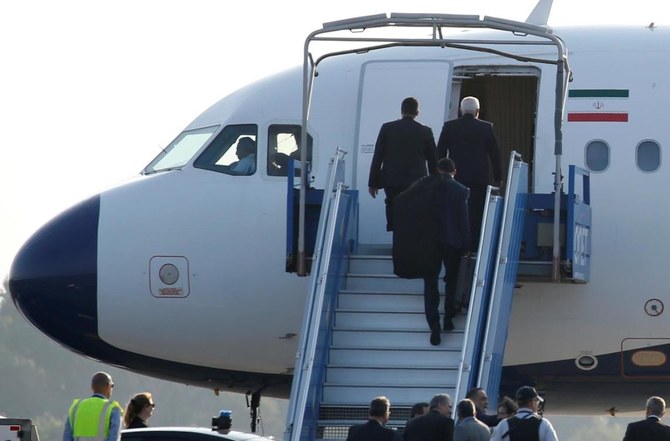
Fazel was traveling with Zarif’s delegation as part of an international tour to Finland, Sweden and Norway and other countries.
On August 20, “when I was in Sweden, one of my colleagues in Tehran contacted me via Internet and said ‘four plainclothes came to the news agency with a warrant for your arrest’,” he said in an interview with Swedish television SVT.
He had recently published a list of names of Iranian officials who allegedly hold dual citizenship in countries the Iranian government views as “hostile states.”
Iran does not recognize dual citizenship and refuses to provide consular aid to Iranian dual nationals.
“The Iranian government officially announced that it will file a complaint,” Fazel told SVT.
The day after his colleague in Iran tipped him off, while still in Sweden, Fazel managed to slip away from the delegation.
“It was very difficult because of the 48 bodyguards that were there to provide security for Dr. Zarif and keep an eye on the reporters,” he said.
The journalist refused to be drawn on his political affiliation.
Zarif has been on a world diplomatic tour that kicked off in Kuwait on August 17, before visiting the Nordic countries and France, where he held meetings on the sidelines of the G7 summit in Biarritz.
Iran occupies spot 170, out of 180, in the 2019 Reporters Without Borders rankings of countries’ press freedoms.
Iran has arrested and imprisoned a number of Iranians with dual nationality, in what Western governments have denounced as a ruthless policy to exercise diplomatic pressure.


Iran journalist flees Zarif delegation to stay in Sweden
Iran journalist flees Zarif delegation to stay in Sweden

- The Swedish Migration Agency said Amir-Tohid Fazel, a political reporter for Iran’s ultra-conservative news agency Moj, had applied for a residence permit
- Fazel was traveling with Zarif’s delegation as part of an international tour to Finland, Sweden and Norway and other countries


Mexican army kills leader of powerful Jalisco New Generation Cartel during operation to capture him
- The killing of the powerful drug lord set off several hours of roadblocks with burning vehicles in Jalisco and other states
MEXICO CITY: The Mexican army killed the leader of the Jalisco New Generation Cartel, Nemesio Rubén Oseguera Cervantes, “El Mencho, ” on Sunday, decapitating what had become Mexico’s most powerful cartel and giving the government its biggest prize yet to show the Trump administration its efforts.
Oseguera Cervantes was wounded in an operation to capture him Sunday in Tapalpa, Jalisco about a two-hour drive southwest of Guadalajara and he died while being flown to Mexico City, the Defense Department said in a statement. The state is the base of the cartel known for trafficking huge quantities of fentanyl and other drugs to the United States.
During the operation, troops came under fire and killed four people at the location. Three more people, including Oseguera Cervantes, were wounded and later died, the statement said. Two others were arrested and armored vehicles, rocket launchers and other arms were seized. Three members of the armed forces were wounded and receiving medical treatment.
Roadblocks and burning vehicles
The killing of the powerful drug lord set off several hours of roadblocks with burning vehicles in Jalisco and other states. Such tactics are commonly used by the cartels to block military operations. Jalisco canceled school in the state for Monday.
Videos circulating on social media showed plumes of smoke billowing over the tourist city of Puerto Vallarta in Jalisco, and people sprinting through the airport of the state’s capital in panic. On Sunday afternoon, Air Canada announced it was suspending flights to Puerto Vallarta “due to an ongoing security situation” and advised customers not to go to their airport.
In Guadalajara, the state capital, burning vehicles blocked roads. Mexico’s second-largest city is scheduled to host matches during this summer’s soccer World Cup.
The US State Department warned US citizens in Jalisco, Tamaulipas, Michoacan, Guerrero and Nuevo Leon states to remain in safe places due to the ongoing security operations. Canada’s embassy in Mexico warned its citizens in Puerto Vallarta to shelter in place and generally to keep a low profile in Jalisco.
Jalisco Gov. Pablo Lemus told residents to stay at home and suspended public transportation.
US had offered up to $15 million for his capture
The US State Department had offered a reward of up to $15 million for information leading to the arrest of El Mencho. The Jalisco New Generation Cartel, known as CJNG, is one of the most powerful and fastest growing criminal organizations in Mexico and was born in 2009.
In February, the Trump administration designated the cartel as a foreign terrorist organization.
Mexican President Claudia Sheinbaum, like her predecessor, has criticized the “kingpin” strategy of previous administrations that took out cartel leaders only to trigger explosions of violence as cartels fractured. While she has remained popular in Mexico, security is a persistent concern and since US President Donald Trump took office a year ago, she has been under tremendous pressure to show results against drug trafficking.
Known as aggressive cartel
The Jalisco cartel has been one of the most aggressive cartels in its attacks on the military — including on helicopters — and is a pioneer in launching explosives from drones and installing mines. In 2020, it carried out a spectacular assassination attempt with grenades and high-powered rifles in the heart of Mexico City against the then head of the capital’s police force and now federal security secretary.
The DEA considers the cartel to be as powerful as the Sinaloa cartel, one of Mexico’s most infamous criminal groups, with a presence in all 50 US states. It is one of the main suppliers of cocaine to the US market and, like the Sinaloa cartel, earns billions from the production of fentanyl and methamphetamines. Sinaloa, however, has been weakened by infighting after the loss of its leaders Ismael “El Mayo” Zambada and Joaquín “El Chapo” Guzmán, both in US custody.
Oseguera Cervantes, 59, was originally from Aguililla in the neighboring state of Michoacan. He had been significantly involved in drug trafficking activities since the 1990s. When he was younger, he migrated to the US where he was convicted of conspiracy to distribute heroin in the US District Court for the Northern District of California in 1994 and served nearly three years in prison.
Following his release from custody, Oseguera Cervantes returned to Mexico and reengaged in drug trafficking activity with drug lord Ignacio Coronel Villarreal, alias “Nacho Coronel.” After Villarreal’s death, Oseguera Cervantes and Erik Valencia Salazar, alias “El 85”, created the Jalisco New Generation Cartel around 2007.
Initially, they worked for the Sinaloa Cartel, but eventually split and for years the two cartels have battled for territory across Mexico.
Indicted several times in the United States
Since 2017, Oseguera Cervantes has been indicted several times in the United States District Court for the District of Columbia.
The most recent superseding indictment, filed on April 5, 2022, charges Oseguera Cervantes with conspiracy and distribution of controlled substances (methamphetamine, cocaine, and fentanyl) for the purpose of illegal importation into the United States and use of firearms during and in connection with drug trafficking offenses. Oseguera Cervantes is also charged under the Drug Kingpin Enforcement Act for directing a continuing criminal enterprise.
Last year, people searching for missing relatives founds piles of shoes and other clothing, as well as bone fragments at what authorities later said was a Jalisco cartel recruitment and training site.