Israeli drone strikes on Lebanon ‘equal to declaration of war,’ Aoun tells UN

1 / 2
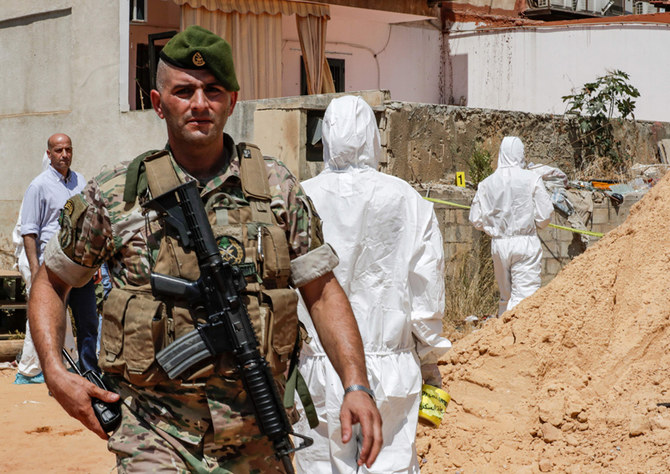
A Lebanese army soldier walks past military intelligence forensic investigators of inspecting the scene where two drones came down in the vicinity of a media center of the Shiite Hezbollah movement earlier in the day, in the south of the capital Beirut on August 25, 2019. (AFP / ANWAR AMRO)
2 / 2
Lebanese President Michel Aoun on Monday said Israel's drone strikes in Lebanon is tantamount to a declaration of war. (Hussein Malla/Pool via REUTERS/File Photo)
Updated 27 August 2019
Follow

Israeli drone strikes on Lebanon ‘equal to declaration of war,’ Aoun tells UN

  • Drones targetted Hezbollah-linked base in Bekaa Valley and and southern Lebanon
  • UN spokesman Stephane Dujarric said the UN took note of Aoun’s statements

BEIRUT: Three Israeli airstrikes on a Palestinian base in eastern Lebanon near the border with Syria were “equal to a declaration of war,” Lebanese President Michel Aoun said on Monday.

The three drone attacks a few minutes apart early on Monday hit a base near Qusaya in the Bekaa Valley of a Syrian-backed group known as the Popular Front for the Liberation of Palestine-General Command, an ally of Hezbollah.

The strikes came a day after an Israeli drone crashed in a Hezbollah stronghold in southern Beirut, and another exploded and crashed nearby. The attacks violated the UN Security Council resolution that ended the 2006 war between Israel and Hezbollah, Aoun told the UN Special Coordinator for Lebanon, Jan Kubis.

“What happened is equal to a declaration of war and gives us the right to defend our sovereignty, independence, and the safety of our land,” Aoun said. “We are people who seek peace and not war, and we don’t accept that anyone threatens us through any means.”

UN spokesman Stephane Dujarric said the UN took note of Aoun’s statements and repeated its appeal to stop violations of the Security Council resolution and implement all its provisions.

“The UN calls on the parties to exercise maximum restraint, both in action and in rhetoric,” Dujarric said.

Lebanese diplomatic expert Riyad Tabarah said the drone incidents in the southern Beirut suburbs were mysterious. “This kind of drone is usually used to target people and not places,” he told Arab News.

“Israel has been using these drones lately in Syria and Iraq to kill Iranians. These drones do not usually explode in the skies. The Israeli technology does not work this way. Plus, there is a difference between the places where the first drone crashed and the second exploded.

“Israeli media said that, according to the images on Lebanese TV channels, the drone that was downed was Iranian, and not made in Israel.”

He said that increasing Israeli pressure against Hezbollah and Iran came from the US, which could not exert this pressure directly. Israel was acting on behalf of the US, to force Iran to come to the negotiating table, he said.

Meanwhile, Israeli drones continued on Monday to fly over the Bekaa Valley and also southern Lebanon, where the United Nations Interim Force in Lebanon (UNIFIL) patrols the border with Israel.

“Our mission is limited to the south of Lebanon,” UNIFIL spokesman Andrea Teneneti told Arab News.  “The Lebanese authorities are handling this part with the relevant authorities.

“We are issuing reports regarding the air violations and focusing on preventing any tensions in the south. Our mission is confined to the south ... and the situation there is stable and calm, just as it was before.”


Trump warns Iran of ‘very traumatic’ outcome if no nuclear deal

Updated 5 sec ago
Follow

Trump warns Iran of ‘very traumatic’ outcome if no nuclear deal

WASHINGTON: US President Donald Trump threatened Iran Thursday with “very traumatic” consequences if it fails to make a nuclear deal — but Israeli Prime Minister Benjamin Netanyahu said he was skeptical about the quality of any such agreement.
Speaking a day after he hosted Netanyahu at the White House, Trump said he hoped for a result “over the next month” from Washington’s negotiations with Tehran over its nuclear program.
“We have to make a deal, otherwise it’s going to be very traumatic, very traumatic. I don’t want that to happen, but we have to make a deal,” Trump told reporters.
“This will be very traumatic for Iran if they don’t make a deal.”
Trump — who is considering sending a second aircraft carrier to the Middle East to pressure Iran — recalled the US military strikes he ordered on Tehran’s nuclear facilities during Israel’s 12-day war with Iran in July last year.
“We’ll see if we can get a deal with them, and if we can’t, we’ll have to go to phase two. Phase two will be very tough for them,” Trump said.
Netanyahu had traveled to Washington to push Trump to take a harder line in the Iran nuclear talks, particularly on including the Islamic Republic’s arsenal of ballistic missiles.
But the Israeli and US leaders apparently remained at odds, with Trump saying after their meeting at the White House on Wednesday that he had insisted the negotiations should continue.

- ‘General skepticism’ -

Netanyahu said in Washington on Thursday before departing for Israel that Trump believed he was laying the ground for a deal.
“He believes that the conditions he is creating, combined with the fact that they surely understand they made a mistake last time when they didn’t reach an agreement, may create the conditions for achieving a good deal,” Netanyahu said, according to a video statement from his office.
But the Israeli premier added: “I will not hide from you that I expressed general skepticism regarding the quality of any agreement with Iran.”
Any deal “must include the elements that are very important from our perspective,” Netanyahu continued, listing Iran’s ballistic missile program and its support for armed groups such as the Palestinian movement Hamas, Yemen’s Houthi rebels and Hezbollah in Lebanon.
“It’s not just the nuclear issue,” he said.
Despite their differences on Iran, Trump signaled his strong personal support for Netanyahu as he criticized Israeli President Isaac Herzog for rejecting his request to pardon the prime minister on corruption charges.
“You have a president that refuses to give him a pardon. I think that man should be ashamed of himself,” Trump said on Thursday.
Trump has repeatedly hinted at potential US military action against Iran following its deadly crackdown on protests last month, even as Washington and Tehran restarted talks last week with a meeting in Oman.
The last round of talks between the two foes was cut short by Israel’s war with Iran and the US strikes.
So far, Iran has rejected expanding the new talks beyond the issue of its nuclear program. Tehran denies seeking a nuclear weapon, and has said it will not give in to “excessive demands” on the subject.