I owe my freedom to Saudi government, says jubilant Pakistani trucker as he arrives home

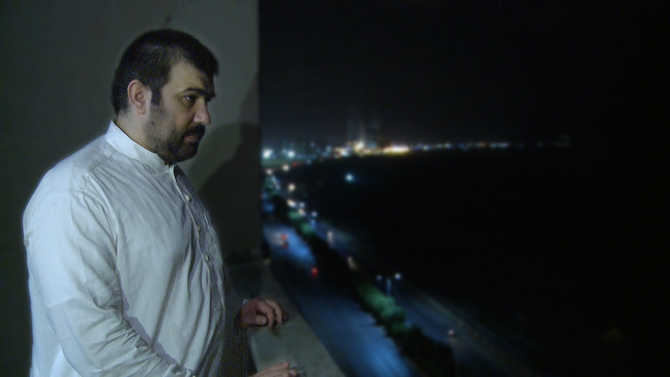
Zahir Hussain Zar Khan who landed in Karachi on Monday looks at the open sea from the balcony of his relative’s apartment on August 26, 2019. Khan was released from a Saudi prison after the Kingdom’s Bait-ul-Maal paid blood money for his freedom upon King Salman’s instruction. (AN Photo)
Updated 27 August 2019
Follow

I owe my freedom to Saudi government, says jubilant Pakistani trucker as he arrives home

  • Saudi bait-ul-maal paid SAR1.3 million as blood money to secure Zahir Khan’s freedom last month
  • Khan was jailed after a 2013 road accident that claimed four lives on Makkah Highway

KARACHI: A Pakistani truck driver, who on Monday morning arrived in Karachi after spending about seven years in a Saudi prison, said he got his freedom due to the kindness of the Saudi authorities, particularly King Salman bin Abdulaziz.
“I am extremely thankful to Allah and then King Salman, whose special kindness helped me come out of the jail,” the trucker, Zahir Hussain Zar Khan, told Arab News in Karachi.
Khan recalled he had several dreams when he went to Saudi Arabia as a driver in 2012. “I wanted to support my family and make a bright future for my children,” he said. However, those dreams shattered almost a year later when, in 2013, he had an accident on the Makkah Highway in which four people lost their lives and he was sent to jail for negligent driving.
Khan said the diyāt – or blood money – demanded by the families of deceased individuals was too high for him, making him think he would spend his entire life in prison. “It was the kindness of King Salman bin Abdulaziz, which put an end to my agony and ensured my freedom,” Khan said.
He added his elder daughter Afreen Khan started crying when he connected with his family in Khyber Pakhtunkhwa province through a video call on Monday morning, asking him to straightaway come home.
Khan said he wanted to spend some time with his children, wife and ailing mother who he had missed him in all these years. “I will try my luck here in Pakistan; but if get a chance, I will love to go back to Saudi Arabia since it is a kind land for poor and jobless people.”


ADB, Pakistan sign over $300 million agreements to undertake climate resilience initiatives

Updated 11 sec ago
Follow

ADB, Pakistan sign over $300 million agreements to undertake climate resilience initiatives

  • Pakistan ranks among nations most vulnerable to climate change and has seen erratic changes in weather patterns
  • The projects in Sindh and Punjab will restore nature-based coastal defenses and enhance agricultural productivity

ISLAMABAD: The Pakistani government and the Asian Development Bank (ADB) have signed more than $300 million agreements to undertake two major climate resilience initiatives, Pakistan’s Press Information Department (PID) said on Tuesday.

The projects include the Sindh Coastal Resilience Sector Project (SCRP), valued at Rs50.5 billion ($180.5 million), and the Punjab Climate-Resilient and Low-Carbon Agriculture Mechanization Project (PCRLCAMP), totaling Rs34.7 billion ($124 million).

Pakistan ranks among nations most vulnerable to climate change and has seen erratic changes in its weather patterns. In 2022, monsoon floods killed over 1,700 people, displaced another 33 million and caused over $30 billion losses, while another 1,037 people were killed in floods this year.

The South Asian country is ramping up climate resilience efforts, with support from the ADB and World Bank, and investing in climate-resilient infrastructure, particularly in vulnerable areas.

“Both sides expressed their commitment to effectively utilize the financing for successful and timely completion of the two initiatives,” the PID said in a statement.

The Sindh Coastal Resilience Project (SCRP) will promote integrated water resources and flood risk management, restore nature-based coastal defenses, and strengthen institutional and community capacity for strategic action planning, directly benefiting over 3.8 million people in Thatta, Sujawal, and Badin districts, according to ADB.

The Punjab project will enhance agricultural productivity and climate resilience across 30 districts, improving small farmers’ access to climate-smart machinery, introducing circular agriculture practices to reduce residue burning, establishing testing and training facilities, and empowering 15,000 women through skills development and livelihood diversification.

Earlier this month, the ADB also approved $381 million in financing for Pakistan’s Punjab province to modernize agriculture and strengthen education and health services, including concessional loans and grants for farm mechanization, Science, Technology, Engineering and Mathematics (STEM) education, and nursing sector reforms.