White House says Trump regrets not raising tariffs higher

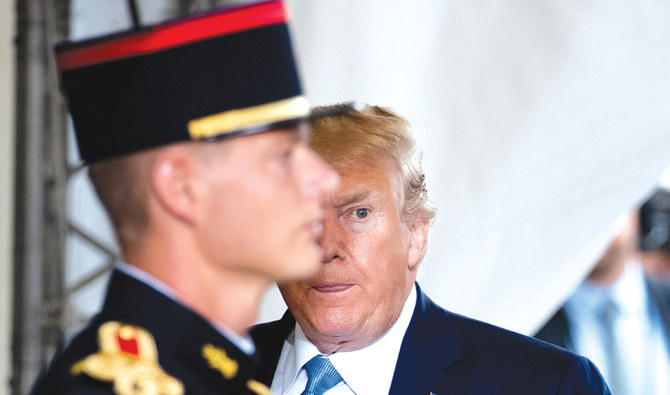
US President Donald Trump arrives at the G7 summit in Biarritz, France, on Sunday. Trump had been trying to use the conference to rally global leaders to do more to stimulate their economies, as fears rise of a potential slowdown in the US ahead of his reelection. (AP)
Updated 26 August 2019
Follow

White House says Trump regrets not raising tariffs higher

  • President’s comments appear at first to mark a rare moment of self-reflection by the US leader

TOKYO: President Donald Trump said Sunday that he had second thoughts about escalating the trade war with China, but the White House later reversed that message saying the president was misinterpreted and that his only regret in hiking tariffs is that he didn’t raise them higher. Trump faced a tense reception from world leaders meeting amid mounting anxiety of a global economic slowdown at the Group of Seven summit in France. During a breakfast meeting with British Prime Minister Boris Johnson, Trump suggested he had qualms about the spiraling conflict. “Yeah. For sure,” Trump told reporters when asked if he has second thoughts about escalating the dispute, adding he has “second thoughts about everything.”
But hours later, White House press secretary Stephanie Grisham issued a statement saying Trump’s comments about US tariffs on China were “greatly misinterpreted.”
She said Trump only responded “in the affirmative — because he regrets not raising the tariffs higher.” The comments appeared at first to mark a rare moment of self-reflection by the famously hard-nosed leader. But the later reversal fit a pattern for Trump in recoiling from statements he believes suggest weakness.

HIGHLIGHTS

• President Donald Trump faced a tense reception from world leaders meeting amid mounting anxiety of a global economic slowdown at the Group of Seven summit in France.

• White House said comments about US tariffs on China were ‘greatly misinterpreted.’

Trump had been trying to use the conference to rally global leaders to do more to stimulate their economies, as fears rise of a potential slowdown in the US ahead of his reelection. Trump’s counterparts, including Johnson, are trying to convince him to back off his trade wars with China and other countries, which they see as contributing to the economic weakening.

US-Japan agreement
Trump and Japan’s Prime Minister Shinzo Abe announced on Sunday a deal in principle on a major bilateral trade deal.
“It’s a very big transaction,” Trump said after talks with Abe on the sidelines of the G7 summit.
“Billions and billions of dollars,” he said. “It involves agriculture, it involves e-commerce. It involves many things. We’ve agreed in principle.”

Amazon fires
Also on Sunday, French President Emmanuel Macron said that world leaders at the G7 summit have agreed to help the countries affected by the huge wildfires ravaging the Amazon rainforest as soon as possible.
“We are all agreed on helping those countries which have been hit by the fires as fast as possible,” he told journalists.


Gold rises on Iran war safe-haven bid; firm dollar limits upside

Updated 6 sec ago
Follow

Gold rises on Iran war safe-haven bid; firm dollar limits upside

BENGALURU: Gold prices rose on March 5, lifted by safe-haven demand amid an escalating war in the Middle East, while a stronger dollar and concerns around the US Federal Reserve’s monetary policy capped gains.

Spot gold was up 0.6 percent at $5,168.43 per ounce, as of 11:55 am Saudi time. US gold futures for April delivery were up 0.9 percent at $5,179.20.

Israel launched a large wave of strikes on Tehran on March 5, targeting what it said was infrastructure belonging to the Iranian authorities, after Iranian missiles sent millions of Israelis rushing into bomb shelters.

“On the one hand, there may be greater safe-haven demand for gold given the ongoing conflict in the Middle East. On the other hand, the risk of a prolonged period of higher energy prices that takes rate cuts off the table, and adds to the chance of rate hikes, could be capping further gains,” said Hamad Hussain, a climate and commodities economist at Capital Economics.

The US dollar rose about 0.3 percent after briefly retreating from three-month highs, as the fallout from the war roiled global markets and kept sentiment fragile.

Concerns about energy supply continued to drive up oil prices and stoke inflation fears.

Gold is considered a hedge against inflation in the long run, but also tends to thrive when interest rates are lower, as it is a non-yielding asset.

President Donald Trump, on March 4, officially nominated former Federal Reserve Governor Kevin Warsh to be the US central bank’s next chair.

US economic activity grew slightly, prices continued to increase and employment levels were stable in recent weeks, the Federal Reserve said on Wednesday in its latest “Beige Book” report.

Markets expect the Fed to keep rates steady at its next policy meeting on March 18, according to CME Group’s FedWatch tool.

Investors are looking out for the weekly US jobless claims data, due later today, and the US employment report for February on March 6 for further clues on monetary policy this year.

Spot silver rose 0.5 percent to $83.80 per ounce. Platinum gained 1.1 percent to $2,172.20, while palladium lost 0.7 percent to $1,662.07.