

White House says Trump regrets not raising tariffs higher

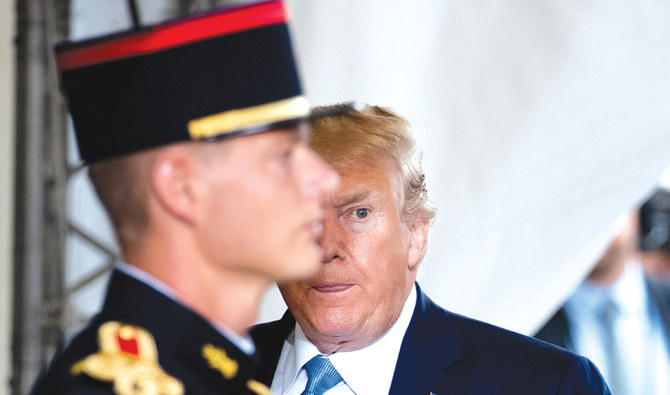
US President Donald Trump arrives at the G7 summit in Biarritz, France, on Sunday. Trump had been trying to use the conference to rally global leaders to do more to stimulate their economies, as fears rise of a potential slowdown in the US ahead of his reelection. (AP)
Updated 26 August 2019
Follow

White House says Trump regrets not raising tariffs higher

  • President’s comments appear at first to mark a rare moment of self-reflection by the US leader

TOKYO: President Donald Trump said Sunday that he had second thoughts about escalating the trade war with China, but the White House later reversed that message saying the president was misinterpreted and that his only regret in hiking tariffs is that he didn’t raise them higher. Trump faced a tense reception from world leaders meeting amid mounting anxiety of a global economic slowdown at the Group of Seven summit in France. During a breakfast meeting with British Prime Minister Boris Johnson, Trump suggested he had qualms about the spiraling conflict. “Yeah. For sure,” Trump told reporters when asked if he has second thoughts about escalating the dispute, adding he has “second thoughts about everything.”
But hours later, White House press secretary Stephanie Grisham issued a statement saying Trump’s comments about US tariffs on China were “greatly misinterpreted.”
She said Trump only responded “in the affirmative — because he regrets not raising the tariffs higher.” The comments appeared at first to mark a rare moment of self-reflection by the famously hard-nosed leader. But the later reversal fit a pattern for Trump in recoiling from statements he believes suggest weakness.

HIGHLIGHTS

• President Donald Trump faced a tense reception from world leaders meeting amid mounting anxiety of a global economic slowdown at the Group of Seven summit in France.

• White House said comments about US tariffs on China were ‘greatly misinterpreted.’

Trump had been trying to use the conference to rally global leaders to do more to stimulate their economies, as fears rise of a potential slowdown in the US ahead of his reelection. Trump’s counterparts, including Johnson, are trying to convince him to back off his trade wars with China and other countries, which they see as contributing to the economic weakening.

US-Japan agreement
Trump and Japan’s Prime Minister Shinzo Abe announced on Sunday a deal in principle on a major bilateral trade deal.
“It’s a very big transaction,” Trump said after talks with Abe on the sidelines of the G7 summit.
“Billions and billions of dollars,” he said. “It involves agriculture, it involves e-commerce. It involves many things. We’ve agreed in principle.”

Amazon fires
Also on Sunday, French President Emmanuel Macron said that world leaders at the G7 summit have agreed to help the countries affected by the huge wildfires ravaging the Amazon rainforest as soon as possible.
“We are all agreed on helping those countries which have been hit by the fires as fast as possible,” he told journalists.


Airlines across Middle East, Asia extend flight suspensions for 3rd straight day 

Updated 12 sec ago
Follow

Airlines across Middle East, Asia extend flight suspensions for 3rd straight day 

RIYADH: Airlines and airport operators across the Middle East extended flight suspensions for a third consecutive day after US and Israeli strikes on Iran triggered widespread airspace closures, disrupting global travel routes. 

Major Gulf hubs halted operations as authorities kept sections of regional airspace closed, forcing carriers to cancel thousands of flights and reroute long-haul services linking Europe, Asia and Australia.  

This comes as flight cancellations affected seven airports across the Middle East on March 1, including Dubai and Abu Dhabi in the UAE, Doha in Qatar, and Manama in Bahrain.

Emirates said in a statement that, due to multiple regional airspace closures, it has temporarily suspended all operations to and from Dubai until 3:00 p.m. UAE time on March 3. 

“The situation remains dynamic and is assessed continuously. We urge all customers to review the latest operational updates on emirates.com and check their email for any notifications about changes or cancellations to their flights before travelling to the airport,” the airline said. 

Hamad International Airport said flights remain suspended and will resume once the Civil Aviation Authority announces the reopening of Qatari airspace. The airport advised passengers not to travel to the airport and to contact their airlines for updates. 

The closures disrupted key hub airports in Dubai, Abu Dhabi and Doha. Emirates, Qatar Airways and Etihad — which operate from these hubs — normally handle around 90,000 passengers daily, with even more traveling to other Middle Eastern destinations, according to aviation analytics firm Cirium.

The disruption has compounded volatility in airline shares amid concerns over higher fuel costs and prolonged operational uncertainty.   

Ipek Ozkardeskaya, senior analyst at Swissquote, said: “The weekend was marked by tensions between the US, Israel, and Iran, leading to hundreds of explosions targeting broader Middle East countries as well, including the UAE, Saudi Arabia, Qatar, Bahrain and Kuwait.” 

He added: “The flare-up was predictable; markets had been preparing for weeks as US warships advanced to the region preceding the explosions.”  

Asian airlines shares plunge 

Asian airline stocks slid on March 2, with Hong Kong’s Cathay Pacific, Australia’s Qantas, Singapore Airlines, and Japan Airlines falling more than 5 percent after the escalation disrupted travel flows and heightened concerns over fuel prices, Asharq Bloomberg reported. 

Qantas shares dropped as much as 10.4 percent to a 10-month low at the Australian market open before trimming losses to trade down nearly 6 percent. 

Other carriers, including Japan Airlines, Air China and Malaysia Airlines, also declined. 

Cathay Pacific canceled all flights to the Middle East, including passenger services to Dubai and Riyadh, until further notice. 

Singapore Airlines suspended flights to and from Dubai until March 7, while Japan Airlines halted services between Tokyo and Doha for the time being.  

Flight data provider VariFlight said Chinese airlines have canceled 26.5 percent of their services to and from the Middle East scheduled between March 2 and 8.