

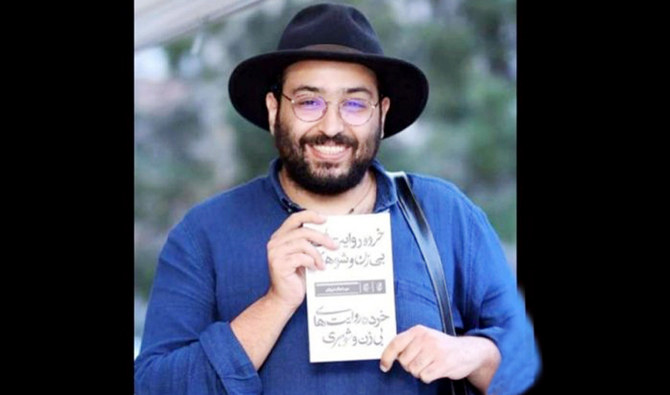
Iran satirist to serve 11 years in jail for US cooperation

Keyomars Marzban
Updated 25 August 2019
Follow

Iran satirist to serve 11 years in jail for US cooperation

  • Marzban had been facing charges of “assembly and collusion against national security, cooperation with a hostile state

TEHRAN: An Iranian court has sentenced writer and satirist Keyomars Marzban to 11 years in prison after convicting him of charges including cooperation with the US, state media reported.

The official IRNA news agency said Marzban had “collaborated” with Radio Farda and Manoto television — broadcasters that are based abroad and banned in Iran.

Marzban had been facing charges of “assembly and collusion against national security, cooperation with a hostile state, spreading propaganda against the system, and insulting sanctities and officials,” IRNA quoted his lawyer as saying.

The court cleared him of the first count of assembly and collusion but found him guilty of the other four charges, said the lawyer Mohammad Hossein Aghasi.

In line with Iranian law, he would have to serve only the longest of the sentences — 11 years behind bars for cooperating with a hostile state — if he loses an appeal.

“We will definitely appeal this verdict as we believe that there has been no connection between the client and American government,” said Aghasi.

“We also don’t accept (the charge of) insulting sanctities.”

IRNA said that according to posts on social media, Marzban had left Iran in 2009 and returned eight years later before being arrested in Aug. 26, 2018.

Iran has meanwhile blacklisted US-based think-tank the Foundation for Defense of Democracies and its chief Mark Dubowitz on accusations of being behind “economic terrorism” against the Islamic republic.

The Iranian Foreign Ministry said in a statement that it had “added the so-called Foundation for Defense of Democracies (FDD) and its director to the sanctions list.”

The FDD and Dubowitz were blamed for “seriously and actively trying to harm the Iranian people’s security and vital interests,” according to the English-language statement posted on the ministry’s website.

They were accused of doing so through “fabricating and spreading lies, encouraging, providing consultations, lobbying, and launching a smear campaign” against Iran. As a result, they would be “subject to legal consequences,” it said.

The move would be “without prejudice to any further legal measures that the other administrative, judicial or security institutions and organizations may take” against them and their “collaborators and accomplices.”

The FDD describes itself as a Washington-based “non-partisan research institute focusing on national security and foreign policy.”

The think-tank responded to Tehran’s move with a statement saying: “FDD considers its inclusion on any list put out by the regime as a badge of honor and looks forward to the day when Americans and others can visit a free and democratic Iran.”

It strongly opposed the 2015 deal that saw world powers lift sanctions against Iran in return for limits on its nuclear program.

Tensions between arch-foes Iran and the US have escalated since President Donald Trump unilaterally withdrew the US from the accord last year and began reimposing sanctions against the Islamic republic.



Israel army says struck Hezbollah targets in ‘several areas’ of Lebanon

Updated 8 sec ago
Follow

Israel army says struck Hezbollah targets in ‘several areas’ of Lebanon

  • The Israeli military said it struck “several areas in Lebanon,” targeting “weapons storage facilities and a weapons production site
  • Lebanese official news agency NNA reported strikes on southern Lebanon in areas far from the border

JERUSALEM: Israel’s military said it struck Hezbollah targets in several areas of Lebanon on Friday, a day after the Lebanese army said it had completed the first phase of its plan to disarm the group.
Under US pressure and amid fears of expanded Israeli strikes, Lebanon has committed to disarming the Iran-backed militant group, which was weakened by more than a year of hostilities with Israel including two months of all-out war that ended with a November 2024 ceasefire.
Despite the truce, Israel has kept up regular strikes in Lebanon, usually saying it is targeting Hezbollah sites and operatives, and has maintained troops in five south Lebanon areas it deems strategic, accusing the group of rearming.
In a statement on Friday, the Israeli military said it struck “several areas in Lebanon,” targeting “weapons storage facilities and a weapons production site that were used for the rehabilitation and military build-up of the Hezbollah terrorist organization.”
“Additionally, several launch sites and rocket launchers, along with military structures, were struck,” it added.
Lebanese official news agency NNA reported strikes on southern Lebanon in areas far from the border, as well as in the eastern Bekaa area where Hezbollah has a strong presence.
No casualties were immediately reported.
“The targets that were struck, and Hezbollah’s reestablishment activity in these sites, constitute a violation of the understandings between Israel and Lebanon, and pose a threat to the State of Israel,” the military statement said.

- ‘Encouraging announcements’ -

Lebanon’s army said Thursday it had “achieved the objectives of the first phase” of its plan to disarm Hezbollah, covering the area south of the Litani River — around 30 kilometers (20 miles) from the Israeli border — with the intention to extend it to the rest of the country.
Israel said the efforts were encouraging but not enough.
“The ceasefire agreement... states clearly, Hezbollah must be fully disarmed,” the office of Prime Minister Benjamin Netanyahu said in a statement.
“Efforts made toward this end by the Lebanese government and the Lebanese armed forces are an encouraging beginning, but they are far from sufficient,” it added.
Lebanese official media said a strike on Thursday killed one person near the southern city of Sidon, as Israel’s army said it targeted a Hezbollah operative.
Under the ceasefire, Hezbollah was to withdraw its forces north of the Litani River and have its military infrastructure dismantled in the evacuated areas.
The group has refused to surrender its weapons.
On Friday, French President Emmanuel Macron welcomed the “encouraging announcements by the Lebanese authorities,” calling for the disarmament process to be pursued “resolutely.”
“The second phase of the plan will be a decisive step,” he wrote on X, adding that “the ceasefire agreement must be strictly respected by all parties.”
“Lebanon’s sovereignty must be fully restored,” he added, saying an international conference would soon be held in Paris “to provide them with the concrete means to guarantee this sovereignty.”