SEOUL: South Korean forces began two days of expanded drills on Sunday around an island also claimed by Japan, prompting a protest from Tokyo only days after Seoul said it would scrap an intelligence-sharing pact with its neighbor amid worsening relations.
Tokyo and Seoul have long been at loggerheads over the sovereignty of the group of islets called Takeshima in Japanese and Dokdo in Korean, which lie about halfway between the East Asian neighbors in the Sea of Japan, also known as the East Sea.
The latest military drills began on Sunday and included naval, air, and army forces, as well as marines, a South Korean ministry of defense official said.
The Japanese foreign ministry called the drills unacceptable and said it had lodged a protest with South Korea calling for them to end.
The island is “obviously an inherent part of the territory of Japan,” Kenji Kanasugi, the director general at the ministry’s Asian and Oceanian Affairs Bureau, told the South Korean Embassy in Tokyo in a statement.
Ko Min-jung, a spokeswoman for South Korea’s presidential Blue House, said the drill was an annual exercise and not aimed at any specific country.
“It’s an exercise to guard our sovereignty and territory,” she told reporters in Seoul.
The exercise included significantly more South Korean forces than previously involved and spanned a wider area in the sea between South Korea and Japan, a South Korean navy official told Reuters.
For the first time the drills included an Aegis-equipped destroyer and army special forces, the official said, speaking on condition of anonymity because of the sensitivity of the issue.
Tensions in the region have spiked amid a worsening political and economic spat between South Korea and Japan, a string of missile launches by North Korea, and increasingly assertive military patrols by China and Russia.
South Korea announced the scrapping of an intelligence-sharing pact with Japan on Thursday, drawing a swift protest from Tokyo and deepening a decades-old dispute over wartime history that has hit trade and undercut security cooperation over North Korea.
Relations between South Korea and Japan began to deteriorate late last year following a diplomatic row over compensation for wartime forced laborers during Japan’s occupation of Korea.
They soured further when Japan tightened its curbs on exports of high-tech materials needed by South Korea’s chip industry, and again this month when Tokyo said it would remove South Korea’s fast-track export status.
The disputed islands have long been one of the most sensitive areas of contention between Japan and South Korea.
A detachment of South Korean guards has been stationed there since the 1950s and South Korea has conducted annual defense drills in the area.
The current exercises had been delayed as relations deteriorated, Yonhap news agency reported.
In July, South Korea and Japan responded to what they saw as a violation of their air space near the islands by a Russian military plane.
The South Korean navy said the drills were designed to underscore its commitment to defending the broader area.
“The military has changed the name of the drills to ‘East Sea Territorial Protection Exercise’ reflecting the scale and meaning of the drills to solidify the military’s resolve to protect the territory in the East Sea,” the South Korean navy said in a statement. Previous drills had been called the “Dokdo Defense Exercise.”


![]()

Expanded South Korean military drills around disputed island draw Japanese protest
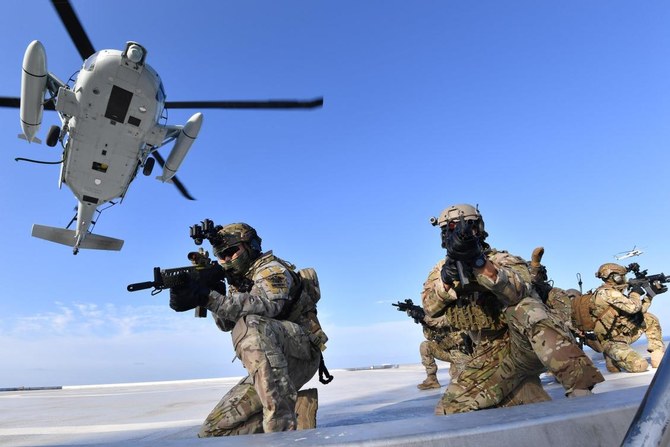
Expanded South Korean military drills around disputed island draw Japanese protest
- Tokyo and Seoul have long been at loggerheads over the sovereignty of the group of islets
- The Japanese foreign ministry called the drills unacceptable and said it had lodged a protest with South Korea


Latest updates


Recommended


© 2026 SAUDI RESEARCH & PUBLISHING COMPANY, All Rights Reserved And subject to Terms of Use Agreement.