Pakistan’s Senate chairman postpones UAE trip over Indian PM’s visit

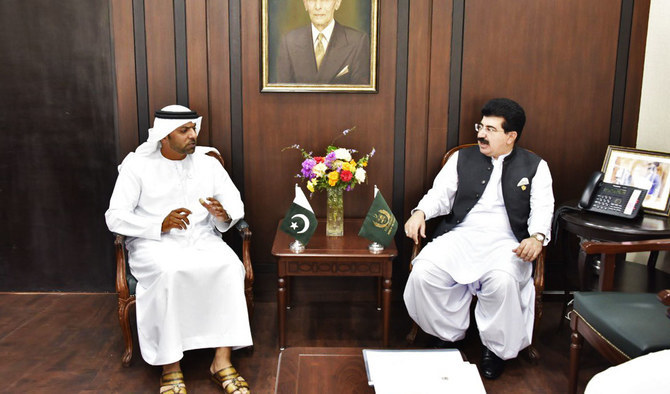
Pakistan’s Senate Chairman Muhammad Sadiq Sanjrani, right, discusses bilateral relations between Pakistan and United Arab Emirates with UAE envoy to Pakistan Hamad Obaid Alzaabi in Islamabad on Aug. 22, 2019. (Photo courtesy: UAE Embassy)
Updated 25 August 2019
Follow

Pakistan’s Senate chairman postpones UAE trip over Indian PM’s visit

  • Premier Modi was honored with the emirates’ highest civilian award on Saturday
  • Pakistan and UAE enjoy close bilateral ties, around 1.6 million Pakistani expatriates in the UAE

ISLAMABAD: Pakistan’s Senate chairman Sadiq Sanjrani postponed a trip to the UAE following Indian Prime Minister Narendra Modi’s visit to Abu Dhabi earlier this week, his office said in a statement on Saturday night.
Sanjrani was scheduled to travel to the emirates from August 25 to 28, but hours after PM Modi was honored with the “Order of Zayed” – the UAE’s highest civilian award – He announced his decision to postpone the visit.
“Pakistan strongly supports the freedom movement of Kashmiri people, while the Modi government is subjecting Kashmiri Muslims to extreme oppression and a curfew is imposed (in Indian administered Kashmir),” excerpts from the statement read.
“Under the given circumstances, a visit to the UAE would hurt the sentiments of Kashmiri mothers, sisters and old people. So the chairman canceled the visit of a parliamentary delegation,” it added.
On August 5, PM Modi’s government revoked Article 370 of the Indian constitution which accorded a special status to India-administered Kashmir.
The move generated widespread anger in Pakistan and Azad Kashmir.
Pakistan and the UAE enjoy close bilateral ties, with the UAE Crown Prince Sheikh Mohammad bin Zayed bin Sultan Al-Nahyan visiting Islamabad in January this year, following two visits by Prime Minister Imran Khan to the UAE last year to seek economic assistance. In December, the UAE announced a $3 billion financial support package for Pakistan.
According to the Ministry of Overseas Pakistanis, around 1.6 million expatriates live and work in the UAE and remit more than $4.5 billion to the country every year.


Pakistan assembly speaker, Indian FM shake hands in first high-level contact since May

Updated 5 sec ago
Follow

Pakistan assembly speaker, Indian FM shake hands in first high-level contact since May

  • Tensions persist between India and Pakistan after they engaged in brief military conflict in May this year
  • Pakistan assembly speaker, Indian FM both attend former Bangladesh PM Khaleda Zia’s funeral in Dhaka

ISLAMABAD: Pakistan’s National Assembly Speaker Sardar Ayaz Sadiq and India’s External Affairs Minister Subrahmanyam Jaishankar shook hands in Dhaka on Wednesday, establishing the first high-level contact between officials of both countries since their brief military conflict in May. 

Sadiq and Jaishankar arrived in Dhaka to attend the funeral of Bangladesh’s first female prime minister Khaleda Zia, who passed away earlier this week at the age of 80 after prolonged illness. Diplomats from several countries attended Zia’s funeral on Wednesday, which drew large crowds to the Bangladeshi capital. 

Tensions persist between nuclear-armed neighbors India and Pakistan, who engaged in a four-day military conflict in May this year. The conflict was triggered when India blamed Pakistan for supporting a militant attack in Indian-administered Kashmir in April that killed over 20 tourists. Pakistan denied involvement and called for a transparent probe into the incident. 

“Sardar Ayaz Sadiq, Speaker of the National Assembly of Pakistan, exchanges greetings with Indian External Affairs Minister S. Jaishankar in Dhaka on Wednesday ahead of the funeral program of former Bangladesh Prime Minister Khaleda Zia,” the official X account of Bangladesh’s Chief Adviser Muhammad Younus wrote. 

https://x.com/ChiefAdviserGoB/status/2006340330585833665

Sadiq also met Zia’s son Tarique Rahman, the acting chairperson of the Bangladesh Nationalist Party (BNP), to convey condolences over his mother’s demise from the people and government of Pakistan, the Pakistan High Commission in Bangladesh said.

“During the meeting, he recalled Begum Zia’s remarkable political leadership and noted her pivotal role in promoting historical affinities, mutual respect and cooperation between our two nations,” the high commission wrote on social media platform X.

https://x.com/PakinBangladesh/status/2006313161088204976

Senior officials from both India and Pakistan have refrained from shaking hands or exchanging pleasantries since the May conflict, as tensions persist between the two sides. 

The May conflict saw both countries exchange artillery fire, pound each other with fighter jets and trade missiles and drone strikes before Washington brokered a ceasefire on May 10. 

Sadiq is expected to meet senior officials of Bangladesh’s interim government during his trip, according to an earlier statement issued by his office.

Prime Minister Shehbaz Sharif had described Zia as a “committed friend of Pakistan” on Tuesday, praising her role in Bangladesh’s political life and expressing solidarity with the Bangladeshi people during what he called a difficult moment.

Zia, who served three terms as prime minister, led the BNP and remained a central figure in Bangladeshi politics despite years of ill health and imprisonment under the government of her longtime rival, Sheikh Hasina. She was released last year following Hasina’s ouster after a violent uprising.

Pakistan and Bangladesh were part of the same country until Bangladesh’s secession following a bloody civil war in 1971, an event that has long cast a shadow over bilateral ties. Relations remained largely strained for decades, shaped by historical grievances and political mistrust.

However, Islamabad enjoyed comparatively warmer ties with Dhaka during Zia’s tenure than under Hasina.

Engagement between Islamabad and Dhaka has increased since Hasina’s removal and the formation of an interim administration, with both sides signaling interest in improving political, diplomatic, economic and security ties.