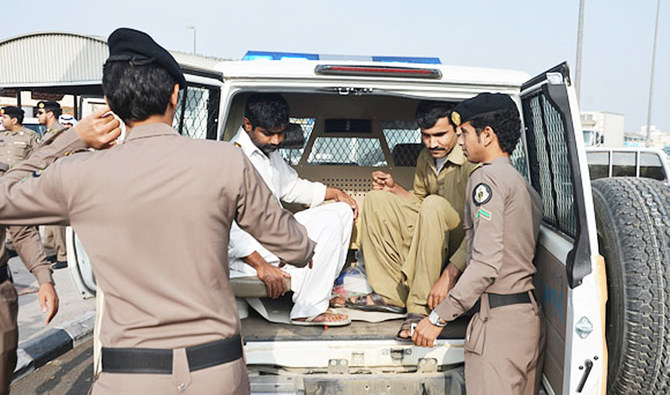
More than 3.7 million held for residency, border violations across KSA

Immediate penalties were imposed on 521,252 offenders. (Supplied)
Updated 24 August 2019
Follow

More than 3.7 million held for residency, border violations across KSA

  • 2,718 people were arrested for trying to cross the border into neighboring countries

RIYADH: More than 3.7 million violators of residency, work and border security systems have been arrested in Saudi Arabia, according to an official report.
Since the campaign began in November 2017, there have been 3,714,418 offenders, including 2,899,318 for violating residency regulations, 572,573 for labor violations and 242,527 for border violations, the Saudi Press Agency reported on Saturday.
The report said that 62,852 people were arrested while trying to cross the border into the Kingdom, 46 percent of whom were Yemeni citizens, 51 percent were Ethiopians and 3 percent were of other nationalities.
2,718 people were arrested for trying to cross the border into neighboring countries and 4,139 were arrested for involvement in transporting and harboring those violators. 1,543 Saudi citizens were arrested for harboring the violators against local laws, of which 86 are being detained, pending the completion of procedures.
The total number of offenders subject to procedures is 15,556, comprising 13,306 men and 2,250 women.
Immediate penalties were imposed on 521,252 offenders; 474,221 were transferred to diplomatic missions to obtain travel documents; 617,581 were transferred to complete their travel reservations, and 918,203 were deported. 


Fragrance artisans weave heritage into Jazan Festival experience

Updated 02 January 2026
Follow

Fragrance artisans weave heritage into Jazan Festival experience

Riyadh: Perfumes are emerging as living connections to ancestral memory at the Jazan Festival 2026, which opened on Friday, the Saudi Press Agency reported.

A narrative rooted in botanical origins is unfolding as veteran craftswomen showcase decades of accumulated wisdom, transforming the contents of native plants into small vessels that distill the human bond with terrain.

Aromas wafting through the space suggest imagery of regional ecosystems — fragrant vegetation cultivated across highland and lowland zones, harvested during optimal periods, then subjected to extended drying and distillation processes before materializing as perfumes and essences embodying geographical character, the Saudi Press Agency reported.

Arranged fragrance containers resemble nature’s output, composed by skilled practitioners versed in harvest timing, plant dormancy requirements and scent extraction methods, yielding products preserving organic integrity and territorial identity.

Craftswoman Fatima bint Mohammed Al-Faifi has dedicated two decades to perfume production, characterizing regional practice as social custom interwoven throughout daily existence — deployed in guest reception, featured at celebrations, accompanying community gathering — elevating scent to cultural signature, the Saudi Press Agency reported.

Festival attendees are discovering aromatic botanicals, absorbing production methodology explanations and discerning nuanced olfactory distinctions, demonstrating how craftsmanship blends persistence with expertise, tradition with innovation.

Perfume artisan involvement aligns with Jazan Festival’s initiative repositioning traditional crafts as dynamic, evolving culture while spotlighting women’s contributions safeguarding regional inheritance and expressing this through modern methods, the Saudi Press Agency reported.