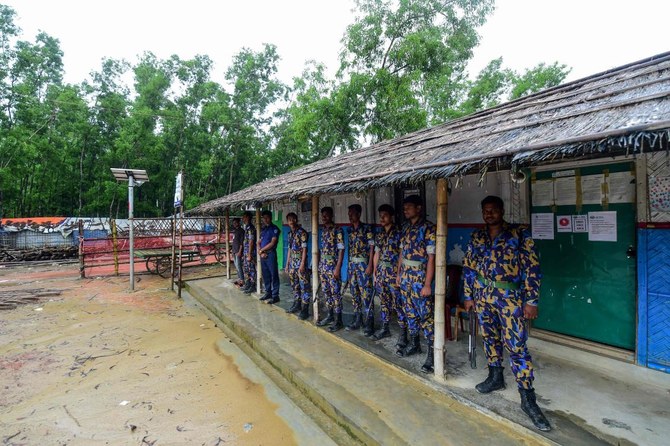
TEKNAF, Bangladesh: Bangladesh police said they had shot dead two Rohingya refugees during a gunfight in a refugee camp on Saturday after the pair were accused of killing a ruling party official.
Nearly a million Rohingya live in squalid camps in southeast Bangladesh, 740,000 of whom fled a 2017 military offensive against the Muslim minority in Myanmar.
Rights activists, who asked not to be named, said they believe the two Rohingya men were killed by police in what appeared to be a staged encounter.
The incident comes two days after a second failed attempt to repatriate the refugees, which saw not a single Rohingya turn up to return across the border to conflict-scarred Rakhine state.
“Both men died as they were rushed to a hospital,” local police inspector Rasel Ahmad told AFP, adding that the incident took place in Jadimura refugee camp in Cox’s Bazar district.
Ahmad said the two Rohingya were shot and critically injured during a manhunt for suspects after a youth wing official of the ruling Awami League party was killed, allegedly by armed refugees.
Awami League official Omar Faruk was shot in the head on Thursday, at a settlement near the border town of Teknaf, Ahmad said.
His murder had sparked anger among the local population, with hundreds of furious people blocking a key highway leading to the camps for hours, burning tires and vandalising shops visited by refugees.
Ahmad said the two men killed on Saturday had been identified as key suspects in Faruk’s killing and added that they had been shot while the officers were ambushed by the suspected criminals.
“It was wrong of the refugees to agitate the locals. We want justice in the quickest possible time,” said Abdul Matin, a friend of the deceased politician.
Refugees said the recent bloodshed has created an atmosphere of fear in the camps, where security has been tightened.
The killings came as the Rohingya are set to commemorate the second anniversary of their mass influx into Bangladesh from Rakhine after the brutal military campaign.
UN investigators have said the 2017 violence warrants the prosecution of top Myanmar generals for “genocide.”
On Thursday Bangladesh’s second attempt to start repatriation of Rohingya back to Myanmar faltered after the refugees said they won’t return unless their security is ensured and they were granted citizenship in their homeland.


![]()

Bangladesh police shoot dead two Rohingya in refugee camp
Bangladesh police shoot dead two Rohingya in refugee camp
- “Both men died as they were rushed to a hospital,” local police inspector Rasel Ahmad told AFP, adding that the incident took place in Jadimura refugee camp in Cox’s Bazar district
- Nearly a million Rohingya live in squalid camps in southeast Bangladesh, 740,000 of whom fled a 2017 military offensive against the Muslim minority in Myanmar

Latest updates


© 2026 SAUDI RESEARCH & PUBLISHING COMPANY, All Rights Reserved And subject to Terms of Use Agreement.