


CAIRO: Egypt is seeking Japan’s help to improve its education system, which has fallen to 130th place in international rankings.
The Japanese education system is recognized as one of the top five worldwide, and Cairo is hoping to apply key aspects of Japan’s approach to the Egyptian curriculum.
Education has played a major role in transforming Japan from a feudal state receiving aid following World War II to a modern economic powerhouse.
During a visit to Japan in 2016, Egyptian President Abdel Fattah El-Sisi discussed political and economic development with Japanese officials, and was also briefed on the Japanese education system.
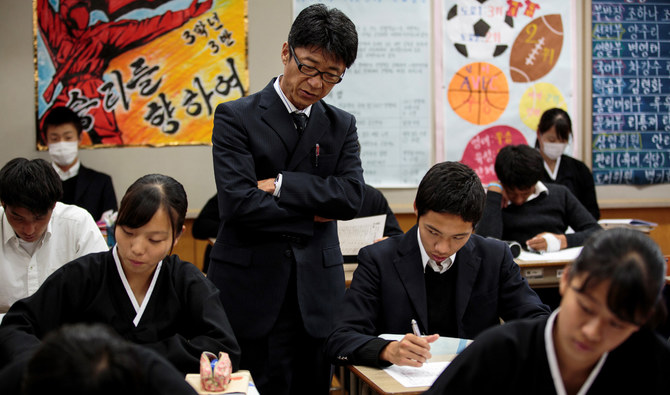
The Egyptian leader visited Japanese schools and called on Japan to help Egypt introduce a similar system in its schools.
As part of Egyptian-Japanese cooperation, Japan’s embassy established cultural cooperation as well as technical and professional education links between the two countries. Collaboration has been strengthened from kindergarten to post-university, with Japanese experts contributing in various education fields.
Japanese experts have held seminars in schools across the country, focusing on basic education.
During one seminar, Japan highlighted the importance of enhancing education by playing games during kindergarten and primary school, encouraging children’s ability and desire to explore.
Education expert Ola El-Hazeq told Arab News that the Japanese system focuses on developing students’ sense of collective worth and responsibility toward society. This starts with their surrounding environment by taking care of school buildings, educational equipment and school furniture, for example.
“Japanese schools are known for being clean,” El-Hazeq said. “The first thing that surprises a school visitor is finding sneakers placed neatly in a locker or on wooden shelves at the school entrance. Each sneaker has its owner’s name on it. This is a habit picked up at most primary and intermediate schools as well as in many high schools.”
Japanese students also clean their classrooms, collect leaves that have fallen in the playground and take out the garbage. In many cases, teachers join students to clean up schools and also public gardens and beaches during the summer holidays.
El-Hazeq added that neither the teachers nor the students find it beneath their dignity to carry out such chores.
The academic year in Japan continues for almost 11 months, different from most other countries, with the Japanese academic year starting on April 1 and ending on March 31 the following year.
Japan’s school days and hours are relatively longer in comparison with other countries. Usually the school day is from 8 a.m. to 4 p.m. Teachers normally work until 5 p.m. but sometimes up to 7 p.m. Holidays are shorter than in other countries. Spring and winter holidays are no longer than 10 days, and the summer holiday ranges from 40 to 45 days.


