BAGHDAD: The head of Iraq’s paramilitary Shiite forces, supported by Iran, on Thursday appeared to walk back a statement by his deputy the day before blaming Israeli drones and claiming the US was responsible for a series of attacks on bases run by the militia.
Faleh Al-Fayyadh said the statement by his deputy, Abu Mahdi Al-Muhandis, did not represent the view of the mainly Shiite paramilitary group known as Popular Mobilization Forces — or the view of the Iraqi government. Al-Fayyadh’s statement alleged the attacks on the bases over the past weeks “were the result of an act organized by a foreign side,” but refrained from naming that side.
The statements highlight divisions within the Shiite militia force, headed by Al-Fayyadh but practically run by his deputy, a powerful military commander known for his anti-American sentiments. The militia group’s website published only Al-Muhandis’ statement on Thursday.
Iraq’s fragile government is walking a fine line trying to manage its alliances with both the United States and Iran amid rising tensions between the two.
Iran wields powerful influence through its support of the Shiite militias, which are sanctioned by the Iraqi government and which were a major force in the fight against Daesh. At the same time, Iraq hosts American troops and forces belonging to the US-led coalition fighting Daesh.
The statements by Al-Fayyadh and Al-Muhandis followed at least three mysterious explosions at militia bases and munitions depot around Iraq over the past month, including a massive blast near Baghdad that killed one civilian and wounded 28. A government investigation, a copy of which was obtained by The Associated Press on Wednesday, found the blast near Baghdad on Aug. 12 was caused by a drone strike.
The blast has also given rise to a host of theories, including that Israel may have been behind the attacks. Israel has struck Iranian bases in neighboring Syria on numerous occasions, and there has been speculation that it might be expanding its campaign to target Iranian bases to Iraq. Israel has neither confirmed nor denied the reports.
On Wednesday, the statement signed by Al-Muhandis said that the militia group had information that the US brought four Israeli drones from Azerbaijan to Iraq “as part of the US fleet” to carry out reconnaissance and targeting of militia positions. It was not clear from the statement who was being accused of carrying out the attacks but the militia said it holds the US “ultimately responsible for what happened.”
The Iraqi government did not address the statement by Al-Muhandis, which appears to have been issued without prior consultation with Iraqi security forces — an embarrassing sign of how the militias operate independently.
American officials denied the US had any role in the explosions.
“The US is not involved in the recent warehouse explosions,” said Navy Cmdr. Sean Robertson, a Pentagon spokesman.


![]()

Head of Iran-backed militia in Iraq walks back US accusation
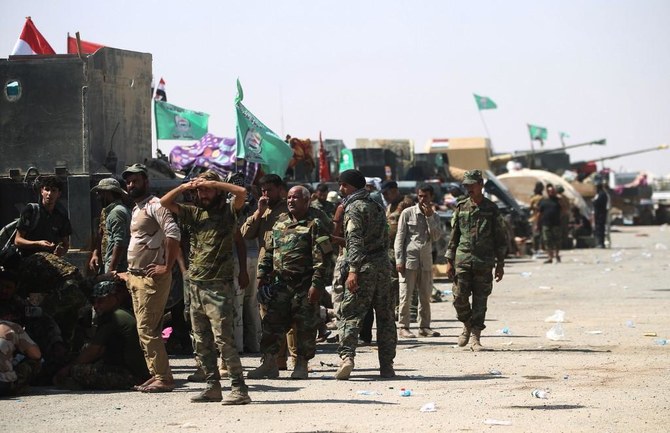
Head of Iran-backed militia in Iraq walks back US accusation
- The statements by Al-Fayyadh and Al-Muhandis followed at least three mysterious explosions at militia bases and munitions depot around Iraq over the past month
- Al-Fayyadh’s statement alleged the attacks on the bases over the past weeks “were the result of an act organized by a foreign side”


Latest updates


© 2026 SAUDI RESEARCH & PUBLISHING COMPANY, All Rights Reserved And subject to Terms of Use Agreement.