PARIS: French leader Emmanuel Macron backed the idea of a month of further talks to find a solution to Brexit while ruling out major compromises as he met British Prime Minister Boris Johnson for talks on Thursday.
Like German Chancellor Angela Merkel on Wednesday, Macron supported allowing another 30 days to find a solution to the vexed issue of the Irish border which has bedevilled negotiations since 2017.
“We need to try to have a useful month,” Macron said alongside Johnson who insisted that solutions were “readily available” to prevent checkpoints returning in divided Ireland.
But Macron, who admitted he had a reputation as the “hardest in the gang” on Brexit, has rejected Johnson’s calls to scrap a key arrangement for Ireland negotiated between the EU and former British premier Theresa May.
At stake is the so-called “backstop,” which is a provision guaranteeing that border checks will not return between EU member Ireland and Northern Ireland which is part of Britain.
Johnson considers the backstop to be “anti-democratic” and an affront to British sovereignty because it will require London to keep its regulations aligned with the EU during a transition exit period.
“The technical solutions are readily available (to avoid checkpoints) and they have been discussed at great length,” Johnson said. “You can have trusted trader schemes, you can have electronic pre-clearing.”
The EU argues the backstop is necessary to avoid the re-emergence of checkpoints which could lead to a return of fighting on the divided island where anti-British violence has claimed thousands of lives.
“I want to be very clear. In the coming month, we will not find a new withdrawal agreement that is far from the fundamentals,” Macron said at the Elysee palace in central Paris.
Since Johnson’s ascent to power last month, the chances of a “no deal” Brexit on October 31 have risen, which economists see as likely to wreak economic damage on Britain and the EU.
“The EU and member states need to take the possibility of a ‘no deal’ outcome much more seriously than before,” a senior EU official told reporters in Brussels on Thursday on condition of anonymity.
A French official said on Wednesday that this was becoming the “most likely” scenario.
The Paris visit was the second leg of Johnson’s first foreign trip as prime minister.
On Wednesday, he was in Berlin for talks with Merkel who appeared to offer a glimmer of hope by saying Britain should try to find a breakthrough to the issue over the next month.
“I want a deal,” Johnson told Macron. “I think we can get a deal and a good deal.”
He added that he had been “powerfully encouraged” by his talks with Merkel. “I admire that ‘can do’ spirit that she seemed to have.”
But many Brexit watchers see Merkel’s remarks as fitting a pattern in which she has often been more conciliatory in public about Brexit than Macron, whose abrasive remarks have caused anger in London in the past.
“There is not the width of cigarette paper between Paris and Berlin on these issues,” a senior aide to Macron said on Wednesday on condition of anonymity.
The EU official in Brussels added that the EU was “a little concerned based on what we heard yesterday (in Berlin).”
“We are waiting for new facts, workable ideas,” the official added.
Johnson, who has deployed his French language skills to charm diplomats in Paris before, has staked his leadership on withdrawing Britain from the EU by the current deadline of October 31 — “do or die.”
Some analysts see a risk of relations between Macron and Johnson becoming stormy in public, which could lead to a blame game about a “no deal” Brexit.
Johnson reportedly once called the French “turds” over their stance on Brexit during his time as foreign secretary — remarks he later said he could not recall.
But Macron pre-empted any attempt to deflect blame onto the European side during a press conference on Wednesday before Johnson’s arrival.
“It will be the responsibility of the British government, always, because firstly it was the British people that decided Brexit, and the British government has the possibility up to the last second to revoke Article 50,” he said.
Article 50 is the legal mechanism used by EU members states to withdraw from the bloc which was triggered by Britain in March 2017.
At the weekend, Macron, Merkel and Johnson will meet US President Donald Trump, a vocal supporter of both Brexit and Johnson, at a G7 summit in the French seaside resort of Biarritz.


Macron backs month of Brexit talks as Johnson visits
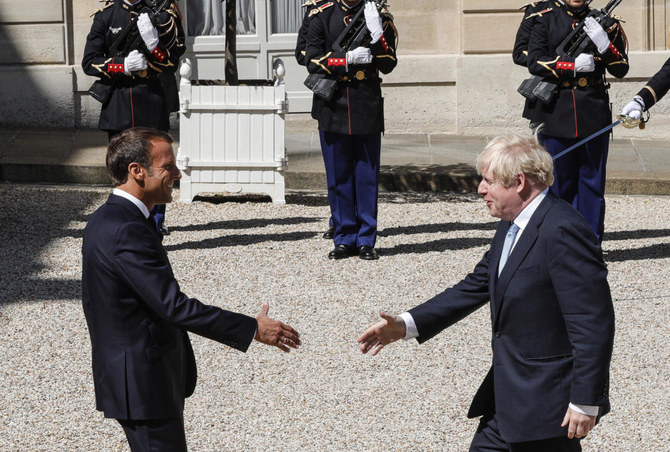
Macron backs month of Brexit talks as Johnson visits

- Macron has rejected Johnson’s calls to scrap a key arrangement regarding Ireland
- The EU argues the backstop is necessary to avoid the re-emergence of checkpoints in Ireland


Greek court to deliver verdict on 2022 spyware scandal
- Predator is sophisticated software that makes it possible to infiltrate mobile phones, access messages and photos, and even remotely activate the microphone and camera
Athens: A Greek court was due Thursday to deliver its verdict on an illegal wiretapping scandal targeting politicians, journalists, business leaders and senior military officials that shook the conservative government in 2022.
Dubbed the "Greek Watergate" by local media, it forced the resignation of senior officials in Prime Minister Kyriakos Mitsotakis's administration.
Four defendants -- two Israelis including a former soldier and two Greeks -- face up to five years in prison for violating the confidentiality of telephone communications. They deny involvement.
The sentences are expected to be suspended, to the outrage of lawyers for the victims. The defendants could benefit from a 2019 law under which breaches of the confidentiality of communications are classed as a misdemeanour.
The defendants include Tal Dilian, a former Israeli soldier and founder of Intellexa, a company specialising in the supply of spyware, which marketed the Predator software in Greece.
His partner, as well as two former Greek executives of the company, are also on trial.
According to Greek media reports, Dilian, who remains free pending judgement, is not expected to be in court for the verdict.
Politicians, journalists monitored
The affair broke in early 2022 when a Greek investigative journalist, Thanassis Koukakis, discovered he had been wiretapped by the intelligence services (EYP) and that his phone had also been infected with the Predator spyware.
Predator is sophisticated software that makes it possible to infiltrate mobile phones, access messages and photos, and even remotely activate the microphone and camera.
"The government initially played down the affair to cover for the real political culprits," Koukakis told AFP in an interview a few months ago.
According to the Greek Authority for Communication Security and Privacy watchdog (ADAE) however, it was used against more than 90 people.
It snowballed into a political scandal in July 2022, when the soon-to-be leader of the socialist Pasok-Kinal party, Nikos Androulakis, revealed that his mobile phone had also been tapped.
At the time, Androulakis was a member of the European Parliament.
Facing mounting pressure, Mitsotakis insisted that the government had "never purchased or used" Predator.
The prosecutor in the case however made it clear he found that difficult to accept in his closing arguments earlier this month.
"Predator is not accessible to private individuals; it is only offered for sale to state services," he told the court.
High-level resignations
The "Greek Watergate" led to the resignation of one of the prime minister's closest aides, his nephew Grigoris Dimitriadis.
The head of the EYP intelligence service also stepped down.
Mitsotakis later weathered a motion of no confidence in parliament.
In July 2024, the Supreme Court cleared the intelligence services and political officials of wrongdoing, angering victims and human rights bodies.
Paris-based media rights campaigners Reporters Without Borders (RSF) has described this case as "a fresh blow to media freedom" in Greece.
Only two proven victims of Predator were questioned by the Supreme Court, and the prosecutor did not request access to the bank accounts of the company that marketed the software.
The Greek employees who, in December 2021, hurriedly moved the servers out of their office were not questioned either.
"One may wonder whether the case was really investigated or whether everything was done to bury it," Androulakis's lawyer, Christos Kaklamanis, told the court.
The socialist leader has filed an appeal with the European Court of Human Rights (ECHR).


