

Russia to send ‘Fedor’ its first humanoid robot into space

1 / 2
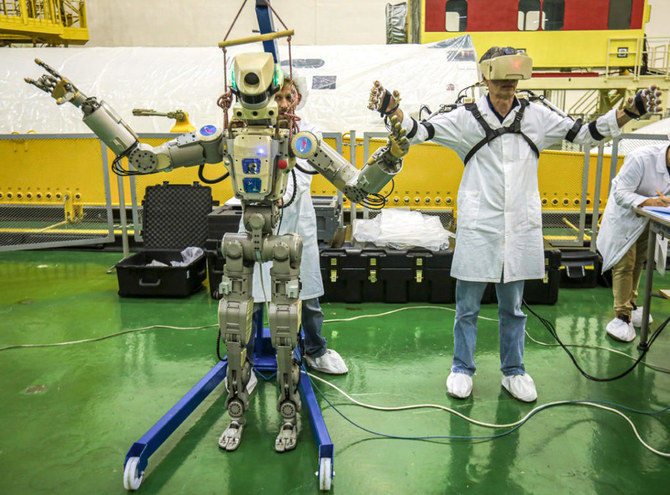
This handout picture taken on July 26, 2019 and released by the official website of the Russian State Space Corporation ROSCOSMOS on August 21, 2019 shows Russian humanoid robot Skybot F-850 (Fedor) being tested ahead of its flight on board Soyuz MS-14 spacecraft at the Baikonur Cosmodrome in Kazakhstan. (AFP)
2 / 2
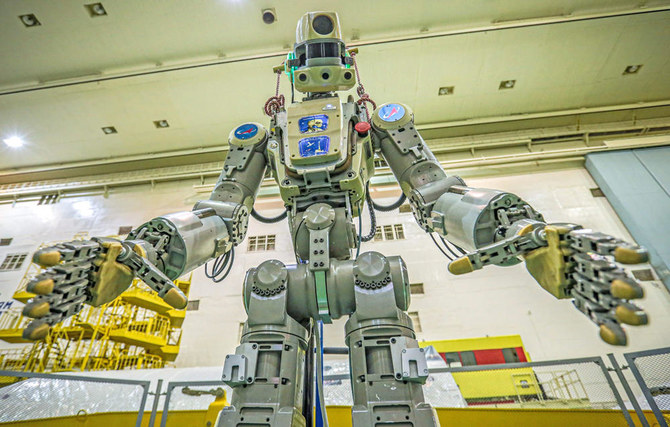
This handout picture taken on July 26, 2019 and released by the official website of the Russian State Space Corporation ROSCOSMOS on August 21, 2019 shows Russian humanoid robot Skybot F-850 (Fedor) being tested ahead of its flight on board Soyuz MS-14 spacecraft at the Baikonur Cosmodrome in Kazakhstan. (AFP)
Updated 22 August 2019
Follow

Russia to send ‘Fedor’ its first humanoid robot into space

  • Fedor was to blast off in a Soyuz rocket at 6:38 am Moscow time (0338 GMT) from Russia’s Baikonur cosmodrome
  • Fedor is not the first robot to go into space

MOSCOW: Russia was set to launch on Thursday an unmanned rocket carrying a life-size humanoid robot that will spend 10 days learning to assist astronauts on the International Space Station.
Named Fedor, for Final Experimental Demonstration Object Research with identification number Skybot F850, the robot is the first ever sent up by Russia.
Fedor was to blast off in a Soyuz rocket at 6:38 am Moscow time from Russia’s Baikonur cosmodrome in Kazakhstan, dock with the space station on Saturday and stay till September 7.
The Soyuz spacecraft is normally manned on such trips, but on Thursday no humans will be traveling in order to test a new emergency rescue system.
Instead of cosmonauts, Fedor will sit in a specially adapted pilot’s seat.

The silvery anthropomorphic robot stands one meter 80 centimeters tall (5 foot 11 inches) and weighs 160 kilograms (353 lbs).
Fedor has Instagram and Twitter accounts that describe it as learning new skills such as opening a bottle of water. In the station, it will trial those manual skills in very low gravity.
“That’s connecting and disconnecting electric cables, using standard items from a screwdriver and a spanner to a fire extinguisher,” the Russian space agency’s director for prospective programs and science, Alexander Bloshenko, said in televised comments.
Fedor copies human movements, a key skill that allows it to remotely help astronauts or even people on Earth carry out tasks while they are strapped into an exoskeleton.
Such robots will eventually carry out dangerous operations such as space walks, Bloshenko told RIA Novosti state news agency.
On the website of one of the state backers of the project, the Foundation of Advanced Research Projects, Fedor is described as potentially useful on Earth for working in high radiation environments, de-mining and tricky rescue missions.
On board, the robot will perform tasks supervised by Russian cosmonaut Alexander Skvortsov, who joined the ISS last month, and will wear an exoskeleton in a series of experiments scheduled for later this month.

Robonaut 2, Kirobo
Space agency chief Dmitry Rogozin showed pictures of the robot to President Vladimir Putin this month, saying it will be “an assistant to the crew.”
“In the future we plan that this machine will also help us conquer deep space,” he added.
Fedor is not the first robot to go into space.
In 2011, NASA sent up Robonaut 2, a humanoid robot developed with General Motors and a similar aim of working in high-risk environments.
It was flown back to Earth in 2018 after experiencing technical problems.
In 2013, Japan sent up a small robot called Kirobo along with the ISS’s first Japanese space commander. Developed with Toyota, it was able to hold conversations — albeit only in Japanese.


Heavy shelling, explosions spark fear along Pakistan-Afghanistan border 

Updated 2 sec ago
Follow

Heavy shelling, explosions spark fear along Pakistan-Afghanistan border 

  • Residents fear for their safety amid border clashes
  • 1,500 Afghan families displaced ‌due to heavy shelling and explosions
  • Pakistan denies targeting civilians, says its strikes focus on militants

LAL PUR, Afghanistan/PESHAWAR, Pakistan: People living along Pakistan’s border with Afghanistan said they ​were considering fleeing their homes because of heavy shelling and explosions as fighting between troops from both sides entered a seventh day on Wednesday.
The South Asian allies-turned-foes have engaged in their worst fighting in years following Pakistani airstrikes on major Afghan cities last week, increasing volatility in a region also on edge over US and Israeli strikes on Iran.
Islamabad has said its airstrikes, which have at times directly targeted the Taliban government, are aimed at ending Afghan support for militants carrying out attacks on Pakistan. The Taliban has denied aiding militant groups.

SHELLING ‌STARTS AS VILLAGERS ‌ARE BREAKING RAMADAN FAST
Residents of towns and villages in ​Pakistan’s ‌northwest ⁠said fighting between ​border ⁠forces starts in the evenings, placing their homes in the line of fire, often at sunset when families are breaking their fast in the holy month of Ramadan.
“There is complete silence in the day, but the moment we sit for iftar dinner, the two sides start shelling,” Farid Khan Shinwari from Landi Kotal, a town near the Torkham border crossing, told Reuters.
“We open our fast in extremely difficult situations, as you never know when a shell can hit your house.”
Residents ⁠in the town and nearby villages said there had been heavy ‌shelling and some explosions heard in the past ‌few days, prompting many to flee their homes.
On the other ​side of the border, Afghans shared similar stories ‌of skirmishes and families fleeing their homes.
Hundreds had been displaced to an open ‌dirt field under makeshift tents, while others had no shelter at all. Officials say around 1,500 families have fled their homes.
Fighting along the 2,600-km (1,615-mile) border has ebbed and flowed over the week-long conflict, with both sides saying they have inflicted heavy losses on the other country and gained ground in the fighting.
Reuters ‌has been unable to verify these accounts.

TURKEY HAS OFFERED TO MEDIATE
Turkish President Recep Tayyip Erdogan told Pakistani Prime Minister Shehbaz Sharif that ⁠Ankara would help ⁠reinstate a ceasefire, the Turkish Presidency said on Tuesday, as other countries that had offered to mediate have since been hit by the conflict in the Gulf.
On Wednesday, both countries reported exchanges of heavy fire, with Afghanistan’s defense ministry saying Taliban forces shot down a Pakistani drone and captured seven border posts.
A spokesperson for the ministry said 110 civilians, including 65 women and children, had been killed since the fighting began and another 123 were wounded. The United Nations mission for Afghanistan has listed 42 deaths so far.
Pakistan’s Information Minister Attaullah Tarar disputed both figures, saying: “Pakistan exercises great care in only targeting terrorists and support infrastructure. No civilian structures have been targeted.”
On Saturday, Pakistan struck “ammunition and critical equipment” at the Bagram air base north ​of Kabul, Tarar said, a key American command ​center through the 20-year Afghan war.