

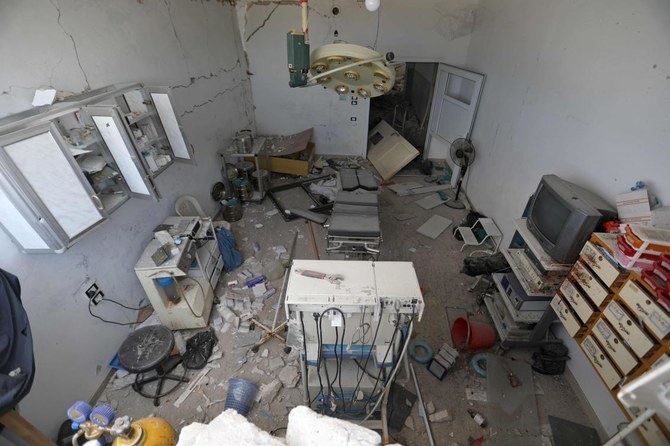

DUBAI: Airstrikes hit a hospital in a rebel-held village in northwestern Syria, knocking it out of service early on Wednesday, opposition activists said as government forces pressed their offensive on the last major rebel stronghold in the war-torn country.
There was no immediate word on casualties from the airstrike on the Rahma hospital in Tel Mannas, said the Britain-based Syrian Observatory for Human Rights and the Thiqa news agency, an activist collective.
The Observatory said the hospital was struck four times but that it had been evacuated hours earlier.
Earlier this month, UN Secretary-General Antonio Guterres authorized an investigation into attacks on health facilities and schools in the rebel-held enclave, following a petition from Security Council members.
Wednesday’s airstrike was one of several to hit Idlib province, home to some 3 million people and the area where government forces have been on the offensive for months.
The violence came a day after the main insurgent group in Idlib pulled out of Khan Sheikhoun, a key rebel town, as government forces advanced in the area slowly, clearing land mines and explosives.
The withdrawal of Al-Qaeda-linked Hayat Tahrir Al-Sham from Khan Sheikhoun is a blow to the opposition. Syrian government forces have been on the offensive in Idlib and northern parts of Hama province since April 30, which have killed more than 2,000 people, including hundreds of civilians.
Ten of thousands of people have fled to Syria’s border with Turkey in the last few days, residents, rights groups and opposition sources said on Wednesday.
They left Maarat Al-Numan, a city in Idlib province that has been a sanctuary for families fleeing former rebel areas, as a Russian-led push has come close to capturing the strategic town of Khan Sheikhoun further south.
“The flow of cars and vehicles leaving is not stopping,” said Abdullah Younis from the city. Rescuers there said around 60,000 people had fled in the last four days alone.
On Tuesday, Russian and Syrian jets intensified their bombing of scattered villages and towns around Maarat Al-Numan, with the Al-Rahma hospital in the area struck, residents said.
“There were 15 raids on Jarjanaz in less than five minutes,” Abdul Rahman al Halabi told Reuters from the area.
On Wednesday, government forces captured the Teraei Hill, east of the town of Khan Sheikhoun. Syrian government forces are trying to capture more ground to meet troops marching from the west in order to lay siege on rebel-held towns and villages in the central province of Hama, according to the Observatory.
Activists also reported fighting in the rebel-held areas in the Jabal Al-Akrad region in the coastal province of Latkia.
State media, broadcasting from the outskirts of Khan Sheikhoun on Tuesday, said government forces were battling militants but had extended their advance and seized a highway running through the town.
Capturing Khan Sheikhoun would be an important gain for Moscow and its ally into the northwestern region, where Moscow has helped President Bashar Assad turn the tide against insurgents in the eight year conflict since stepping up its intervention in 2015.
Russia has thrown its weight behind the campaign, conducting thousands of raids and strikes on rebel-held northern Hama and southern Idlib in what Western military experts and opposition figures say is a “scorched earth strategy.”
Foreign Minister Sergei Lavrov acknowledged on Tuesday that Russia had military personnel on the ground in Idlib province, the Interfax news agency quoted him as saying.
The Russian military has previously downplayed its direct role in the advance, where it used mercenaries and special forces as well as directing battles, according to Western intelligence sources.
The fall of Khan Sheikhoun ends rebel control over neighboring northern Hama province, where a leading rebel group, Jaish Al-Izza, had been until now defending the three major towns of Latamneh, Kfr Zita and Morek.
The latest Russian-backed advance since a cease-fire broke down over two weeks ago has been aided by thousands of new reinforcements including Iranian-backed militias who had been absent from earlier battles.
Rebels said a Turkish patrol on Wednesday moved from one of a dozen military posts established in the area under agreements reached with Russia in what they said was a message by Ankara that it won’t succumb to Syrian government pressure to pull out.
A suspected Syrian army strike on Monday hit a Turkish military convoy heading to an observation post near Khan Sheikhoun. Damascus denounced what it said was a Turkish attempt to save routed rebels.
The Turkish presence in northwestern Syria and extensive covert military aid it has extended to some Ankara-backed rebel factions had complicated the campaign to seize the last rebel bastion, both Syrian military experts and rebels say.
A senior Turkish security official told Reuters talks were going on with Russia over the fate of convoy that was en route to an outpost near the frontline and that it had not moved since the strike but there was no question “it would be abandoned.”
After months of stalemate Russia has increased the intensity of raids in the last 10 days, transforming the situation on the ground. Hundreds of civilians have been killed and at least 400,000 people displaced, according to medics and NGOs and the United Nations.
The Syrian Network for Human Rights,(SNHR), which monitors casualties and briefs various UN agencies, said 196 children were among the 843 civilians killed in the Russian and Syrian raids since the campaign began last April.
“The bombing has escalated this week and this makes it likely they will win since they are absolving themselves from the rules of war by indiscriminate bombing of civilian areas and use of internationally banned weapons,” Fadel Abdul Ghany, chairman of SNHR, told Reuters.
Moscow and Damascus, who deny indiscriminate bombing of civilians areas or targeting hospitals, say they are fighting extremist militants drawn from across the world.
(With AP and Reuters)


