

Space telescope offers rare glimpse of Earth-sized rocky exoplanet

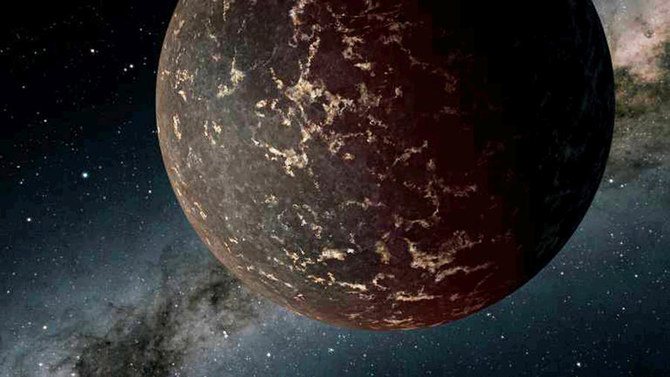
An artist's conception of an exoplanet beyond our own solar system known to astronomers as LHS 3844b, which lies about 48.6 light years from Earth is shown in this handout photo obtained August 19, 2019. (NASA-JPL/Handout via REUTERS)
Updated 20 August 2019
Follow

Space telescope offers rare glimpse of Earth-sized rocky exoplanet

  • LHS 3844b, an exoplanet about 1.3 times the size of Earth, is locked in a tight orbit around a small, relatively cool star called a red dwarf

Direct observations from a NASA space telescope have for the first time revealed the atmospheric void of a rocky, Earth-sized world beyond our own solar system orbiting the most common type of star in the galaxy, according to a study released on Monday.
The research, published in the scientific journal Nature, also shows the distant planet’s surface is likely to resemble the barren exterior of the Earth’s moon or Mercury, possibly covered in dark volcanic rock.
The planet lies about 48.6 light years from Earth and is one of more than 4,000 so-called exoplanets identified over the past two decades circling distant stars in our home galaxy, the Milky Way.
Known to astronomers as LHS 3844b, this exoplanet about 1.3 times the size of Earth is locked in a tight orbit — one revolution every 11 hours — around a small, relatively cool star called a red dwarf, the most prevalent and long-lived type of star in the galaxy.
The planet’s lack of atmosphere is probably due to intense radiation from its parent red dwarf, which, though dim by stellar standards, also emits high levels of ultraviolet light, the study says.
The study will likely add to a debate among astronomers about whether the search for life-sustaining conditions beyond our solar system should focus on exoplanets around red dwarfs — accounting for 75% of all stars in the Milky Way — or less common, larger, hotter stars more like our own sun.
The principal finding is that it probably possesses little if any atmosphere — a conclusion reached by measuring the temperature difference between the side of the planet perpetually facing its star, and the cooler, dark side facing away from it.
A negligible amount of heat carried between the two sides indicates a lack of winds that would otherwise be present to transfer warmth around the planet.
“The temperature contrast on this planet is about as big as it can possibly be,” said researcher Laura Kreidberg of the Harvard-Smithsonian Center for Astrophysics in Cambridge, Massachusetts. She is lead author of the study. Similar analysis previously was used to determine that another exoplanet, 55 Cancri e, about twice as big as Earth and believed to be half-covered in molten lava, likely possesses an atmosphere thicker than Earth’s. This exoplanet, unlike LHS 3844b, orbits a sun-like star.
The planet in the latest study was detected last year by NASA’s newly launched Transiting Exoplanet Survey Satellite, an orbiting telescope that pinpoints distant worlds by spotting periodic, dips in the light observed from their parent stars when an object passes in front of them.
But it was follow-up observations from another orbiting instrument, the Spitzer Space Telescope, which can detect infrared light directly from an exoplanet, that provided new insights about its features.


Apple to update EU browser options, make more apps deletable

Updated 22 August 2024
Follow

Apple to update EU browser options, make more apps deletable

  • iPhone maker came under pressure from regulators to make changes after the EU’s sweeping Digital Markets Act took effect on March 7
  • Apple users will be able to select a default browser directly from the choice screen after going through a mandatory list of options

STOCKHOLM: Apple will change how users choose browser options in the European Union, add a dedicated section for changing default apps, and make more apps deletable, the company said on Thursday.
The iPhone maker came under pressure from regulators to make changes after the EU’s sweeping Digital Markets Act took effect on March 7, forcing big tech companies to offer mobile users the ability to select from a list of available web browsers on a “choice screen.”
The new rules require mobile software makers to show the choice screen where users can select a browser, search engine and virtual assistant as they set up their phones, which earlier came with preferred options from Apple and Google.
In an update later this year, Apple users will be able to select a default browser directly from the choice screen after going through a mandatory list of options.
A randomly ordered list of 12 browsers per EU country will be shown to the user with short descriptions, and the chosen one will be automatically downloaded, Apple said. The choice screen will also be available on iPads through an update later this year.
Apple released a previous update in response to the new rules in March, but browser companies criticized the design of its choice screen, and the Commission opened an investigation on March 25 saying it suspected that the measures fell short of effective compliance.
The company said it has been in dialogue with the European Commission and believes the new changes will address regulators’ concerns.
It also plans to introduce a dedicated area for default apps where a user will be able to set defaults for messaging, phone calls, spam filters, password managers and keyboards.
Users will also be able to delete certain Apple-made apps such as App Store, Messages, Camera, Photos and Safari. Only Settings and Phone apps would not be deletable.