

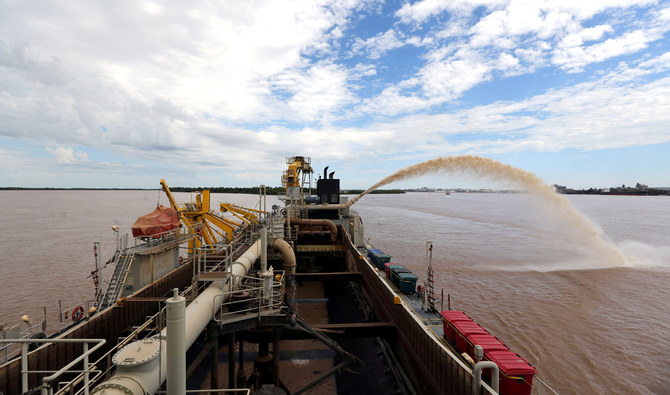

BUENOS AIRES: Chinese state-owned construction giant CCCC is preparing a bid to dredge Argentina’s Parana River, the country’s main cargo superhighway that takes soy and corn from the Pampas farm belt to the shipping lanes of the south Atlantic and the world.
Representatives of China Communications Construction Co. Ltd. and its Shanghai Dredging unit have met with Argentine government and local port officials to sound out the dredging concession, according to three people involved in the talks, which have not been previously reported.
CCCC is at the forefront of China’s push to lock in food supplies by investing in commodities transport hubs globally.
Dredging the Parana is the biggest logistics contract in Argentina. China is already the main buyer of Argentine soybeans while Chinese state-owned conglomerate Cofco has, through acquisitions, become the biggest agricultural commodities exporter operating in Argentina.
Shanghai Dredging’s interest in the Parana appears part of China’s broader effort to “invest across international agricultural supply chains to better control supply and pricing,” said Margaret Myers, head of the Asia-Latin America program at the Inter-American Dialogue, a Washington-based think tank.
From 2005 through the first half of this year China invested about $579 billion internationally in the energy, power, transport and agricultural sectors, according to Washington-based American Enterprise Institute’s Chinese Global Investment Tracker, of which $71 billion went to South America.
There have been a flurry of meetings between the world’s main dredging firms and port operators preparing a study of the river as a preliminary step to issuing an invitation for bids next year, according to Argentina’s Port and Maritime Activities Chamber and the ACSOJA soy industry chamber.
The Parana carries 80% of Argentine farm exports. (Graphic on river: https://tmsnrt.rs/2YEkvtl)
Marcos De Vincenzi, dredging manager for Servimagnus, CCCC’s local partner, acknowledged the Chinese firm’s interest in the concession, saying, “We think that the dredging of the waterway must be upgraded to meet its new traffic and trade needs.”
As world food demand increases, Argentina will likely expand the Parana’s navigable channel to accommodate increased cargo.
Argentina is already the world’s top exporter of soymeal livestock feed and a major global supplier of corn and wheat, and this week’s crash of the Argentine peso, driven by political uncertainty ahead of the October presidential election, has made the country’s farm exports more competitive.
Argentina’s transportation ministry declined to comment for this story, and CCCC officials in China did not respond to requests for comment.
The Parana is dredged deep enough to allow ocean-going cargo ships to get into the heart of the grains belt, giving Argentina an advantage over agricultural rivals Brazil and the United States, where products move long distances by less-efficient trucks and barges before being loaded for export.
Going deeper
The dredging concession, set for renewal in April 2021, involves keeping a channel in the river clear for cargo ships. In return, larger vessels pay up to $80,000 in tolls to travel to and from the grains hub of Rosario on the Parana.
The current holder of the dredging concession is private, Luxembourg-based dredger Jan De Nul. The firm will compete with CCCC and other dredgers for the 2021 concession, according to industry sources with direct knowledge of the situation.
In a meeting with port operators, Servimagnus offered to dredge the Parana deeper than its current 34 feet, without increasing tolls, said a ports source who attended the meeting and is involved in drawing up the tender.
Each additional foot of depth would increase efficiency by allowing ships to carry 1,800 tons to 2,500 tons of additional cargo.
“China is already our principal buyer of soybeans. For them to also have control over navigation would give them a very strong stance in negotiating prices,” said the ports source, who asked not to be named due to the sensitivity of the matter.
Myers, of the Inter-American Dialogue, said Argentine authorities should be wary of becoming over reliant on investment or finance from any one economic partner.
“Extensive Chinese presence in critical sectors could give China undue influence over Argentine decision-making,” she said.
Others argue China could help to keep river cargo tolls down by bolstering competition among dredgers bidding for the job.
“I see no problem in receiving offers from all serious companies around the world to make them compete,” said Luis Zubizarreta, president of Argentina’s ACSOJA soy industry organization that represents farmers, exporters and seed firms.


