BEIJING: Luckin Coffee turned in a bigger-than-expected loss as costs ballooned on store openings and heavy discounts aimed at competing with Starbucks, driving the Chinese firm’s US-listed stock down sharply on Wednesday.
The startup, which opened its doors early last year and listed its shares in May, spent aggressively and opened 593 new stores in the June quarter, its first as a public company.
While the brisk spending fueled a seven-fold jump in revenue growth over the period, losses widened and costs ballooned more than three times as it offered cut-price alternatives to US coffee giant Starbucks.
Luckin, which had previously eschewed a timeline for turning a profit, told Reuters it aims to break even on a key metric next year, earnings before interests and taxes (EBIT), a target Luckin’s chief financial officer said investors were keen on.
“Our shareholders want us to focus on revenue growth and store level profitability ... they do expect us also to get to a sort of EBIT level break-even point somewhere toward the end of next year,” CFO Reinout Schakel told Reuters.
The way to achieve that would be to offer coupons more smartly and through dynamic pricing, Schakel said, suggesting the company might have fewer promotions than earlier.
The company’s stock closed down nearly 17% at $20.44 on Wednesday, but it is still about 20% above the IPO price.
For the third quarter, Luckin expects revenue between 1.35 billion yuan ($192.4 million) and 1.45 billion yuan. Analysts were expecting revenue of $229.4 million.
On an adjusted basis, Luckin lost 48 cents per share in the quarter ended June 30. Analysts expected a loss of 43 cents, according to IBES data from Refinitiv.
Luckin’s store count stood at 2,963, about 1,000 fewer than Starbucks. By year end, Luckin aims to open 4,500 stores.
Tall order
Luckin’s rapid expansion is in stark contrast to Starbucks, which opened its first store in China in 1999 and spent two decades reaching its current store count.
The US chain was responsible for the rise of coffee drinkers in the largely tea-drinking country.
To stave off competition in China, Starbucks has signed a delivery partnership with Alibaba and last month opened its first express retail store — with a barista at the concierge counter to help customers with ordering and pickup — in a direct challenge to Luckin’s pickup-store format.
Luckin CEO Qian Zhiya said the company was on track to break even at a store level at every store during the third quarter because rising scale would it give it more bargaining power to lower input costs. Store level costs exclude marketing expenses.
Ben Cavender, Shanghai-based principal at China Market Research Group, cautioned that might prove to be a tall order.
“It’s difficult because they have trained consumers to only want to go to the stores when there are big discounts,” he said, adding that each store does not attract enough customers to cover cost of operations.
“Eventually they will probably have to cut non-performing stores and find a way to convince people that they have improved coffee quality along with slightly higher prices.”
Luckin has also expanded beyond coffee, allowing customers to buy food and other beverages via its app.
CEO Qian said Luckin recently launched tea products which could complement a fall in coffee sales in the afternoon and was testing feasibility of launching coffee vending machines in places such as small office buildings and gas stations.
The company said earlier it was also looking for partners to expand in other countries.


![]()

China’s Luckin counts cost of Starbucks battle, looks to break even
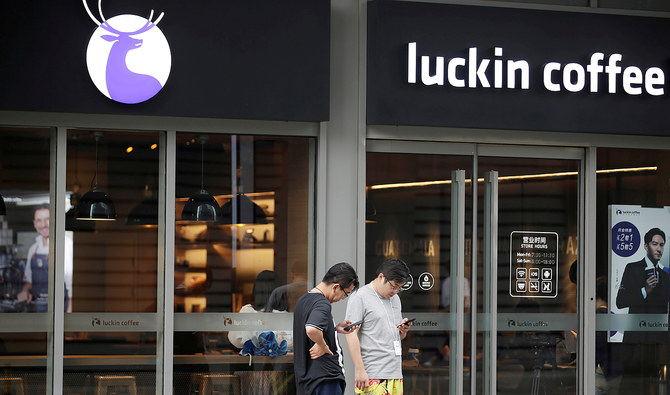
China’s Luckin counts cost of Starbucks battle, looks to break even
- The startup spent aggressively and opened 593 new stores in the June quarter, its first as a public company


Latest updates


© 2026 SAUDI RESEARCH & PUBLISHING COMPANY, All Rights Reserved And subject to Terms of Use Agreement.