

Iran tanker Grace 1 shifts position but still at anchor off Gibraltar

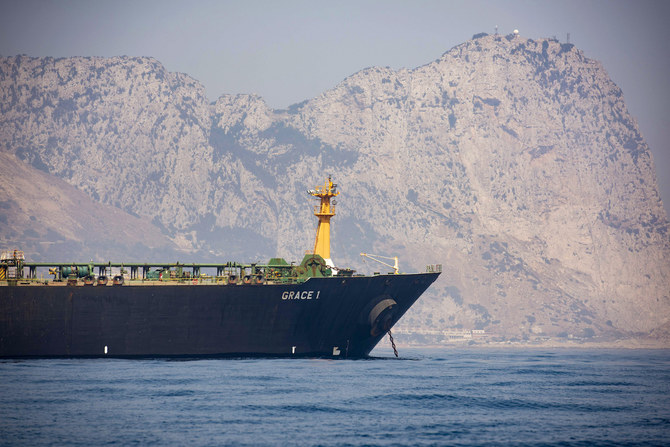
A view of the Grace 1 supertanker is seen backdropped by Gibraltar's Rock, as it stands at anchor in the British territory of Gibraltar on Thursday, Aug. 15, 2019. (AP)
Updated 16 August 2019
Follow

Iran tanker Grace 1 shifts position but still at anchor off Gibraltar

  • The tanker was renamed Adrian Darya and reflagged under the Iranian flag
  • The Grace 1 was seized by British Royal Marine commandos in darkness at the western mouth of the Mediterranean on July 4

GIBRALTAR: An Iranian tanker caught in the standoff between Tehran and the West shifted position on Friday but its anchor was still down off Gibraltar and it was unclear if it was ready to set sail, a Reuters reporter said.
Gibraltar authorities could not be reached for comment.
The Grace 1 was seized by British Royal Marines at the western mouth of the Mediterranean on July 4 on suspicion of violating European Union sanctions by taking oil to Syria, a close ally of Iran.
Gibraltar lifted the detention order on Thursday but the vessel's fate was further complicated by the United States, which made a last-ditch legal appeal to hold it.
A Reuters reporter in Gibraltar said the vessel appeared to be moving and more smoke could be seen coming from the funnel than in recent days. However it was not clear that the ship was actually leaving and it still appeared to be at anchor.
Refinitiv data did not show the vessel moving.
Gibraltar's chief minister, Fabian Picardo, said earlier that the tanker was free to leave as soon as it had organised its logistics.
"Could be today, could be tomorrow," Picardo told BBC Radio.
Washington has attempted to detain the Grace 1 on the grounds that it had links to Iran's Islamic Revolutionary Guard Corps, which it has designated a terrorist organization.
Asked about Washington's position, Picardo said that would be subject to the jurisdiction of Gibraltar's Supreme Court.
"It could go back to the court absolutely."
The last-minute US intervention was the latest twist in a saga that started in the early hours of July 4, when British Royal Marines abseiled onto the Grace 1 to impound the ship.
That kicked off a sequence of events that saw Tehran seize a British-flagged oil tanker in the Gulf two weeks later, heightening tension on a vital international oil shipping route.
That tanker, the Stena Impero, is still detained.
The two vessels have since become pawns in a bigger game, feeding into wider hostilities since the United States last year pulled out of an international agreement to curb Iran's nuclear programme, and reimposed economic sanctions.
Gibraltar said it had found evidence confirming the Grace 1 was carrying its cargo - 2.1 million barrels of oil - to the Baniyas refinery in Syria. Tehran denies that.
Gibraltar Chief Minister Picardo said on Thursday he had agreed to release the ship after receiving written assurances that the cargo would not go to Syria. Tehran also denied that it had made any commitments to secure the release of the tanker.
US Secretary of State Mike Pompeo warned all mariners that if they crewed a ship affiliated to the Revolutionary Guard, they would jeopardise their ability to enter the United States. "#NotWorthIt," he tweeted.
Calling the US attempt to block the tanker "piracy" and denying any commitments had been made to secure its release, Iranian officials have said Grace 1 would sail shortly after the 25-member crew made preparations including refuelling.
"Based on the owner's request, the oil tanker Grace 1 will depart for the Mediterranean after being reflagged under the Iranian flag and renamed Adrian Darya after preparing for the journey," Iranian state television quoted Jalil Eslami, deputy head of the country's Ports and Maritime Organisation, as saying.

Britain said on Thursday Iran must abide by assurances it had given that the Grace 1 tanker would not travel to Syria, and said it would not allow Iran or anyone to bypass European Union sanctions.
“We note the Government of Gibraltar has received assurances from Iran that the Grace 1 will not proceed to Syria. Iran must abide by the assurances they have provided,” a British foreign office spokesman said in a statement.
“We will not stand by and allow Iran – or anyone – to bypass vital EU sanctions on a regime that has deployed chemical weapons against its own people.”
“There is no comparison or linkage between Iran's unacceptable and illegal seizure of, and attacks on, commercial shipping vessels in the Strait of Hormuz and the enforcement of EU Syria sanctions by the Government of Gibraltar.”
A spokesman for the Stena Impero tanker, seized by Iran last month, said the situation remained the same with the Stena Impero and that the company awaited further developments from the United Kingdom and Iran.
Earlier on Thursday, the Gibraltar government confirmed earlier media reports that the US Department of Justice had sought to extend the detention of the oil tanker Grace 1, prompting the Supreme Court in the territory to adjourn a scheduled decision on whether to release the ship until later in the day.

“The U.S. Department of Justice has applied to seize the Grace 1 on a number of allegations, which are now being considered,” the Gibraltar government said in a statement, adding that the matter would be reviewed by the court at 4 p.m. local time.
The Justice Department did not immediately respond to a request for comment.
Britain’s Foreign Office said in a statement that the “investigations conducted around the Grace 1 are a matter for the government of Gibraltar” and that it could not comment further as the investigation was ongoing.
Prime Minister Boris Johnson’s Downing Street office said that Iran was discussed during the UK leader’s meeting with Donald Trump’s national security adviser John Bolton earlier in the week, though no details were released on the talks.


US intel did not suggest a preemptive strike from Iran before US-Israeli attacks, AP sources say

Updated 5 sec ago
Follow

US intel did not suggest a preemptive strike from Iran before US-Israeli attacks, AP sources say

WASHINGTON: Trump administration officials told congressional staff in private briefings Sunday that US intelligence did not suggest Iran was preparing to launch a preemptive strike against the US, three people familiar with the briefings said.
The administration officials instead acknowledged there was a more general threat in the region from Iran’s missiles and proxy forces, two of the people said. The third person, however, said the administration emphasized that Iran’s missiles and proxy forces posed an imminent threat to US personnel and allies in the region.
The officials did not provide any clarity about what would happen next in Iran after the joint US-Israeli operation, the two people said. All three people insisted on anonymity to discuss details that have not been made public.
The information conveyed to the congressional staff contrasts with the message from President Donald Trump. “Our objective is to defend the American people by eliminating imminent threats from the Iranian regime. A vicious group of very hard, terrible people,” he said in a video message after launching strikes on Iran.
Senior Trump administration officials, who like others were not authorized to comment publicly and spoke on condition of anonymity, had told reporters Saturday that there were indicators that the Iranians could launch a preemptive attack.
The White House and Pentagon did not immediately reply to requests for comment on Sunday night. Details of the briefing were first reported by Politico.
On Tuesday, Secretary of State Marco Rubio, Defense Secretary Pete Hegseth, CIA Director John Ratcliffe and Gen. Dan Caine, chairman of the Joint Chiefs of Staff, will brief the full membership of Congress on the US military operation against Iran, the White House said Sunday. Rubio also was slated to brief Hill leadership Monday, the same day Hegseth and Caine are planning a press conference about the operation.
Three strikes, three locations, within a single minute
The military operation came after authorities from Israel and the US spent weeks tracking the movements of senior Iranian leaders, including Supreme Leader Ayatollah Ali Khamenei, and shared information that allowed the strikes to be carried out in a surprise daylight attack, according to an Israeli military official and another person familiar with the operation.
The eventual barrage of US-Israeli attacks on Iran came so quickly that they were nearly simultaneous — with three strikes in three locations hitting within a single minute — killing Khamenei and some 40 senior figures, including the head of the paramilitary Revolutionary Guard and the country’s defense minister, the Israeli military official said Sunday.
The official said a variety of factors created a golden opportunity to take out much of Iran’s leadership, like weeks of training and monitoring the movements of senior figures as well as intelligence in real-time before the attack began that key targets were gathered together.
Striking by day also gave an additional element of surprise, said the official, who said so many major, rapid-fire strikes were critical to keep key officials from fleeing after the first strike. The official said Israel closely cooperated with its US counterparts and had used a similar tactic at the beginning of last June’s war — which resulted in the killing of several senior Iranian figures.
The official also noted Khamenei having posted defiant tweets taunting President Donald Trump in the days before the attack.
The details about the strikes came as the conflict entered its second day, with Trump saying in a video message Sunday that he expected it would continue until “all of our objectives are achieved.” He did not spell out what those objectives were.
The Republican president also said the US military and its partners hit hundreds of targets in Iran, including Revolutionary Guard facilities, Iranian air defense systems and nine warships, “all in a matter of literally minutes.”
CIA had long tracked top Iranian leaders
Before the attacks, the CIA had for months tracked the movements of senior Iranian leaders, including Khamenei.
The intelligence was shared with Israeli officials, and the timing of the strikes was adjusted in part because of that information about the Iranian leaders’ location, according to the person familiar with the planning.
The intelligence-sharing between US and Israel reflects the preparation that went into the strikes, which threw the future of the Islamic Republic into uncertainty and raised the risk of escalating regional conflict.
The US regularly shares intelligence with allies including Israel. Those partnerships, and the accuracy of the intelligence they yield, is often critical not only to the success of a military operation but also to the public’s support for it.
Virginia Sen. Mark Warner, the senior Democrat on the committee, told The Associated Press that, historically, “our working relationship with the Mossad and Israel is really strong.” Mossad is the Israeli spy agency.
Warner said he has serious concerns about the justification for the strikes, Trump’s long-term plans for the conflict and the risks that US service members will face. The military announced Sunday that three American troops had been killed in the Iran operation.
“No tears will be shed over their leadership being eliminated, but always the question is: OK, what next?” Warner said.
Iran has signaled it’s open to talks with the US
A senior White House official said Iran’s “new potential leadership” has suggested it is open to talks with the United States. That official, who spoke on condition of anonymity to discuss internal administration deliberations, said Trump has indicated he’s “eventually” willing to talk but that for now the military operation “continues unabated.”
The official did not say who the potential new Iranian leaders are or how they made their alleged willingness to talk known. Separately, Trump told The Atlantic that he planned to speak with Iran’s new leadership.
“They want to talk, and I have agreed to talk, so I will be talking to them,” he said Sunday, declining comment on the timing.