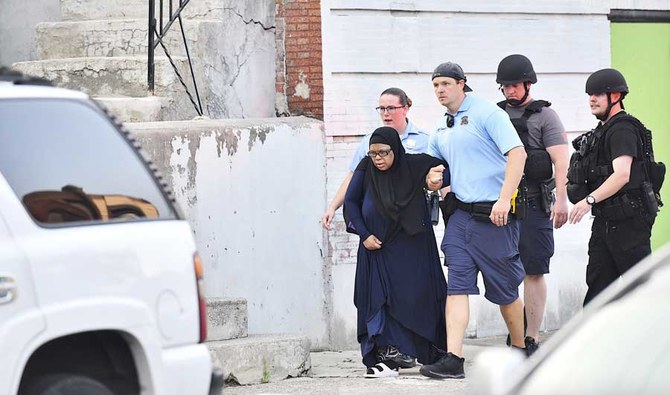
PHILADELPHIA: A gunman who opened fire on police Wednesday as they were serving a drug warrant in Philadelphia, wounding six officers and triggering a standoff that extended into the night, is in police custody, authorities said.
Philadelphia police Sgt. Eric Gripp said early Thursday morning that the man was taken into custody after an hourslong standoff with police.
The shooting began around 4:30 p.m. as officers went to a home in a north Philadelphia neighborhood of brick and stone rowhomes to serve a narcotics warrant in an operation “that went awry almost immediately,” Philadelphia Police Commissioner Richard Ross said.
Many officers “had to escape through windows and doors to get (away) from a barrage of bullets,” Ross said.
The six officers who were struck by gunfire have been released from hospitals, Philadelphia police Sgt. Eric Gripp said.
Two other officers were trapped inside the house for about five hours after the shooting broke out but were freed by a SWAT team well after darkness fell on the residential neighborhood. Three people that officers had taken into custody in the house before the shooting started were also safely evacuated.
“It’s nothing short of a miracle that we don’t have multiple officers killed today,” Ross said.
Temple University locked down part of its campus, and several children and staff were trapped for some time in a nearby day care.
Police tried to push crowds of onlookers and residents back from the scene. In police radio broadcasts, officers could be heard calling for backup as reports of officers getting shot poured in.
“I was just coming off the train and I was walking upstairs and there were people running back downstairs who said that there was someone up there shooting cops,” said Abdul Rahman Muhammad, 21, an off-duty medic. “There was just a lot of screaming and chaos.”
Police implored the gunman to surrender, at one point patching in his lawyer on the phone with him to try to persuade him to give up, Ross said.
“We’re doing everything within our power to get him to come out,” Ross said during the standoff. “He has the highest assurance he’s not going to be harmed when he comes out.”
Dozens of officers on foot lined the streets. Others were in cars and some on horses.
The Bureau of Alcohol, Tobacco, Firearms and Explosives said its agents responded to the scene to assist Philadelphia police.
President Donald Trump and Attorney General William Barr were briefed on the shooting, officials said.
Philadelphia Mayor Jim Kenney said he was thankful that officers’ injuries weren’t life-threatening.
“I’m a little angry about someone having all that weaponry and all that firepower, but we’ll get to that another day,” Kenney said.

Philadelphia gunman in custody after hourslong standoff
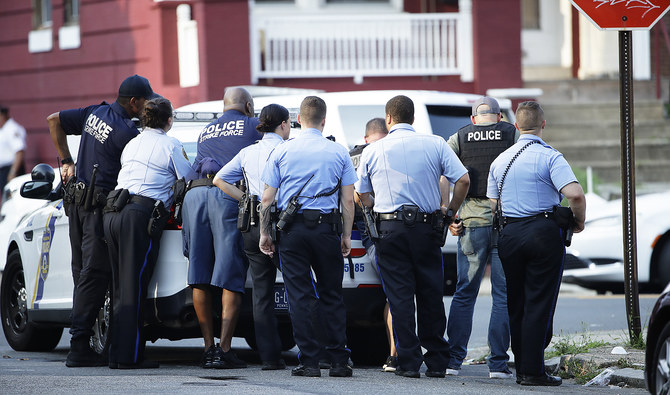
- Local media reported the shooter appeared to have a high-powered weapon and a significant amount of ammunition
Ireland’s defense gaps exposed as EU presidency nears
- Militarily neutral Ireland is not a NATO member, yet its waters — seven times its landmass — account for around 16 percent of the EU’s total
THE CURRAGH: Sheep amble around steel fences skirting Ireland’s largest military base on a grassy plain west of Dublin, a bucolic scene masking an underfunded defense force struggling with outdated equipment.
Ireland’s threadbare military and its long-standing policy of neutrality are under heightened scrutiny as the country prepares to assume the rotating EU presidency from July.
“Ireland is the only EU country with no primary radar system, nor have we sonar or anti-drone detection equipment — let alone the ability to disable drones,” said former Irish special forces member Cathal Berry.
“We can’t even monitor the airspace over our capital city and main airport,” he said as he surveyed Ireland’s main military base at The Curragh.
Militarily neutral Ireland is not a NATO member, yet its waters — seven times its landmass — account for around 16 percent of the EU’s total.
Nearly three-quarters of transatlantic subsea cables run close to or beneath them.
But the Irish army numbers only a few thousand troops, is focused largely on UN peacekeeping missions and has neither a combat air force nor a sizeable navy.
Ireland’s annual defense spending of roughly €1.2 billion is the lowest in Europe at around 0.2 percent of the GDP, well below the EU average of 1.3.
“Neutrality itself is actually a fine policy. If you want to have it, it must be defended,” said retired Irish army colonel Dorcha Lee.
“That’s the whole point. Undefended neutrality is absolutely definitely not the way to go.”
Berry points to a long-standing “complacency” about defense in Ireland that has fueled a vacuum in debate over neutrality and military spending.
“If you wanted to squeeze the EU without any risk of NATO retaliation, Ireland is where you’d come,” he said, adding that also applied to US interests in Europe.
US tech giants like Google, Apple and Meta have their European headquarters in Ireland, supported by vast data centers that analysts say are vulnerable to cyberattacks.
European Council President Antonio Costa said he was still “confident” Ireland could protect EU summits during its presidency.
Defense Minister Helen McEntee has pledged that new counter-drone technology will be in place by then.
Speaking in front of a row of aging army vehicles at the Curragh military site, she also announced a broader increase in military spending, although the actual details remain unclear.
On Dec. 17, the Irish government said it plans to buy a military radar system from France at a reported cost of between €300 and €500 million (around $350-$585 million).
For Paul Murphy, a left-wing opposition member of parliament, “scaremongering over allegedly Russian drones with concrete evidence still unprovided” is
giving the government cover to steer Ireland away from neutrality toward NATO.
“But it’s more important than ever that we’re genuinely neutral in a world that is increasingly dangerous,” he told AFP.
Ireland has historically prioritized economic and social spending over defense investment, he said.
“Joining an arms race that Ireland cannot compete in would waste money that should be spent on real priorities like climate change,” he added.
Pro-neutrality sentiment still holds sway among the Irish public, with an Irish Times/Ipsos poll earlier this year finding 63 percent of voters remained in favor of it.
And very few voices in Ireland are calling to join NATO.
Left-winger Catherine Connolly, who won Ireland’s presidential election in October by a landslide, is seen as a pacifist.
“I will be a voice for peace, a voice that builds on our policy of neutrality,” she said in her victory speech.