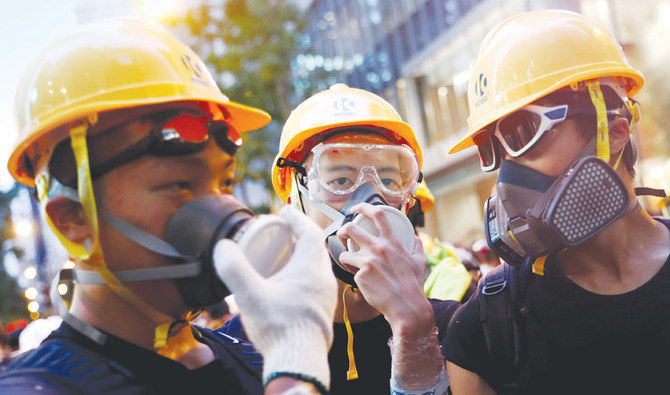

BEIJING: John Lam’s safety equipment shop has been spared the global downdraft shaking Hong Kong’s economy. In times of crisis, businesses providing basic necessities tend to fare better.
In Lam’s case, that means hard hats, filtered masks, goggles and other gear that millions of anti-government protesters taking to the streets in the past two months bought to protect themselves as clashes with police turned increasingly violent.
“Many people are willing to save a meal in order to buy some protective equipment, especially students,” Lam said inside his Shing Fat Safety Products shop in Yau Ma Tei, a working class commercial area of the city.
“Usually unnecessary items for civilians have become the necessity of the moment.”
Lam, who opposes the violence that has marked many of the protests, said sales had “doubled or tripled” since early June.
At times, he could not replenish stocks fast enough to meet demand. Some customers were buying 50 items at once. But lately, in a sign of saturation, demand has been easing. The reality of a slowing economy is also kicking in.
Behind the tear gas, flying bricks and transport disruptions there are bigger factors at play, such as shrinking global trade volumes and a slowdown in demand from mainland China.
Those trickle through into all aspects of the economy, including the construction industry — Lam’s core customer base.
“Although our business has improved lately, it does not mean that the economic downturn will not affect our business next month,” Lam said.
Indeed, the problems facing Hong Kong’s wide-open economy — which is expected to grind to a halt in coming quarters — run so deep that even those businesses whose products have been repurposed as protest paraphernalia are losing momentum.
Joe Chan, director of Many Stationery & Book Centre Co in the Sham Shui Po, a neighbourhood that has been the scene of protests and has been soaked in tear gas multiple times, said sales of Post-It notes are up 20 percent. Protesters have been using them to cover walls with part-art, part-political messages across the territory.
But his more important clients, event organisers who use stationery as promotion materials, are now few and far between. Overall, revenues are down 10 percent.
“This year they cancelled, or delayed,” Chan said, referring to orders.
FASTFACT
Hong Kong became a Special Administrative Region of the People’s Republic of China in 1997.
Emily Tam, store manager of Baleno, a clothing shop in Causeway Bay, said stocks of black T-shirts, the unofficial uniform of the protests, ran out on a daily basis in June and July.
But over the past two weekends, the shopping district witnessed violent clashes and barricaded roads. Her shop closed early and since then it has seen fewer customers.
“We’re getting close to the red line that means business losses,” Tam said.
Across the road, a seller surnamed Hui at a Watsons pharmacy says her store often runs out of cooling pads, surgical masks and other supplies that protesters use. But sales of other, more expensive items, such as cosmetics, are dropping.
“Surely we are also experiencing an overall economic downturn. And when there was tear gas, we shut the door,” Hui said.
The economy has become a focus for a public relations battle between authorities and protesters.
As a city-wide strike kicked off last week, government officials said protests were scaring high-end shoppers and tourists away, threatening growth.
Protesters are blaming the downturn on the fact that Hong Kongers have little control over public policy in the absence of universal suffrage.
They say the government spends too many resources on Beijing’s priorities, such as developing a “Greater Bay Area” around the Pearl River Delta, and it is not doing enough to solve income inequality and a housing shortage.
Chan Chi Ming, 60, at Shing Cheong Stationery & Books Ltd, in Sham Shui Po, agrees with the government. He is losing business and hopes police “arrest thousands.”
But Hungry Dino owner Tracy Tang sees it differently. She has been handing out discounted rice balls to young protesters after hearing some skipped dinner amid family feuds over their participation in the movement.
“If we say that the economic deterioration is all related to the protests, it is extremely unfair,” Tang said. “We should shift the question to why youngsters are sacrificing themselves.
“As Hong Kongers with a conscience, we feel heartbroken for what has happened in the past two months. It has already affected the economy. But we will still offer discounts and high-quality food to Hong Kong people.”