

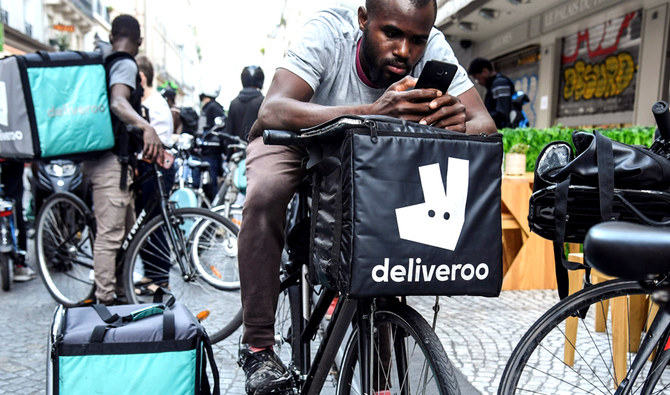
Deliveroo’s food parcels hit European roadblocks

An inability to turn a profit has seen food app Deliveroo abandon certain European markets, including Germany, to focus elsehwere. (AFP)
Updated 14 August 2019
Follow

Deliveroo’s food parcels hit European roadblocks

  • Restaurant home-delivery app finds life on the continent difficult to swallow

LONDON: Striking French couriers. Spanish court setbacks. The white flag of surrender raised over Germany.

British food delivery company Deliveroo — its boxy lime-blue bags a welcome sight for legions of office workers across London — is hitting sudden bumps along other European roads.

The rough times come as a growing group of startups jostle for the pocketbooks of hungry city dwellers craving special burgers and bento boxes.

Deliveroo has helped revolutionise meals on wheels in much the same way as Uber — which has a rival food catering app — has upended the taxi market.

It is now encountering identical questions over whether its employment schemes meet labor laws across around 200 cities where it has set up shop.

Its tens of thousands of delivery workers — most of them young men on bikes and scooters — are officially self-employed and deprived of a minimum wage or paid leave.

They must also provide their own means of transportation and smartphones that keep them connected to both clients and dispatchers.

This arrangement prompted Deliveroo’s French bikers to call for clients to boycott the brand last week.

Discontent in Deliveroo’s second-biggest market after the UK boiled over only days after a Madrid court ruled that it had wrongly signed up more than 500 riders as self-employed contractors.

Deliveroo has appealed the ruling but faces several more similar cases in Spain later this year.

These cost-cutting contracts are being tested at a turbulent time for a new service that is booming in popularity but unable to turn a profit.

Deliveroo announced Monday that it was pulling out of Germany after four years and refocusing on other parts of Europe and further afield in Asia.

The decision was especially painful because it clears the path for a local rival called Lieferando to dominate Germany on its own.

Lieferando is owned by the Dutch company Takeaway — itself in the process of merging with the UK-based upstart Just Eat.

“Consolidation has come to the hyper-crowded food delivery space,” Euromonitor International research group analyst Maxine Vogt said.

“There are at least two dozen companies in the restaurant ordering and delivery business. And that doesn’t even include grocery delivery!”

Scale and size are essential for these rivals to forgo immediate profits as they pile money into expansion that could eventually force the laggards to drop out.

Deliveroo remains an investor darling that has made it into one of the world’s few “unicorns” — privately-owned tech companies valued at more than a billion dollars by the market.

It has even piqued the interest of Amazon.

The Seattle-based online shopping behemoth was the biggest investor in a round of fundraising in May that brought in $575 million.

The various investments and mergers show that “scale is the only way to survive,” Vogt said.

But they also come with their own sets of pitfalls: The UK’s competition regulator launched a “phase one” review of the Amazon deal last month that could lead to a formal investigation.

The UK Competition and Markets Authority (CMA) said it had “reasonable grounds for suspecting” that the agreement could “result in Amazon and Deliveroo ceasing to be distinct.”

The CMA said Deliveroo and Amazon must remain two separate businesses with their own “sales or brand identity” throughout the review — a process without a clear deadline, but massive repercussions for the entire sector.


Global brands shut Middle East stores as conflict causes chaos

Updated 03 March 2026
Follow

Global brands shut Middle East stores as conflict causes chaos

  • Luxury brands and retailers close stores in Middle East
  • Conflict threatens the region that has ‌been luxury’s fastest growing
  • Mass-market retailers monitor situation, adjust operations in region

PARIS: In Dubai and other major Middle Eastern shopping hubs, many stores are closed or operating with a skeleton staff as the escalating conflict in the ​region causes chaos for businesses and travel.

The US-Israeli air war against Iran expanded on Monday with no end in sight, with Tehran firing missiles and drones at Gulf states as it retaliates for a weekend of bombing that killed Iran’s supreme leader and reportedly killed scores of Iranian civilians, including a strike on a girls’ primary school.

Chalhoub Group, which runs 900 stores for brands from Versace and Jimmy Choo to Sephora across the region, said its stores in Bahrain were closed, while other markets, including the UAE, Saudi Arabia, and Jordan remained open though staff attendance was “voluntary.”

“We operate with a lean team formed of members who volunteered and feel comfortable to come to the store,” Chalhoub’s Vice President of Communications Lynn al ‌Khatib told Reuters, adding ‌that the company’s leadership team personally visited Dubai Mall and Mall of the Emirates ​on ‌Monday ⁠morning to check ​in ⁠with workers.

E-commerce giant Amazon closed its fulfillment center operations in Abu Dhabi, suspended deliveries across the region and instructed its employees in Saudi Arabia and Jordan to remain indoors, Business Insider reported on Monday, citing an internal memo.

Gucci-owner Kering said its stores were temporarily closed in the UAE, Kuwait, Bahrain and Qatar and it has suspended travel to the Middle East.

Luxury growth engine under threat

Shares in luxury groups LVMH, Hermes, and Cartier-owner Richemont were down 4 percent to 5.7 percent on Monday afternoon as investors digested the knock-on impacts of the conflict.

The Middle East still accounts for a small share of global spending on luxury — between 5 percent and 10 percent, according ⁠to RBC analyst Piral Dadhania. But the region was “luxury’s brightest performer” last year, according to consultancy ‌Bain, while sales of expensive handbags have stalled in the rest of the ‌world.

Now, shuttered airports have put an abrupt stop to tourism flows into ​the region and missile strikes — including one that damaged Dubai’s ‌five-star Fairmont Palm hotel — are likely to dissuade travelers, particularly if the conflict drags on.

“If you assume that it’s ‌a $5 billion to $6 billion (travel retail) market and let’s say it’s going to be shut down for a month, we are talking about hundreds of millions of dollars that are definitely at risk,” said Victor Dijon, senior partner at consultancy Kearney.

If Middle Eastern shoppers cannot travel to Paris or Milan, that could also hurt luxury sales in Europe, he added.

Luxury brands have been investing in lavish new stores and exclusive events ‌across the region. Cartier unveiled a “high-jewelry” exhibition in Dubai’s Keturah Park just days before the conflict started.

Cartier and Richemont did not reply to requests for comment.

Luxury conglomerate LVMH ⁠has also bet big on ⁠the region. Last month, its flagship brand Louis Vuitton staged an exhibition at the Jumeirah Marsa Al Arab hotel, and beauty retailer Sephora launched its first Saudi beauty brand.

LVMH does not report specific figures for the region, but in January Chief Financial Officer Cecile Cabanis said the Middle East has been “displaying significant growth.” LVMH did not reply to a request for comment on how its business may be impacted by the conflict.

The Middle East has also attracted new investment from mass-market players. Budget fashion retailer Primark said in January that it plans to open three stores in Dubai in March, April and May, followed by stores in Bahrain and Qatar by the end of the year.

“Primark is set to open its first store in Dubai at the end of March but clearly this is a fast-moving situation which we are monitoring closely,” a spokesperson for Primark-owner Associated British Foods said.

Apple stores in Dubai will remain closed until Thursday morning, the company’s website showed, while Swedish fast-fashion retailer ​H&M said its stores in Bahrain and Israel are ​closed.

Consumer goods group Reckitt has told all employees in the Middle East to work from home, temporarily closed its Bahrain manufacturing site and suspended all business travel to the region until further notice.