

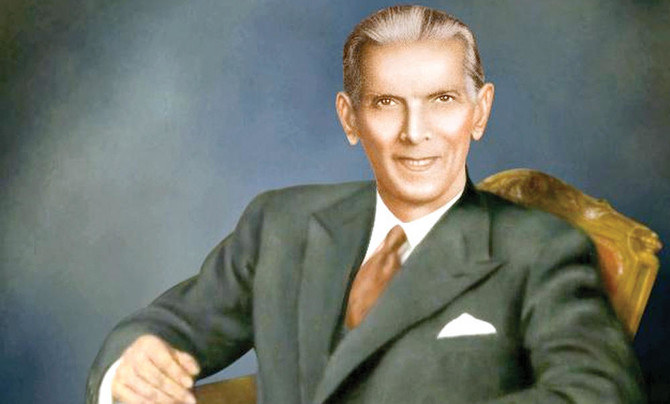
Pakistan founder Quaid-e-Azam Mohammed Ali Jinnah — a true statesman

Pakistan founder Quaid-e-Azam Mohammed Ali Jinnah
Updated 13 August 2019
Follow

Pakistan founder Quaid-e-Azam Mohammed Ali Jinnah — a true statesman

Quaid-e-Azam Mohammed Ali Jinnah, the founder of Pakistan, was no doubt one of the most charismatic leaders in world history. He was there at just the right moment, when Muslims in pre-partition India were facing severe challenges.

Under his leadership, the Muslims of the sub-continent gained independence and created a sovereign state, Pakistan, without a shot's being fired. This has no parallel in the chronicles of history.

Otto von Bismarck, the former German Chancellor, once said: “Man cannot control the current of events. He can only float with them and steer.” Jinnah’s statecraft proved this statement to be true, as he skillfully and successfully steered the adverse currents of events in 1946 and brought the battered Muslim ship ashore, safe and sound, within a year.

Jinnah’s attraction to the world of politics began as a young man working in London. He was very impressed by Dadabhai Naoroji, a Parsi from Bombay who was the first Indian to become an MP in Britain, and upon returning to India Jinnah entered the world of politics and joined the Indian National Congress. The first of the party’s annual sessions that he attended was its 20th, held in Bombay in December 1904.

There is no denying that initially Quaid-e-Azam was an ambassador for Hindu-Muslim unity; given the presence of a non-native government, he did not wish to exacerbate the problems between Muslims and Hindus. Nevertheless, he stood up for the rights of Muslims even when he was a member of Congress. In 1916, a result of his efforts was the Lucknow Pact, an agreement in which Congress accepted the right of Muslims to have separate constituencies and expressed willingness to give them constitutional guarantees.

Quaid-e-Azam was a man of principle who set very high political standards and values and never compromised on them. There were two main keys to Jihisnnah’s successful statesmanship: a rational approach to politics, and a keen knowledge of objective realities, however awkward or complex.

He had the uncanny ability to always make the right choice at the right moment. His statesmanship is evidenced by the fact that he considered each and every proposal put to him, whether it came from the British or from Congress, including the Lucknow Pact, the Roundtable Conferences of the early 1930s on constitutional reform, and the Cabinet Mission that came to India in 1946 to discuss the transfer of power from the British government. He studied them and found and used every opportunity they offered for securing the rights of Muslims.

US historian Stanley Wolpert wrote in his book “Jinnah of Pakistan:” “Few individuals significantly alter the course of history. Fewer still modify the map of the world. Hardly anyone can be credited with creating a nation-state. Mohammad Ali Jinnah did all three.”


Muhammad Arshad Munir is press counselor at the Pakistani Consulate in Jeddah.


WHO chief says reasons US gave for withdrawing ‘untrue’

Updated 25 January 2026
Follow

WHO chief says reasons US gave for withdrawing ‘untrue’

  • US Secretary of State Marco Rubio and US Health Secretary Robert F. Kennedy Jr. announced in a joint statement Thursday that Washington had formally withdrawn from the WHO
  • And in a post on X, Tedros added: “Unfortunately, the reasons cited for the US decision to withdraw from WHO are untrue”

GENEVA: The head of the UN’s health agency on Saturday pushed back against Washington’s stated reasons for withdrawing from the World Health Organization, dismissing US criticism of the WHO as “untrue.”
Tedros Adhanom Ghebreyesus warned that US announcement this week that it had formally withdrawn from the WHO “makes both the US and the world less safe.”
And in a post on X, he added: “Unfortunately, the reasons cited for the US decision to withdraw from WHO are untrue.”
He insisted: “WHO has always engaged with the US, and all Member States, with full respect for their sovereignty.”
US Secretary of State Marco Rubio and US Health Secretary Robert F. Kennedy Jr. announced in a joint statement Thursday that Washington had formally withdrawn from the WHO.
They accused the agency, of numerous “failures during the Covid-19 pandemic” and of acting “repeatedly against the interests of the United States.”
The WHO has not yet confirmed that the US withdrawal has taken effect.

- ‘Trashed and tarnished’ -

The two US officials said the WHO had “trashed and tarnished” the United States, and had compromised its independence.
“The reverse is true,” the WHO said in a statement.
“As we do with every Member State, WHO has always sought to engage with the United States in good faith.”
The agency strenuously rejected the accusation from Rubio and Kennedy that its Covid response had “obstructed the timely and accurate sharing of critical information that could have saved American lives and then concealed those failures.”
Kennedy also suggested in a video posted to X Friday that the WHO was responsible for “the Americans who died alone in nursing homes (and) the small businesses that were destroyed by reckless mandates” to wear masks and get vaccinated.
The US withdrawal, he insisted, was about “protecting American sovereignty, and putting US public health back in the hands of the American people.”
Tedros warned on X that the statement “contains inaccurate information.”
“Throughout the pandemic, WHO acted quickly, shared all information it had rapidly and transparently with the world, and advised Member States on the basis of the best available evidence,” the agency said.
“WHO recommended the use of masks, vaccines and physical distancing, but at no stage recommended mask mandates, vaccine mandates or lockdowns,” it added.
“We supported sovereign governments to make decisions they believed were in the best interests of their people, but the decisions were theirs.”

- Withdrawal ‘raises issues’ -

The row came as Washington struggled to dislodge itself from the WHO, a year after US President Donald Trump signed an executive order to that effect.
The one-year withdrawal process reached completion on Thursday, but Kennedy and Rubio regretted in their statement that the UN health agency had “not approved our withdrawal and, in fact, claims that we owe it compensation.”
WHO has highlighted that when Washington joined the organization in 1948, it reserved the right to withdraw, as long as it gave one year’s notice and had met “its financial obligations to the organization in full for the current fiscal year.”
But Washington has not paid its 2024 or 2025 dues, and is behind around $260 million.
“The notification of withdrawal raises issues,” WHO said Saturday, adding that the topic would be examined during WHO’s Executive Board meeting next month and by the annual World Health Assembly meeting in May.
“We hope the US will return to active participation in WHO in the future,” Tedros said Saturday.
“Meanwhile, WHO remains steadfastly committed to working with all countries in pursuit of its core mission and constitutional mandate: the highest attainable standard of health as a fundamental right for all people.”