

August craze for Pakistani flag brings boom to otherwise dull business

1 / 8
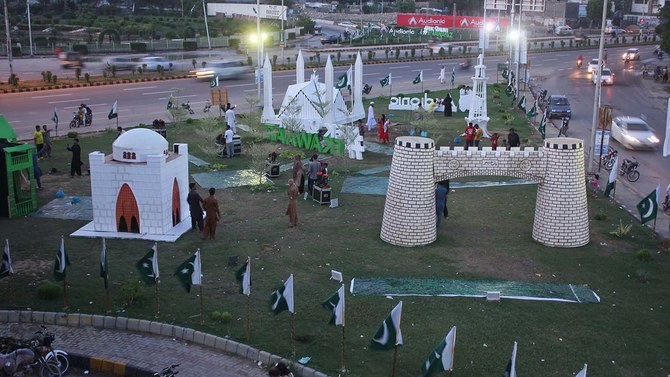
Model of Tome of Qaid-e-Azam (great leader) Muhammad Ali Jinnah, Founder of Pakistan, khyber Pass and Minar-e-Pakistan are displayed in Karachi as part of national independence day celebration. (AN photo)
2 / 8
A girl looks at national flag on Tuesday ahead of Independence Day on August 14. Demand of national flags and related goods booms for the festivities. (AN photo)
3 / 8
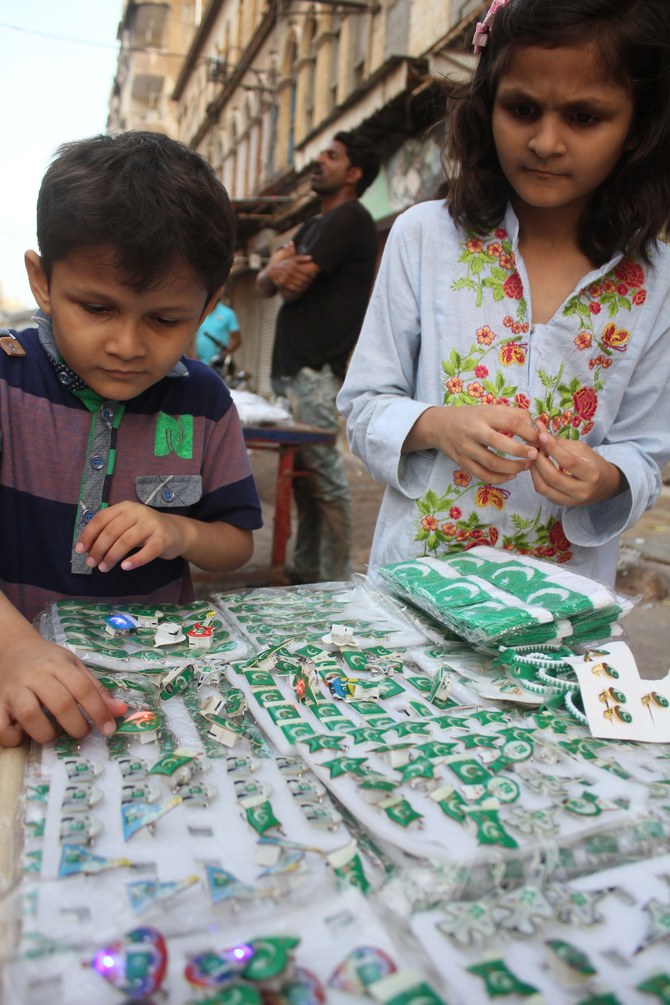
Children buy Pakistani flag from a vendor in old city area of Karachi ahead of celebration of independence day that fall on August 14. (AN photo)
4 / 8
A Pakistani boy wears green and white hat depicting national flag. (AN Photo)
5 / 8
A vendor displays Pakistani flag to attract customer ahead of Independence Day celebration as the business slows down. (AN Photo)
6 / 8
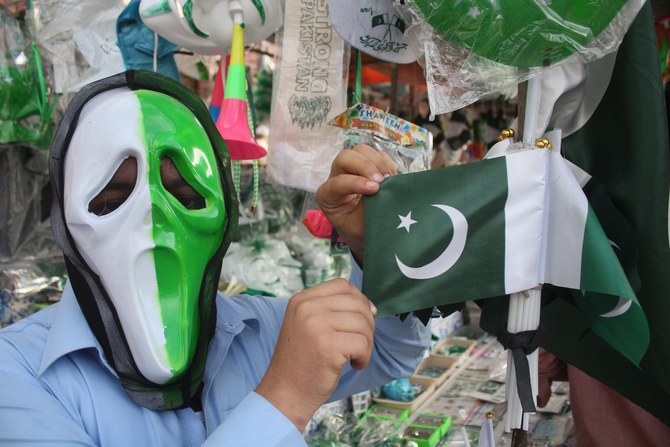
Wearing green and white mask a vendor shows Pakistani flag at local wholesale market in Karachi on Tuesday. (AN Photo)
7 / 8
A vendor blows trumpet to attract customers at a kiosk set up to sell flags and related material a head of 72ndIndependence Day of south Asian nation. (AN Photo)
8 / 8
Children sift through badges and buntings to buy goods of their choice for Independence Day celebrations. (AN Photo)
Updated 14 August 2019
Follow

August craze for Pakistani flag brings boom to otherwise dull business

  • Pakistanis gear up for Independence Day celebrations amid slowing business activity
  • Eid ul Adha and torrential rains slowed down booming seasonal business, traders

KARACHI: As Pakistan gears up to celebrate its 73rd Independence Day on August 14 with traditional fervor, the business for traders selling national flag booms though not as much as previous years given the fact that Eid ul Adha related buying and torrential rains across the country have slowed down the otherwise booming seasonal business, traders say.
“The demand for national flags and decorative ornaments rises by 80 to 90 percent in the month of August mainly due to Independence Day celebrations,” Abdullah Abdul Habib, wholesale trader of Karachi’s paper market, told Arab News on Tuesday.
Every year, Independence Day related businesses activity mobilizes billions of rupees in revenue from sales and purchases of national flags, badges, hats, toys, special dresses with a touch of national flag and other decorative material, Habib told.
“This year, however, the business is almost down by 50 percent,” he added.
“The rains in the port city of Karachi which supplies goods to other part of the country disrupted Independence Day related business activities. Besides, concurrent event of Eid ul Adha also impacted the buying trend,” he said.
Pakistan meets 75 to 80 percent of its seasonal demand through imports that come from neighboring China. This year, the government’s measures to restrict imports in order to keep the balance of payment situation in control have also reduced the imports of flags and other decorative material.
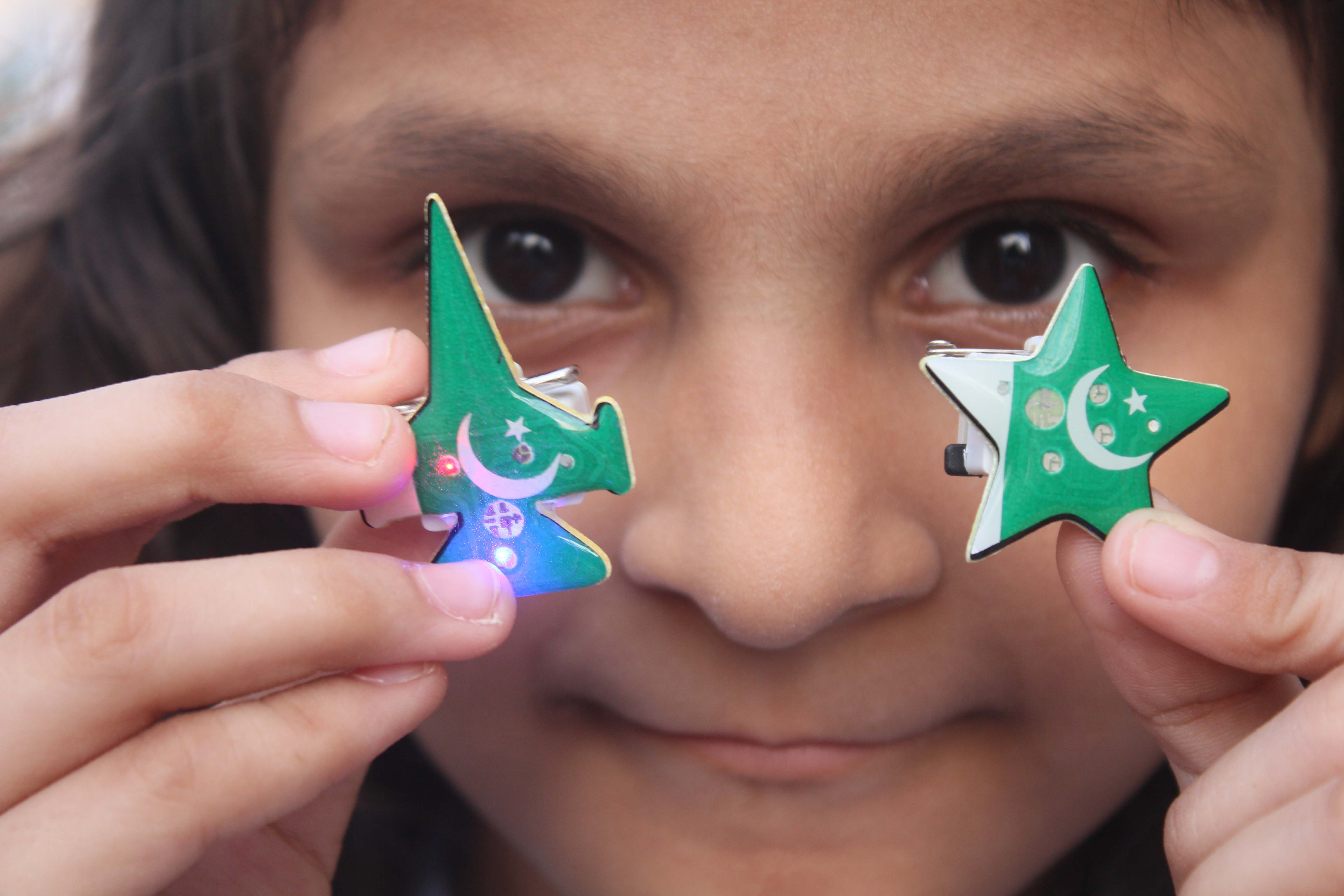


A young girl shows star and fighter jet models painted with Pakistani flag. (AN photo)

“The imports this year were largely constrained and what we are selling is the leftover stock of previous year. Due to duties and taxes, the goods have almost become 40 percent costlier than last year,” said Habib.
According to the traders, the flags and badges are available for as low as PKR 10 where the price increases with the size of the flag or stickers available for the event.
Colorful kiosks and make-shift stalls traditionally mushroom in cities and towns of the country in August where traders take the chance to cash in on Independence Day celebrations.
Muhammad Shoaib, a trader who set up a kiosk in the old city area of Karachi, finds this year difficult amid slowing business. “Last year, the business was very good but this year it is very slow because of rains and bad weather condition,” he said.
Many traders complained of growing prices of goods and blamed the incumbent government for the rising inflation that hit 10.3 percent in July 2019.
“Thank God, it is going on but not as good as it was last year,” Sarfarz Ahmed, a stallholder, said while adding that “people are coming to the market and we will celebrate Independence Day as usual innsha Allah.”
“Business was good last year and the income for children was much better and we enjoyed Independence Day as well,” said Shaam Lal, a vendor in Karachi, showing new green bangles for girls. “This year we are worried about our children,” he added.
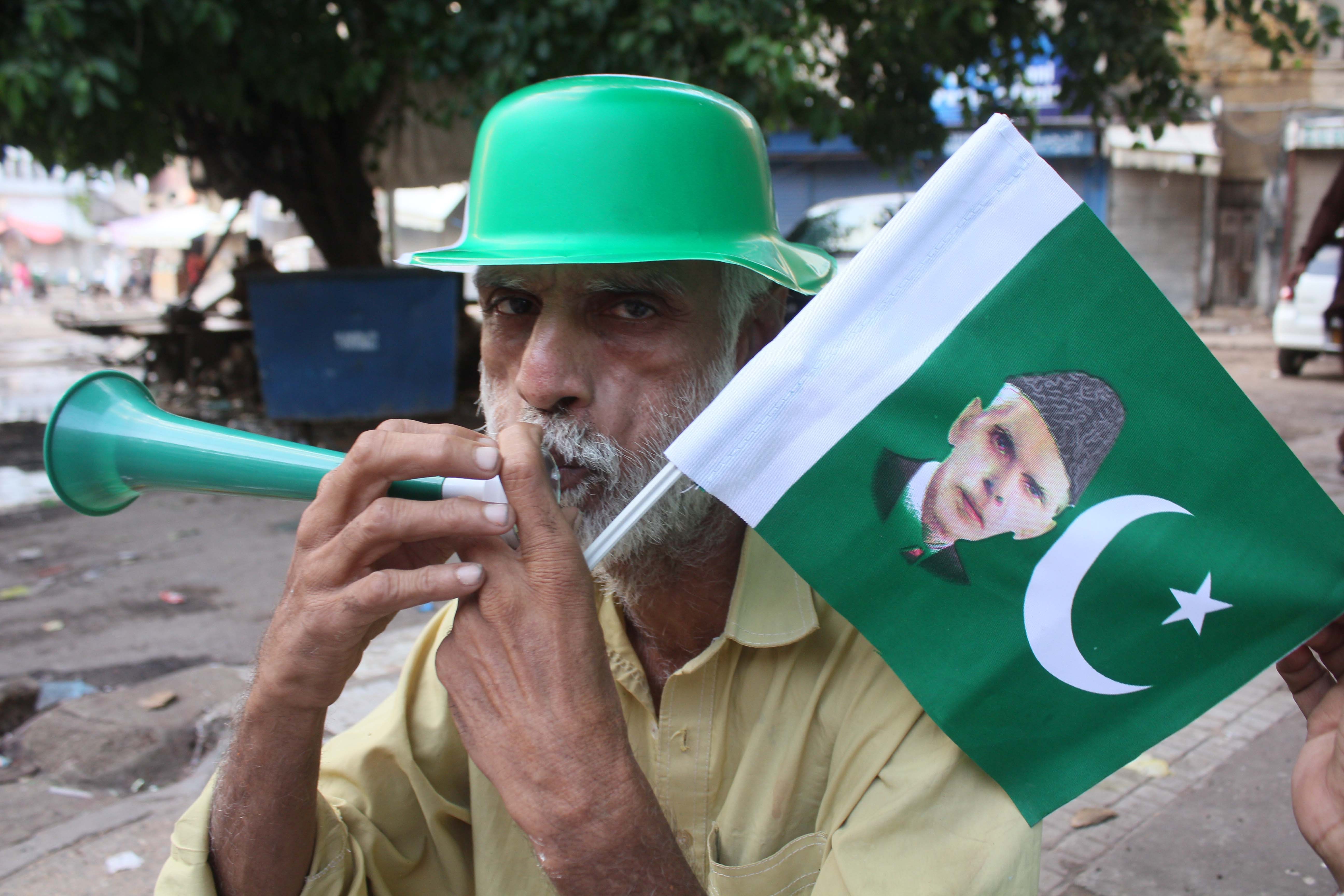


Laxman Das, a vendor, makes all out efforts to attract customers at a kiosk he set up to sell flags and toys for August 14 related celebrations.  (AN Photo)

Among those selling flags, badges, trumpets and other stuff for Independence Day festivities for the first time is Laxman Das and his “trumpets are much in demand this year.”
But Ali Zaib, another vendor, is happy as his stuff has almost entirely sold out. “Business is very good. I have sold almost all this (shirts with national flag) stuff. People are celebrating (the event) you will see on 14 august,” he said.
Citizens busy with Eid ul Adha related activities are now coming out for shopping at kiosks and stalls set up in different areas in the city. “I have come with my children as they wanted to buy flags and buntings and badges for the national day,” Yasir Ali, a teacher based in the metropolitan city of Karachi, commented. In addition to flags, toys painted with national flag are a major attraction among children, he added.
Pakistan that came into existence on August 14,1947 with the partition of Indian subcontinent, will observe its national day in solidarity with the People of Jammu and Kashmir following an attempted annexation of the disputed territory by Indian government with abrogation of Article 370.
“We are with Kashmiris and support their struggle for freedom,” Zafar Iqbal, a resident of Lahore said adding “this year we are also buying flags of Kashmir along with Pakistani national flag.”


Pakistan, global crypto exchange discuss modernizing digital payments, creating job prospects 

Updated 8 sec ago
Follow

Pakistan, global crypto exchange discuss modernizing digital payments, creating job prospects 

  • Pakistani officials, Binance team discuss coordination between Islamabad, local banks and global exchanges
  • Pakistan has attempted to tap into growing crypto market to curb illicit transactions, improve oversight

ISLAMABAD: Pakistan’s finance officials and the team of a global cryptocurrency exchange on Friday held discussions aimed at modernizing the country’s digital payments system and building local talent pipelines to meet rising demand for blockchain and Web3 skills, the finance ministry said.

The development took place during a high-level meeting between Finance Minister Muhammad Aurangzeb, Pakistan Virtual Assets Regulatory Authority (PVARA) Chairman Bilal bin Saqib, domestic bank presidents and a Binance team led by Global CEO Richard Teng. The meeting was held to advance work on Pakistan’s National Digital Asset Framework, a regulatory setup to govern Pakistan’s digital assets.

Pakistan has been moving to regulate its fast-growing crypto and digital assets market by bringing virtual asset service providers (VASPs) under a formal licensing regime. Officials say the push is aimed at curbing illicit transactions, improving oversight, and encouraging innovation in blockchain-based financial services.

“Participants reviewed opportunities to modernize Pakistan’s digital payments landscape, noting that blockchain-based systems could significantly reduce costs from the country’s $38 billion annual remittance flows,” the finance ministry said in a statement. 

“Discussions also emphasized building local talent pipelines to meet rising global demand for blockchain and Web3 skills, creating high-value employment prospects for Pakistani youth.”

Blockchain is a type of digital database that is shared, transparent and tamper-resistant. Instead of being stored on one computer, the data is kept on a distributed network of computers, making it very hard to alter or hack.

Web3 refers to the next generation of the Internet built using blockchain, focusing on giving users more control over their data, identity and digital assets rather than big tech companies controlling it.

Participants of the meeting also discussed sovereign debt tokenization, which is the process of converting a country’s debt such as government bonds, into digital tokens on a blockchain, the ministry said. 

Aurangzeb called for close coordination between the government, domestic banks and global exchanges to modernize Pakistan’s payment landscape.

Participants of the meeting also discussed considering a “time-bound amnesty” to encourage users to move assets onto regulated platforms, stressing the need for stronger verifications and a risk-mitigation system.

Pakistan has attempted in recent months to tap into the country’s growing crypto market, crack down on money laundering and terror financing, and promote responsible innovation — a move analysts say could bring an estimated $25 billion in virtual assets into the tax net.

In September, Islamabad invited international crypto exchanges and other VASPs to apply for licenses to operate in the country, a step aimed at formalizing and regulating its fast-growing digital market.