

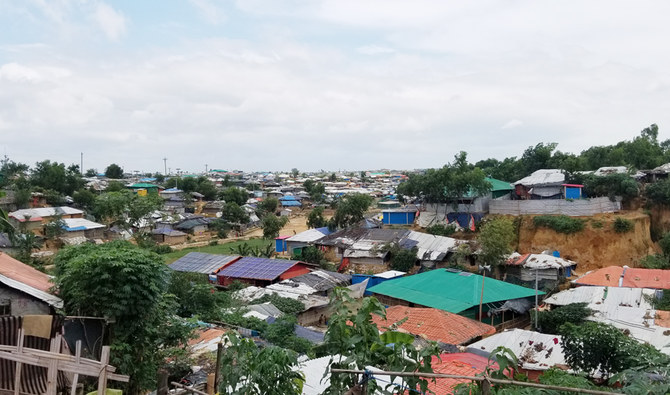


DHAKA: More than half-a-million Rohingya at Cox’s Bazar have received identity cards to ensure better access to humanitarian aid in refugee camps.
The UN High Commissioner for Refugees (UNHCR) and the Bangladeshi government initiated the procedure in June 2018 to store necessary information about the Rohigya people in one database.
This comprehensive registration work has been underway in all refugee settlements at Cox’s Bazar. On an average, about 5,000 refugees are registered every day on seven different sites. More than 550 local staff were recruited to facilitate the registration process.
UNHCR has engaged a number of community representatives, including imams, elders and teachers, to explain the benefits of registration among refugees. Outreach teams of refugee volunteers also go into the community to explain and encourage the registration process.
“This registration aims to establish and secure the identity of individuals and families by collecting basic biographical information. Biometrics such as fingerprints and iris scans are also collected for individuals aged 5 years and above to help verify identities,” said Louise Donovan, a UNHCR spokesperson at Cox’s Bazar.
“Information on family composition, specific needs and protection risks are also gathered. This data is stored on a secure server and on the basis of the information gathered, individual ID cards are issued to all refugees aged over 12,” Donovan added. All children under 12-years-old are included on their parents’ ID cards.
She described the identity card as “extremely important” for the Rohingyas as it is the “first official identification document that they have owned.”
The registration cards record Myanmar as the country of origin. This establishes the right of the refugee to return home when they feel the conditions are safe. However, the registration exercise is not linked to repatriation.
With the aid of the biometric data, UNHCR launched the Global Distribution Tool in one of the refugee camps last week.
“Through verification of fingerprints or iris scans, this tool speeds up distributions and is fraud proof. It can be used by partners to ensure that there is no overlap in assistance and that nobody is left out. It will continue to be rolled out in more settlements in the coming weeks,” said Andrej Mahecic, a UNHCR spokesperson.
“This will help the aid agencies in humanitarian response as no one will be able to fraudulently claim for aid. We will forward the same information to the Myanmar authorities for their verification of repatriation,” Mohammad Shamsuddoja, additional commissioner at the Refugee Relief and Repatriation Commission (RRRC) of Bangladesh told Arab News.
He added that these identity documents will help authorities protect the Rohingyas from illegal migration through preventing the distribution of fake Bangladeshi passports.
HIGHLIGHT
The UNHCR and the Bangladeshi government initiated the procedure in June 2018 to store necessary information about the Rohingya people in one database.
Rohingyas throughout Cox’s Bazar welcomed the documentation process.
“It has given me an identity as Myanmar national. It also contains my family links. Now with this document, Myanmar authorities can easily verify me as a resident of Rakhine,” said Fokan Ullah, 53, a refugee from the Kutupalang Rohingya camp.
Refugee Monowara Begum, 34, said: “This identity card has eased my life at the camps. Now, I don’t need to wait a long time in the queue to receive monthly food aids for my family.”
The authorities expect to complete the registration process by the end of the year. More than 1.1 million Rohingyas have been living in the squalid camps at Cox’s Bazar since August 2017.
Amid dire uncertainty for future, the Rohingyas at Cox’s Bazar are preparing for the Eid-ul-Azha, the second largest Muslim festival, scheduled to be observed on Monday. For many, it is going to be their third Eid celebration at the refugee camps in Bangladesh.
Authorities in the country have taken preparations to make the Eid more colorful for the refugees.
“From different NGOs and benevolent entities, we have received around 4,000 cattle to be sacrificed on the Eid day. We will distribute the meat among the 210,000 families so that the refugees can celebrate the true spirit of this Eid-ul-Azha,” Mohammad Shamsuddoja, from the RRRC told Arab News.
This initiative from Bangladesh has inspired enthusiasm among the Rohingya families.
“In this refugee life we receive rice, lentils, vegetable oil and some other daily needs as food aid. But there is no opportunity to have fish and meat. My children have been waiting for last one month for this Eid day as we knew that cattle will be sacrificed in the camps” said Rahmat Ali, 46, a refugee from the Balukhali camp.
Taslima Khatun, 27, a mother of two, has expressed her frustration over the camp life on the eve of Eid festivals.
“Eid days were full of festivity during our days at Rakhine. On Eid-ul-Azha, I used to sacrifice cattle for my family and shared it with the neighbors. Unfortunately, destiny has brought me here today in this miserable condition of camp life,” Khatun said.
“However, due to savings from our daily needs, I managed to buy two new dresses for my sons. The little boys were really happy with their gifts,” she added.


