Indonesia’s Muslims urged to ‘go green’ and ditch plastic bags on Eid

1 / 2
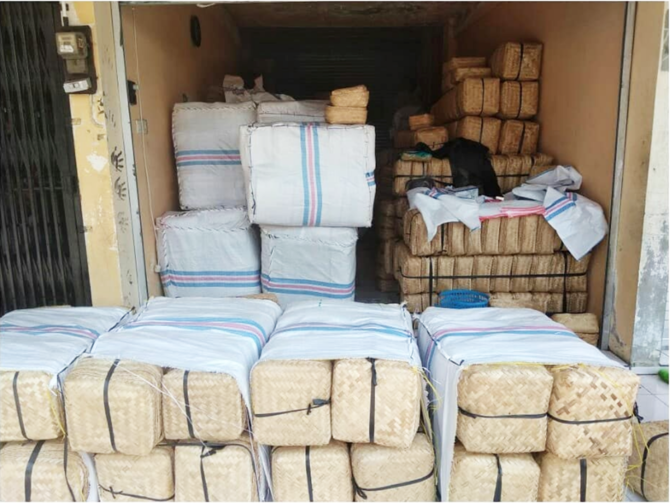
Indonesia is going without plastic bags to distribute qurban meat during this year’s Eid and replace the meat packaging with the more environmentally friendly, reusable woven bamboo baskets or banana leaves. (Photo: Instagram @kerajinan_handycraft_indonesia)
2 / 2
Woven bamboo baskets or besek are ready for shipment as demand for the baskets have soared with Eid approaching after the Indonesian government has called on qurban committees across the archipelago to distribute qurban meat with eco-friendly packaging. Photo: Instagram @kerajinan_handycraft_indonesia (Photo: Instagram @kerajinan_handycraft_indonesia)
Updated 14 August 2019
Follow

Indonesia’s Muslims urged to ‘go green’ and ditch plastic bags on Eid

  • North Jakarta’s Ancol Dreamland Park will hand out sacrificial meat to the first 100 recipients in woven bamboo baskets, or besek

JAKARTA: Indonesia is urging Muslims to use eco-friendly packaging when distributing sacrificial meat on Eid Al-Adha this year, as the country fights to reduce the amount of plastic waste it produces.   
Indonesia is second only to China when it comes to dumping plastic waste in the ocean and, with a Muslim-majority population, the use of plastic bags to package sacrifical meat could lead to tens of thousands of tons of additional waste.
The slaughter of an animal — qurbani — is carried out in remembrance of the Prophet Ibrahim’s willingness to sacrifice his son Ishmael at Allah’s command.
Regional leaders across Indonesia were last month urged by the government to tell people to bring their own reusable containers instead of single-use plastic bags for the sacrificial meat.
“Alternatively, they can replace plastic bags with wrappings from banana or teak leaves, woven bamboo baskets, or other biodegradable or reusable packaging,” an official from the Ministry of Environment and Forestry, Rosa Vivien Ratnawati, said in a circular.
Jakarta Gov. Anies Baswedan said the use of woven bamboo baskets would help to reduce plastic waste and generate additional income for local tradesmen, while Central Jakarta Mayor Bayu Meghantara said his office would distribute 500 woven bamboo baskets to qurbani committees.
Abu Hurairah Abdul Salam, a spokesman for Istiqlal Mosque in Central Jakarta, said the qurbani committee had starting using plastic bags made of cassava pulp four years ago.
“But, in accordance with the governor’s instructions, we will be using woven bamboo baskets to distribute qurbani meat this year. We have prepared 5,000 baskets and, if we run out of baskets, we will be using biodegradable cassava plastic bags,” he told Arab News.
North Jakarta’s Ancol Dreamland Park will hand out sacrificial meat to the first 100 recipients in woven bamboo baskets, or besek.
“We will wrap the rest of the qurbani meat packages, which on average are up to 5,000, in biodegradable, cassava-based bags. This is one of the many policies that park management has issued to address the waste problem. We have stopped using plastic straws at all vendor stalls,” Ancol spokeswoman Rika Lestari told Arab News.
The Indonesian Council of Ulema is backing the nationwide green initiative.
“We can take this Eid moment to start a new habit using eco-friendly bags and to change our society’s dependence on plastic bags,” council official Hasanuddin Abdul Fattah said in a statement.


Thai army accuses Cambodia of violating truce with over 250 drones

Updated 8 sec ago
Follow

Thai army accuses Cambodia of violating truce with over 250 drones

  • The Thai army said on Monday “more than 250 unmanned aerial vehicles (UAVs) were detected flying from the Cambodian side, intruding into Thailand’s sovereign territory” on Sunday night, according to a statement

BANGKOK: Thailand’s army accused Cambodia on Monday of violating a newly signed ceasefire agreement, reached after weeks of deadly border clashes, by flying more than 250 drones over its territory.

The Southeast Asian neighbors agreed to the “immediate” ceasefire on Saturday, pledging to end renewed border clashes that killed dozens of people and displaced more than a million this month.

But the fresh allegation from Bangkok and its threat to reconsider releasing Cambodian soldiers held by Thailand left a sustained truce in doubt, even as their foreign ministers wrapped up two days of talks hosted by China.

The Thai army said on Monday “more than 250 unmanned aerial vehicles (UAVs) were detected flying from the Cambodian side, intruding into Thailand’s sovereign territory” on Sunday night, according to a statement.

“Such actions constitute provocation and a violation of measures aimed at reducing tensions, which are inconsistent with the Joint Statement agreed” during a bilateral border committee meeting on Saturday, it said.

The reignited fighting this month spread to nearly every border province on both sides, shattering an earlier truce for which US President Donald Trump took credit.

Under the truce pact signed on Saturday, Cambodia and Thailand agreed to cease fire, freeze troop movements and cooperate on demining efforts and combatting cybercrime.

They also agreed to allow civilians living in border areas to return home as soon as possible, while Thailand was to return 18 Cambodian soldiers captured in July within 72 hours, if the ceasefire held.

’Small issue’

Cambodian Foreign Minister Prak Sokhonn described the drone incident as “a small issue related to flying drones seen by both sides along the border line.”

He said on Cambodian state television on Monday that the two sides had discussed the issue and agreed to investigate and “resolve it immediately.”

Thai army spokesman Winthai Suvaree said in a statement the drone activity reflected “provocative actions” and a “hostile stance toward Thailand,” which could affect the security of military personnel and civilians in border areas.

Thailand’s army “may need to reconsider its decision regarding the release of 18 Cambodian soldiers, depending on the situation and the behavior observed,” it said.

Several family members of soldiers held by Thailand for six months had little faith they would be released, even before Bangkok raised fresh doubts.

Heng Socheat, the wife of a soldier, told AFP on Monday she worried the Thai military might renege on its pledge.

“Until my husband arrives home, then I will believe them,” she said.

Prayers for peace

Five days of border clashes in July killed dozens of people before a truce was brokered by the United States, China and Malaysia, the chair of the ASEAN regional bloc.

Trump witnessed the signing of a follow-on declaration between Thailand and Cambodia in October but it was broken within months, with each side blaming the other for instigating the fresh fighting.

The conflict stems from a territorial dispute over the colonial-era demarcation of the 800-kilometer (500-mile) Thai-Cambodian border, where both sides claim centuries-old temple ruins.

While the two nations agreed on Saturday to stop fighting, they still need to resolve the demarcation of their border.

Cambodia, Thailand and China issued a statement at the end of talks in China’s Yunnan province on Monday, saying they had discussed “working step by step through mutual efforts to resume normal exchanges, rebuild political mutual trust, improve Cambodia-Thailand bilateral relations, and safeguard regional stability.”

Cambodia also said on Monday it had called on Thailand to join another bilateral meeting in Cambodia in early January “to discuss and continue survey and demarcation work” at the border.

More than a hundred Buddhist monks and hundreds of others dressed in white shirts met at a war monument on the outskirts of the Cambodian capital on Monday evening to pray for peace with their neighbor.