

Staying safe at Arafat: a guide

1 / 2
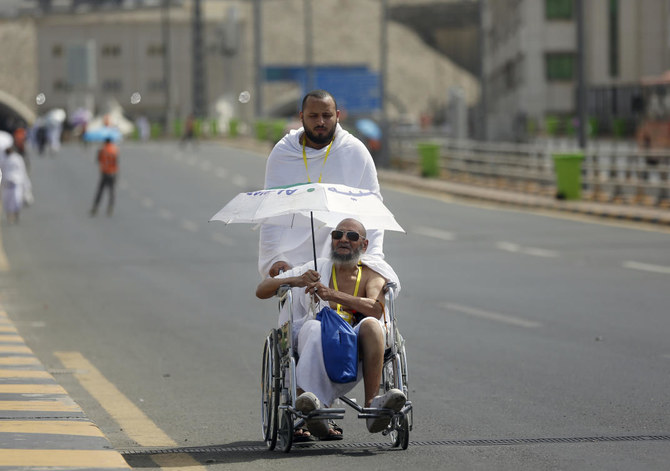
An Egyptian pilgrim pushes his elderly father in a wheelchair Friday at the huge tent city of Mina, in Makkah, Saudi Arabia, where pilgrims will spend the night before heading to Mount Arafat on Saturday. (AP Photo)
2 / 2
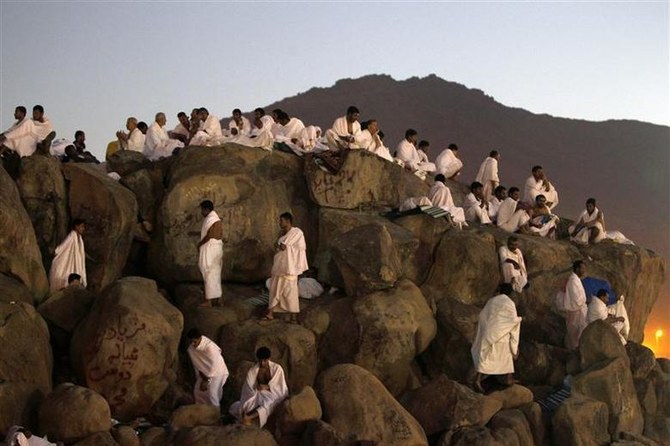
Muslim pilgrims pray on Mount Mercy on the plains of Arafat during the annual Hajj pilgrimage, outside the holy city of Makkah. (File/Reuters)
Updated 09 August 2019
Follow

Staying safe at Arafat: a guide

  • On the 9th of Dhu Al-Hijjah, pilgrims will leave Mina and head to the area of Mount Arafat for a day of prayer and contemplation, repenting for their sins and asking Allah’s forgiveness
  • Umbrellas are an excellent way for pilgrims to gain some protection from the sun’s glare - health experts also highly recommend sunscreen and sunglasses

JEDDAH: As Hajj pilgrims begin their entry into the vicinity of Mount Arafat on Saturday, Arab News takes a look at the most important information you need to know regarding the day of supplication and prayer.

According to the Prophet (PBUH), “Hajj is Arafah”. Arafah Day is the most fundamental of the rites of Hajj, and without it, the pilgrimage cannot be complete. On the 9th of Dhu Al-Hijjah, pilgrims will leave Mina and head to the area of Mount Arafat for a day of prayer and contemplation, repenting for their sins and asking Allah’s forgiveness before heading to Muzdalifah.

With more than 2 million pilgrims performing Hajj this year, safety is a concern for everyone involved. And with Hajj taking place in the middle of summer, the heat poses a serious problem. Here are some tips on how pilgrims can stay safe during this scorching Hajj season.

Pilgrims are required to enter Arafah any time before sunset, which is when pilgrims will start making their journey to Muzdalifah. Therefore some pilgrims can try to avoid the biggest crowds and journey to Arafah any time during the day, as long as they arrive before Maghrib prayer.

The number one concern of Hajj pilgrims is heat stroke; the Ministry of Hajj reported that heat-related illnesses contributed to 24 percent of hospital admissions in 2015. Various hospitals throughout Makkah have echoed the sentiment.

According to the rules of Ihram (Hajj preparation), men are forbidden from covering their heads with hats, turbans, and anything touching the tops of their heads. A common misconception is that this means that they cannot cover their heads at all, but umbrellas are an excellent way for pilgrims to gain some protection from the sun’s glare. Health experts also highly recommend sunscreen, sunglasses and other means of sun protection.

Pilgrims are also advised to ensure that their footwear is appropriate: male pilgrims are allowed to wear open sandals or flip-flops, and are not advised to try to perform Hajj barefoot. Female pilgrims can wear anything, as long as it is taher (free of decontaminants). The ground can often get dangerously hot and cause severe discomfort. The only time during Hajj a pilgrim is required to be barefoot is within the Masjid Al-Haram and during the tawaf (circumambulation of the Ka’abah).

Another important tip is to stay hydrated; the heat can peak at 50 degrees at the worst of times, and combined with the efforts of performing Hajj, the danger of dehydration is very real. There are various points throughout all the major stops of Hajj where pilgrims can get water and zamzam, and having a canteen or a refillable water bottle can be a godsend. For those who prefer their water cold, insulated bottles such as those available from Corkcicle or Thermos can keep your drinks cold for long periods of time.

It’s also important to remember that with so many people from all around the world in such a small place, the potential to get sick rises significantly. It’s important to always have some vitamin C tablets with you, and other immunity boosters. Proper sustenance is also a must; keeping one’s strength up is a vital part of being able to get the most out of one’s Hajj. Healthy foods, healthy snacks, and proper doses of vitamins can help you minimize your chances of getting sick post-Hajj.


New wave of Iranian drone attacks on Saudi Arabia neutralized

Updated 5 min 19 sec ago
Follow

New wave of Iranian drone attacks on Saudi Arabia neutralized

  • 13 drones downed east of Riyadh city and 8 destroyed upon entering Saudi air space
  • Drone attacks continue despite apology given by Iranian officials to Gulf states

RIYADH: Saudi Arabia’s air defenses neutralized a fresh wave of drone attacks on Sunday, the Ministry of Defense announced, as Iranian strikes on Gulf states showed no signs of abating despite Tehran’s conciliatory gestures a day earlier.

Ministry spokesman Major General Turki Al-Maliki said in posts on X that 13 drones were intercepted and destroyed east of Riyadh, while eight more were shot down shortly after entering Saudi airspace.

Sunday’s attacks follow a relentless barrage on Saturday in which the Kingdom’s air defenses intercepted and destroyed 21 drones headed toward Aramco’s Shaybah oil field deep in the Rub’ al-Khali desert, as well as five ballistic missiles fired at various times during the day.

Also on Saturday, Saudi defenses intercepted five ballistic missiles launched toward Prince Sultan Air Base in Al-Kharj, an important industrial zone approximately 80 kilometers southeast of Riyadh. It was the third attempted strike in three consecutive days on the base. A single drone was also intercepted east of Riyadh.

The Shaybah attack on Saturday was the first on the vital facility since Feb. 28, when Israel and the United States launched a massive air campaign against Iran, triggering a wave of retaliatory strikes by Tehran across the Gulf region.

The persistent attacks came despite Iranian President Masoud Pezeshkian issuing a public apology on Saturday to Gulf neighbors, saying Tehran would halt strikes unless attacks against Iran originated from their territory. “I personally apologize to the neighboring countries that were affected by Iran’s actions,” he said in a televised address.

However, Iran’s armed forces spokesman Abolfazl Shekarchi sought to qualify the pledge, saying Iran would avoid targeting neighboring countries only unless their territory was used to launch attacks against Iran — a caveat that left regional officials questioning whether the apology signaled a genuine effort to de-escalate or simply a shift in messaging while military operations continued.

The sincerity of this diplomatic overture has been met with skepticism as air defense sirens continue to wail across the Gulf. In the UAE, debris from a mid-air destruction caused minor damage to a building facade in Dubai Marina, though no injuries occurred.

The situation remains more volatile in Bahrain, where the Interior Ministry reported that an intercepted attack caused a fire in the capital, Manama, damaging a residential home and nearby structures. King Hamad bin Isa Al-Khalifa reaffirmed the kingdom’s commitment to peace and coexistence but emphasized the necessity of maintaining regional stability against persistent threats.

Inside the Kingdom, the focus remains on protecting civilian and industrial hubs. Major General Al-Maliki highlighted that the recent missile threats were the third attempted strikes in three consecutive days on Al-Kharj, an important industrial zone located 80 kilometers southeast of Riyadh. On Friday alone, five missiles and multiple drones were shot down across the Eastern Province and the capital region.

The international community has responded with a mix of condemnation and warnings. US President Donald Trump warned via social media that Iran would be “hit very hard” in response to the aggression. Meanwhile, the Gulf Cooperation Council (GCC), following an extraordinary meeting in Riyadh, affirmed the collective right of member states to defend their territories against what they termed “treacherous Iranian aggression.”