ISLAMABAD: Pakistan’s Prime Minister Imran Khan said on Tuesday that the country will raise its voice on all international forums, including the United Nations Security Council and International Criminal Court, challenging India’s recent actions against Kashmir.
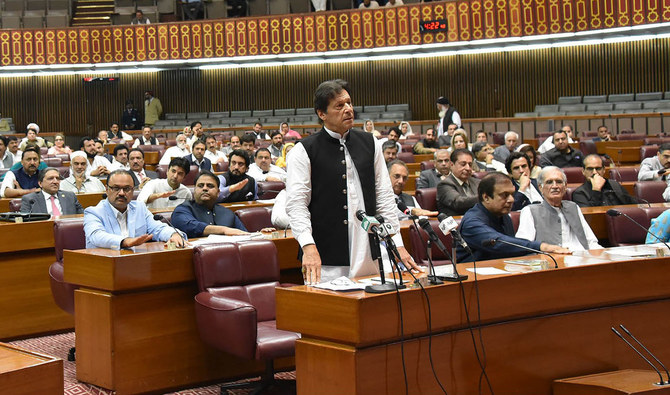
Addressing the joint session of the Parliament, Khan said that he feared India may resort to “ethnic cleansing” in disputed Kashmir valley following revocation of its special status.
He said the move, which was a violation of the Indian constitution itself, was in line with Prime Minister Narendra Modi’s “racist ideology” that would have “global repercussions.”
“The Indian government violated its own constitution to promote its ideology and scrapped occupied Kashmir’s special status,” said Khan.
He added that Islamabad wanted better relations with its neighbors but Pakistan army would respond to any aggression from India’s side.
He said that Pakistan had strongly conveyed to India that it was not involved in Pulwama attack and would never let its soil be used for terrorist activities but Modi government built on “war hysteria” to win the elections at home encashing anti-Pakistan sentiment.
Khan said that India was all out to crush the freedom struggle in Kashmir with force and had turned the valley into a graveyard.
Pakistan’s Foreign Minister Shah Mahmood Qureshi, who was leading the country’s delegation at the OIC meeting on Jammu and Kashmir hosted in Jeddah today, told Arab News that “Pakistan will use all diplomatic, legal and political options against the unilateral and unjust Indian decision of revoking special constitutional status of Indian occupied Kashmir.”
He said that the entire Kashmiri diaspora is in a state of sheer anguish. “The world did not only condemn the ruthlessly imposed decision by India on Kashmiri people but it rejected it out-rightly,” he added.
A day after the implementation of a special decree that aims to change the disputed region’s Muslim-majority demographics, the Kashmir issue has emerged as a major flashpoint for the international community. The restive valley remained under a complete lockdown with huge presence of security forces and blackout through phone and Internet service suspension.
Qureshi said, “Today, the whole world is questioning India’s credibility.”
To substantiate his point, he referred to voices raised from inside India against this move. “Indian legal experts, themselves, are saying the decision is unlawful and can be a big challenge for its government. It will create chaos within India.”
He said that Pakistan had already initiated efforts to lobby world powers. “Pakistan has not only taken up the issue with United States but also has started using its diplomatic contacts with China, Russia and other Powers of the world.”
He said an American delegation headed by US Principal Deputy Assistant Secretary for South and Central Asian Affairs, Alice Wells, is already in Pakistan and that the foreign office has taken up the issue with the US delegation.
He said that US President Trump already offered to mediate on Kashmir dispute between Pakistan and India which India unfortunately rejected.
“Now, Pakistan will use United Nations Security Council as well as other humanitarian and legal ways to take up the volatile issue of Kashmir to save the Kashmiri brothers,” Qureshi added. “Our legal experts are looking into all the possible dimensions to use the International Court of Justice or other legal platforms,” he said.
Qureshi highlighted that India played a “spoiler” just when the Afghan peace process was making a smooth headway, which will likely put the crucial phase of reaching the Afghan peace deal “on back-burner.” He said, “Russia, China, Central Asia, and Pakistan all had the shared objective of peace and prosperity in Afghanistan.”
Pakistan’s former foreign secretary and envoy to India, Salman Bashir termed India’s decision a “big mistake.”
“Pakistan has many forums to take up the recent unacceptable, illegal decision about Indian-administered Kashmir. Foreign minister has already written a letter to the UNSC in which the Indian barbarism and brutalities are mentioned. The demographic changes which India is trying to bring through this move are also mentioned.”
Bashir added that “Pakistan can also take this matter up with the International Committee of Red Cross in Geneva as it is a case of armed occupation of a territory.”
But Pakistan’s former attorney general and an international law expert, Ashtar Ausaf Ali, told Arab News that Pakistan cannot move the ICJ in this case as it does not involve violation of a treaty. It was a bilateral agreement and the ICJ is not the right forum for this case, he said.
“The presidential decree is not the way to bring in a change so it can be challenged in any Indian court including their Supreme Court,” said Ali.


![]()

Pakistan warns Indian move on Kashmir will have 'global repercussions'
Pakistan warns Indian move on Kashmir will have 'global repercussions'
- Islamabad will move international and humanitarian forums seeking help for Kashmiri people
- India may resort to "ethnic cleansing" in disputed Kashmir, PM Khan says
Latest updates




Recommended


© 2026 SAUDI RESEARCH & PUBLISHING COMPANY, All Rights Reserved And subject to Terms of Use Agreement.